Physical Address
Empirical System, 105 First Floor Pitru Krupa, Opp. R.K. Desai College, Koparli Road, Vapi (Gujarat) 396 191
Physical Address
Empirical System, 105 First Floor Pitru Krupa, Opp. R.K. Desai College, Koparli Road, Vapi (Gujarat) 396 191

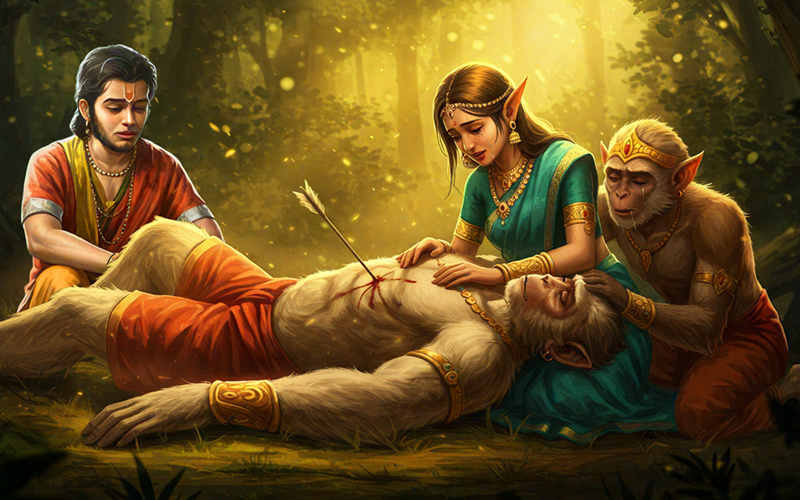
In the epic journey of the Ramayana, there are moments of profound moral complexity that challenge our understanding of Dharma. None are more debated than the fateful encounter in Kishkindha, where Lord Shri Ram, the very embodiment of righteousness, took the life of the mighty Vanara king, Vali, from a hidden position.
Was this an act of injustice? Or was it a necessary move in a divine plan? This is the story of a bond forged in sorrow, a rivalry that tore a kingdom apart, and an arrow that changed the course of destiny.
On the slopes of Rishyamuka Mountain, a banished and fearful Sugriva was hiding from his tyrannical brother, Vali. It was here that Hanuman, in an act of divine orchestration, led two wandering princes to him—Shri Ram and Lakshman.
Seeing the divine radiance of Shri Ram, Sugriva felt a surge of hope. He extended his hand in friendship, and as Rama clasGasped it, an unbreakable bond was formed. They swore an oath of loyalty, their sorrows and triumphs now shared as one.
With tears in his eyes, Sugriva recounted the tale of his misery. He and his elder brother, Vali, once shared a deep bond. But one day, a demon named Mayavi challenged Vali. The two chased the demon into a deep cave. Vali ordered Sugriva to stand guard outside and wait.
A full year passed. Sugriva waited, his heart heavy with dread. One day, a stream of blood flowed from the cave, followed by a terrifying roar. Convinced his brother was dead and fearing the demon would escape, Sugriva sealed the cave with a massive boulder and returned to Kishkindha, where he was crowned the new king.
But Vali was not dead. After slaying the demon, he returned, only to find Sugriva on his throne. Consumed by a blind rage and convinced of his brother’s treachery, he refused to listen to any explanation. He banished Sugriva and, in an act of ultimate cruelty, took Sugriva’s wife, Ruma, as his own.
This grave injustice left Sugriva heartbroken, powerless, and living in constant fear. Moved by his suffering, Shri Ram saw not just a personal feud, but a violation of Dharma that demanded correction. He vowed to end Vali’s tyranny and restore justice.
Guided by Rama, Sugriva challenged Vali to a duel. The brothers, identical in appearance, clashed with ferocious might. Rama stood ready, his arrow poised, but he hesitated. In the heat of battle, he could not distinguish between them. To strike might mean killing the very friend he had sworn to protect.
Sugriva, overpowered and battered, was forced to retreat. He returned to Rama, his spirit crushed. Rama, full of regret, explained his dilemma. To avoid this mistake again, Lakshman wove a garland of flowers and placed it around Sugriva’s neck—a clear marker for the battle to come.
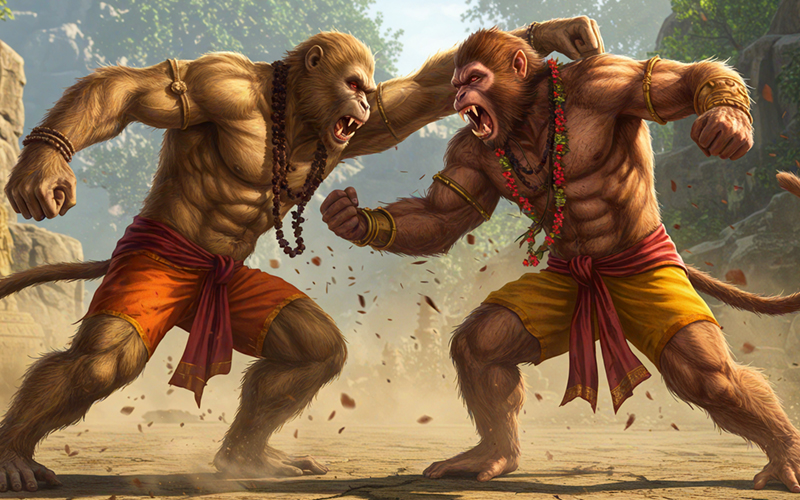
The story of Vali and Sugriva is a whirlwind of emotion—love, betrayal, fear, and divine justice. To truly experience the intensity of their battles and the depth of Shri Ram’s moral dilemma, we have brought this powerful story to life on our YouTube channel, Vibes of Divinity.
Witness the clash of titans and the arrow that changed everything.
[Click here to watch: Why Did Shri Ram Kill Vali from Behind a Tree? The Untold Truth!]
Don’t forget to like, subscribe, and hit the notification bell to continue your journey into the heart of divine stories with us!
With renewed resolve, Sugriva roared his challenge once more. Vali, ignoring the desperate pleas of his wise wife, Tara, stormed out to meet him. Tara had warned him that Sugriva was now allied with the divine princes of Ayodhya, but Vali’s pride was his undoing.
The brothers clashed again. This time, as Vali gained the upper hand, Shri Ram saw his moment. The garland clearly marked his friend. From his hidden position, he drew his bow. The arrow, infused with divine power, flew true. It struck Vali in the chest, and the mighty king, once thought invincible, fell to the earth.
As he lay dying, Vali confronted Shri Ram. “O Raghava,” he lamented, “you are known as the protector of Dharma. Why did you strike me down like a common hunter, hidden from view? If you had faced me directly, you would have known my strength.”
Shri Ram, with the calm authority of cosmic law, explained his actions. He was not just an individual; he was an enforcer of Dharma on behalf of his brother Bharat, the ruler of the land.
He then laid out the grave sins Vali had committed:
“You stole your own younger brother’s wife, an act as sinful as violating one’s own daughter. This is an unforgivable breach of Dharma. As a king sworn to punish unrighteousness, it was my duty to deliver this justice.”
He explained that a ruler can punish a wrongdoer without engaging in a formal duel, just as a hunter is not bound by a warrior’s code. Hearing this, Vali’s arrogance melted away. He realized the weight of his sins and the righteousness of Rama’s actions. In his final moments, he sought forgiveness, entrusted his son Angad to Rama and Sugriva’s care, and passed his divine golden garland to his brother.
Vali’s death brought Sugriva not joy, but a deep, sorrowful regret. He had won his kingdom, but at the cost of his brother’s life. This profound moment teaches us that victory won through loss can often feel hollow.
This story is a mirror to our own lives, reflecting timeless truths:
At its heart, this tale whispers that true strength lies not in might alone, but in humility, forgiveness, and understanding the profound responsibility that comes with power.
What are your thoughts on Shri Ram’s actions? Was it justified? Share your perspective in the comments below!