Physical Address
Empirical System, 105 First Floor Pitru Krupa, Opp. R.K. Desai College, Koparli Road, Vapi (Gujarat) 396 191
Physical Address
Empirical System, 105 First Floor Pitru Krupa, Opp. R.K. Desai College, Koparli Road, Vapi (Gujarat) 396 191


When the great war of Kurukshetra ended, it seemed the story was over. Dharma had prevailed, but not every warrior found closure. Somewhere in the shadows of that silent battlefield walked a man, born of divine power, now burning with grief.
That night, while the world slept, he committed an act so heinous that even the gods could not forgive it. For that one sin, he was cursed—not to die, but to live. His story did not end with the great war. It continues even today, a whisper in the winds of time.
This is the story of Ashwatthama—the son, the warrior, the immortal wanderer.
To understand the curse, we must first understand the blessing. Ashwatthama was no ordinary mortal. His father, the great guru Dronacharya, performed years of severe penance to Lord Shiva, praying for a son of unmatched strength. Moved by his devotion, Shiva granted him a boon: a part of his own divine essence would be born as Drona’s son.
When the child was born, he let out a neigh like a divine horse, earning him the name Ashwatthama (“one whose voice is like a horse”). But his most significant divine gift was a radiant jewel, a mani, embedded in his forehead. This gem made him invincible, shielding him from hunger, thirst, disease, and all weapons. As long as he wore it, he was beyond fear and beyond defeat.
Ashwatthama’s early life was marked by poverty. A memory that scarred him for life was watching other children drink milk while he had none. His innocent joy at being given flour mixed with water, which he believed was milk, broke his father’s heart. This moment fueled Drona’s ambition to seek a better life, eventually leading them to the royal court of Hastinapura.
Here, Ashwatthama grew up alongside the princes, training under his father to become a formidable warrior. He mastered the Vedas and the secrets of celestial weapons (Divyastras), including the all-powerful Brahmastra.
But his heart was a battleground. He harbored a quiet resentment for his father’s favorite student, Arjuna, and a fierce, almost blind loyalty to his childhood friend, Duryodhana. This internal conflict between his learned Dharma and his raw, untamed emotions would ultimately seal his fate.
On the fifteenth day of the war, the Pandavas devised a plan to defeat the invincible Dronacharya. Bhima killed an elephant named Ashwatthama and the cry went out: “Ashwatthama is dead!”
Drona, shaken, turned to the one man he knew would not lie: Yudhishthira. The Dharmaraj spoke a half-truth, confirming the death but mumbling that it was an elephant. In the clamor of war, Drona heard only the devastating news. Shattered by grief, he laid down his weapons. In that moment of vulnerability, he was slain.
For Ashwatthama, this was not war; it was murder. The deceitful killing of his father ignited a fire of vengeance in his soul that would burn away all reason, all Dharma.
The story of Ashwatthama is a powerful and haunting exploration of grief, rage, and the consequences of adharma. To truly feel the weight of his curse and the depth of his tragedy, we have brought this epic tale to life on our YouTube channel, Vibes of Divinity.
Witness the night that sealed a warrior’s fate for millennia.
[Click here to watch: Ashwatthama’s Curse: The Immortal Wanderer of the Mahabharata]
Don’t forget to like, subscribe, and hit the notification bell to continue your journey into the heart of these divine stories!
The war was over. Duryodhana lay dying. But for Ashwatthama, the battle had just begun. Under the cover of darkness, he, along with Kripacharya and Kritavarma, crept into the sleeping Pandava camp.
What followed was not a battle, but a massacre. As described in the chilling Sauptika Parva, Ashwatthama slaughtered countless unarmed, sleeping warriors. He mercilessly killed Dhrishtadyumna, his father’s slayer. In his blind rage, he entered the tent of the Upapandavas—the five sons of Draupadi—and, mistaking them for the Pandavas, killed them in their sleep.
When the Pandavas cornered him, Ashwatthama, in a final act of desperation, unleashed the Brahmastra. Arjuna countered it with his own, and to prevent cosmic destruction, Sage Vyasa ordered them both to withdraw the weapon. Arjuna could, but Ashwatthama, lacking the knowledge, could not. In a horrifying act of malice, he redirected the weapon towards the womb of Uttara, Abhimanyu’s pregnant widow, to end the Pandava lineage forever.
Lord Krishna, with his divine power, intervened and saved the unborn child, Parikshit. But for Ashwatthama, there would be no salvation. His crimes—murdering sleeping men, killing children, and attacking an unborn baby—were beyond pardon.
Krishna did not kill him. He gave him a punishment far worse than death.
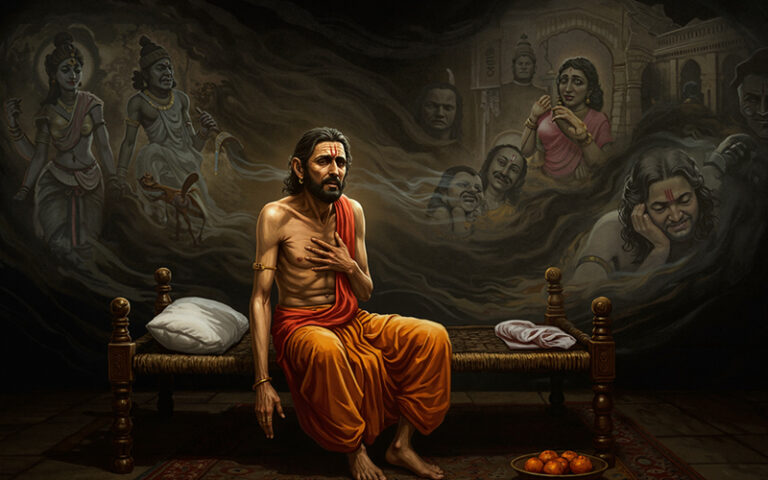
“You will wander the earth for three thousand years, alone, with no one to talk to. Your body will be afflicted with foul-smelling, incurable sores and diseases. You will cry for death, but death will not come.”
Krishna then forcibly removed the divine jewel from Ashwatthama’s forehead, leaving a bleeding, unhealable wound. Stripped of his power, his honor, and his divine protection, Ashwatthama’s immortality became his eternal prison.
And so, Ashwatthama became one of the Chiranjivis (the seven immortals), his existence a curse, not a blessing. For centuries, whispers and legends have spoken of his presence. Pilgrims in the Himalayas, hermits by the Narmada river, and locals near remote temples have reported sightings of a tall, wounded man who fits his description, a silent wanderer burdened by a timeless sorrow.
But in Sanatana Dharma, no soul is beyond redemption. Prophetic texts like the Kalki Purana foretell that at the end of the Kali Yuga, Ashwatthama’s long penance will end. He will be summoned by Kalki, the final avatar of Lord Vishnu, and will once again fight—this time, not for vengeance, but for the restoration of Dharma.
Ashwatthama’s life is a chilling reminder that power without wisdom and loyalty without righteousness lead to ruin. His curse became his path to penance. His long, lonely exile is a preparation for his final redemption. His story teaches us that even the deepest fall holds the spark of transformation, and no soul is ever truly lost to the divine.
What have you heard about Ashwatthama? How do you see his role in the final battle for Dharma? Share your thoughts in the comments below!