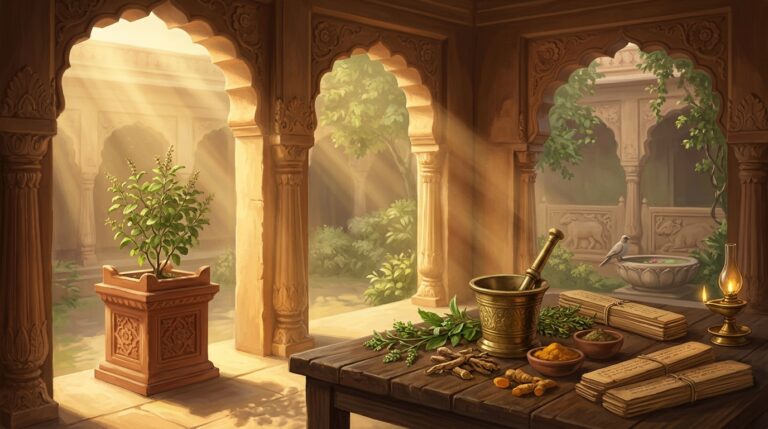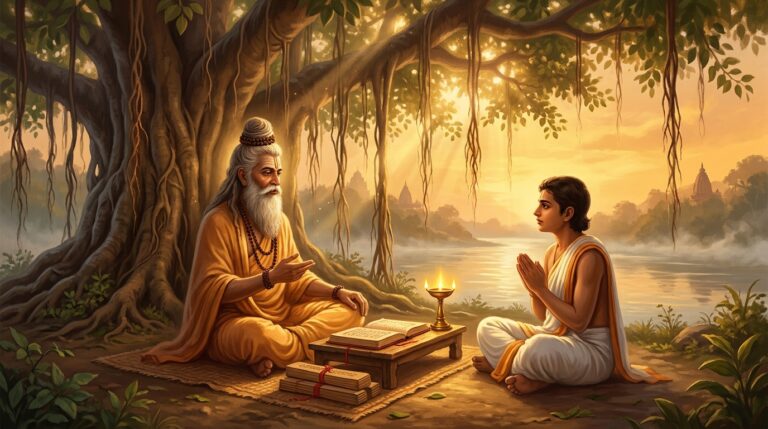

Welcome to Vibes of Divinity. Long before classrooms or meditation halls existed, teachers and students in the ancient Upanishads began and ended every study session with universal prayers for harmony known as Shanti Mantras (Peace Invocations).
Rather than asking for selfish advantage over others, Upanishadic Shanti Mantras pray for shared clarity, fearlessness, and peace across body, mind, and nature. Let us explore two of the most beloved Shanti Mantras from the Upanishads.
Sacred Text, Transliteration & Meaning
Verse 1
असतो मा सद्गमय ।
तमसो मा ज्योतिर्गमय ।
मृत्योर्मा अमृतं गमय ।
ॐ शान्तिः शान्तिः शान्तिः ॥
Asato mā sadgamaya |
Tamaso mā jyotirgamaya |
Mṛtyor mā amṛtaṁ gamaya |
Oṁ Śāntiḥ Śāntiḥ Śāntiḥ ||
Meaning: Lead me from the unreal (illusion) to the Real (Eternal Truth). Lead me from darkness (ignorance) to Light (wisdom). Lead me from mortality and fear to Immortality. Om Peace, Peace, Peace.
Verse 2
ॐ सह नाववतु । सह नौ भुनक्तु । सह वीर्यं करवावहै ।
तेजस्वि नावधीतमस्तु मा विद्विषावहै ।
ॐ शान्तिः शान्तिः शान्तिः ॥
Oṁ saha nāv avatu | Saha nau bhunaktu | Saha vīryaṁ karavāvahai |
Tejasvi nāv adhītam astu mā vidviṣāvahai |
Oṁ Śāntiḥ Śāntiḥ Śāntiḥ ||
Meaning: Om, may the Divine protect us both (teacher and student). May He nourish us both. May we work together with vigor and courage. May our shared study be luminous and fruitful; may we never harbor hatred or jealousy toward one another. Om Peace, Peace, Peace.
Spiritual Significance & Deeper Insights
- Why ‘Shanti’ Is Chanted Three Times: Traditional commentaries explain the triple Shanti calms disturbances at three levels: Adhibhautika (external/environmental), Adhidaivika (natural/cosmic forces), and Adhyatmika (our own mind and body).
- Learning Without Competition or Hatred: Ma vidvishavahai (‘may we never hate one another’) transforms education and teamwork into sacred collaboration.
- From Darkness to Light: Drawn from the Brihadaranyaka Upanishad (1.3.28), Asato Ma Sadgamaya captures the essence of every human spiritual quest.
How & When to Chant
- When to Recite: At the start of meditation, yoga practice, study sessions, family prayers, or peaceful evenings.
- Breath Awareness: Chant each line slowly on an even exhale, pausing briefly before the closing triple ‘Om Shantih Shantih Shantih’.
- Universal Intention: Picture peace radiating outward to your family, community, and all living beings.
Frequently Asked Questions
Where do Asato Ma Sadgamaya and Om Sahana Vavatu come from?
Asato Ma Sadgamaya appears in the Brihadaranyaka Upanishad (1.3.28), while Om Sahana Vavatu opens several Krishna Yajurveda Upanishads including the Katha and Taittiriya Upanishads.
Why do Hindu prayers end with ‘Shanti’ repeated three times?
Repeating Shanti three times prays for peace across the physical world, unseen/natural forces, and one’s inner mind and heart.
Can anyone chant Vedic Shanti Mantras?
Yes—they are universal prayers for truth, light, cooperation, and peace welcome to people of every background.
Explore more sacred hymns in our Mantras & Chants Library or read the Complete Bhagavad Gita Guide.
To explore more sacred mantras, stotras, and Puranic wisdom and timeless wisdom from Hindu scriptures, visit and subscribe to our official Vibes of Divinity YouTube channel.
Have you chanted this sacred prayer in your daily practice? Share your experience in the comments below!