Physical Address
Empirical System, 105 First Floor Pitru Krupa, Opp. R.K. Desai College, Koparli Road, Vapi (Gujarat) 396 191
Physical Address
Empirical System, 105 First Floor Pitru Krupa, Opp. R.K. Desai College, Koparli Road, Vapi (Gujarat) 396 191

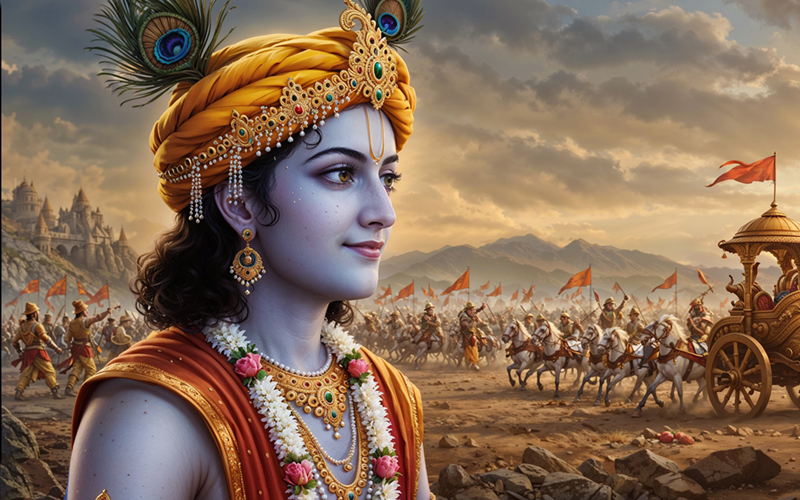
The Kurukshetra War was not just a battle; it was a cosmic cleansing, a devastating conflict that wiped out an entire generation of warriors. Amidst the sorrow and destruction, a profound question has echoed through the ages: Why did Lord Krishna, the Supreme Being, allow this to happen?
If He was the protector of Dharma, the all-powerful God, could He not have stopped the bloodshed? Was this catastrophic war truly necessary? To find the answer, we must journey beyond the battlefield and into the heart of cosmic law, human choice, and divine purpose.
Contrary to what many believe, Krishna’s first and foremost effort was to prevent the war. The seeds of conflict had been sown long before, but the final chance for peace came when Krishna himself traveled to Hastinapura as a peace messenger.
In the court of the blind king Dhritarashtra, surrounded by great elders like Bhishma and Drona, Krishna made a simple, humble request. He wasn’t asking for the kingdom of Indraprastha or for vast riches. He asked for just five villages for the Pandavas to live in peace.
But Duryodhana, his heart consumed by arrogance and hatred, famously declared:
“I will not give them even a needlepoint of land without a fight!”
In his audacity, he even tried to capture and imprison Krishna. Laughing at his foolishness, Krishna revealed a glimpse of his divine, universal form (Vishwaroop), a sight that should have humbled any mortal. Yet, Duryodhana’s heart remained unchanged.
In that moment, Krishna understood. The war was no longer a possibility; it was an inevitability. He had offered a choice, and adharma had chosen its own destruction.
One of the most profound reasons Krishna did not stop the war is the law of karma. As the Supreme Guide, Krishna upholds the laws of the universe; he does not break them. The war was not a singular event but the culmination of generations of unrighteous actions.
To forcibly stop the war would have been to negate the free will and accumulated karma of every individual involved. Krishna’s role was to guide Dharma, not to erase the consequences of adharma.
The question of why Krishna allowed the war is one of the most debated topics in spirituality. To explore this in greater depth, with stunning visuals and profound insights, we have created a special video on our YouTube channel, Vibes of Divinity.
Dive deep into the heart of Krishna’s divine plan and understand the bigger picture.
[Click here to watch: Why Did Lord Krishna Not Stop the Mahabharata War?]
Don’t forget to like, subscribe, and hit the notification bell to continue your journey into the heart of divine wisdom!
Even on the battlefield, when Arjuna, the greatest warrior of his time, dropped his bow in despair, Krishna did not force him to fight. Overwhelmed by the sight of his own family and teachers as his enemies, Arjuna was ready to quit.
Instead of commanding him, Krishna offered him the divine wisdom of the Bhagavad Gita. He explained the nature of the soul, the path of duty (dharma), and the illusion of death. He illuminated the path but left the choice to Arjuna.
“Your duty as a Kshatriya is to fight for righteousness. To turn away now would be a greater sin, allowing adharma to triumph.”
Enlightened, Arjuna picked up his bow, not for revenge or glory, but to fulfill his sacred duty. Krishna’s role was not to be a puppet master, but a divine guide.
If Krishna had miraculously stopped the war, would it have truly solved the problem?
The answer is no. Adharma had grown so powerful, so deeply rooted, that it had to collapse under its own weight. The war was a necessary, cosmic surgery to remove the disease of unrighteousness that was plaguing the earth. The silence of the good had allowed evil to flourish, and now, the universe itself had to correct the balance.
In his universal form, Krishna showed Arjuna the ultimate truth. He revealed that all the warriors on the battlefield were already destined to perish, being consumed by Time (Kaal).
“Even without you,” Krishna declared, “all these warriors will be slain. I am Time, the destroyer of worlds.”
This revelation showed that the war was not Krishna’s creation, but a function of the cosmic cycle. The warriors’ fates were already sealed by their own karma. Arjuna was merely to be an instrument of Dharma in this divine play.
So, did Krishna fail to stop the war? No. He tried with diplomacy. He guided with wisdom. He upheld the cosmic law.
The Mahabharata’s final, poignant message is this: God does not interfere with our karma, but he always provides us with a path to Dharma. The Bhagavad Gita is His eternal voice, waiting to guide us. It is our choice whether to listen.
As the saying goes: If words alone could change the wicked, the flute player would never have had to let the Mahabharata happen. When adharma refuses to listen, destruction is not a choice—it is a destiny.
What does Krishna’s role in the Mahabharata teach you about free will and divine intervention? Share your thoughts in the comments below!