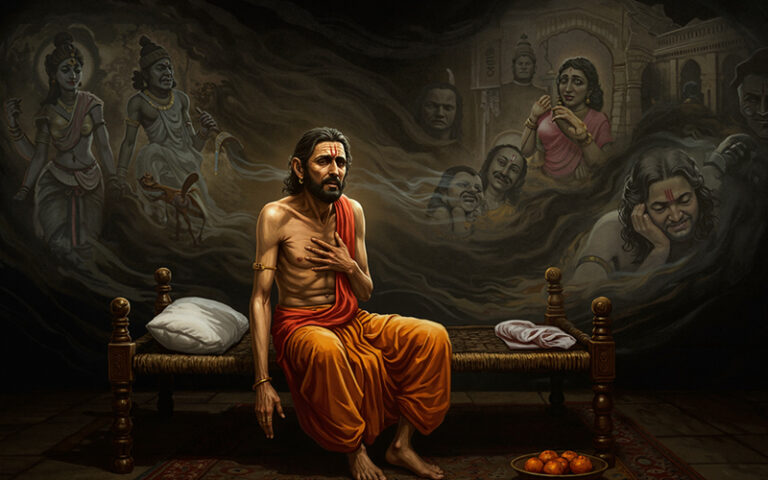

Welcome to Vibes of Divinity. What separates an uplifting, luminous character from a toxic, destructive ego? In Bhagavad Gita Chapter 16 (Daivasura Sampad Vibhaga Yoga), Lord Krishna offers a remarkably vivid psychological contrast between Daivi Sampad (divine qualities leading to freedom) and Asuri Sampad (demonic/egotistical tendencies leading to bondage).
- Chapter Name: दैवासुरसम्पद्विभागयोग (Daivasura Sampad Vibhaga Yoga)
- Section: Section 3: Deepening Wisdom & Final Liberation (Chapters 13–18)
- Complete Text Included: All 24 Sanskrit shlokas with IAST transliteration & English translation
- Series Index: Bhagavad Gita Complete Guide (All 18 Chapters & 701 Shlokas)
Chapter 16 Summary & Context on Kurukshetra
Krishna opens with a radiant list of 26 divine virtues beginning with Abhaya (fearlessness), purity of heart, charity, self-restraint, truthfulness, non-violence, gentleness, forgiveness, and absence of malice or arrogance.
He then describes the mindset of ego-driven arrogance: boasting of wealth and power, dismissing moral order, obsessed with status, and declaring ‘I am the master, I enjoy, I am powerful.’ Such obsessive craving leads to endless anxiety and spiritual downfall.
Summarizing the root dangers succinctly, Krishna warns of the three gates to self-destruction (Naraka): Lust (Kama), Anger (Krodha), and Greed (Lobha)—urging every seeker to guard against them and guide decisions by wisdom and scripture.
Highlighted Shlokas & Spiritual Reflections (Chapter 16)
Shloka 16.1 — The Beginning of Divine Virtues
अभयं सत्त्वसंशुद्धिर्ज्ञानयोगव्यवस्थितिः । दानं दमश्च यज्ञश्च स्वाध्यायस्तप आर्जवम् ॥
Abhayaṁ sattva-saṁśuddhir jñāna-yoga-vyavasthitiḥ | Dānaṁ damaś ca yajñaś ca svādhyāyas tapa ārjavam ||
Meaning: Fearlessness, purity of heart, steadfastness in spiritual wisdom, charity, self-control, sacrifice, study of sacred texts, austerity, and uprightness—these belong to those born with divine nature.
Notice that fearlessness (Abhaya) and purity of heart stand at the very top of spiritual character.
Shloka 16.21 — The Three Gates of Downfall
त्रिविधं नरकस्येदं द्वारं नाशनमात्मनः । कामः क्रोधस्तथा लोभस्तस्मादेतत्त्रयं त्यजेत् ॥
Tri-vidhaṁ narakasyedaṁ dvāraṁ nāśanam ātmanaḥ | Kāmaḥ krodhas tathā lobhas tasmād etat trayaṁ tyajet ||
Meaning: Triple is the gate to hell, destructive of the self: lust (selfish craving), anger, and greed. Therefore, one must abandon these three.
Nearly every personal crisis or broken relationship traces back to unchecked craving, rage, or greed—watching these three transforms your life.
Shloka 16.24 — Aligning Decisions with Wisdom
तस्माच्छास्त्रं प्रमाणं ते कार्याकार्यव्यवस्थितौ । ज्ञात्वा शास्त्रविधानोक्तं कर्म कर्तुमिहार्हसि ॥
Tasmāc chāstraṁ pramāṇaṁ te kāryākārya-vyavasthitau | Jñātvā śāstra-vidhānoktaṁ karma kartum ihārhasi ||
Meaning: Therefore, let sacred wisdom (Shastra) be your guiding authority in determining what ought to be done and what ought not to be done; knowing its principles, act rightly in this world.
When emotions cloud judgment, ethical principles and timeless scriptural wisdom keep you grounded.
Complete Verse-by-Verse Bhagavad Gita Chapter 16 (All 24 Shlokas)
Read all 24 original Sanskrit verses of Chapter 16 below with Roman IAST transliteration and clear English meaning:
Verse 16.1
श्रीभगवानुवाच |
अभयं सत्त्वसंशुद्धिर्ज्ञानयोगव्यवस्थितिः |
दानं दमश्च यज्ञश्च स्वाध्यायस्तप आर्जवम् ||१६-१||
śrībhagavānuvāca .
abhayaṃ sattvasaṃśuddhirjñānayogavyavasthitiḥ .
dānaṃ damaśca yajñaśca svādhyāyastapa ārjavam ||16-1||
Meaning: Lord Shri Krishna continued: Fearlessness, clean living, unceasing concentration on wisdom, readiness to give, self-control, a spirit of sacrifice, regular study of the scriptures, austerities, candour,
Verse 16.2
अहिंसा सत्यमक्रोधस्त्यागः शान्तिरपैशुनम् |
दया भूतेष्वलोलुप्त्वं मार्दवं ह्रीरचापलम् ||१६-२||
ahiṃsā satyamakrodhastyāgaḥ śāntirapaiśunam .
dayā bhūteṣvaloluptvaṃ mārdavaṃ hrīracāpalam ||16-2||
Meaning: harmlessness, truth, absence of wrath, renunciation, contentment, straightforwardness, compassion towards all, uncovetousness, courtesy, modesty, constancy,
Verse 16.3
तेजः क्षमा धृतिः शौचमद्रोहो नातिमानिता |
भवन्ति सम्पदं दैवीमभिजातस्य भारत ||१६-३||
tejaḥ kṣamā dhṛtiḥ śaucamadroho nātimānitā .
bhavanti sampadaṃ daivīmabhijātasya bhārata ||16-3||
Meaning: Valour, forgiveness, fortitude, purity, freedom from hate and vanity; these are his who possesses the Godly Qualities, O Arjuna!
Verse 16.4
दम्भो दर्पोऽभिमानश्च क्रोधः पारुष्यमेव च |
अज्ञानं चाभिजातस्य पार्थ सम्पदमासुरीम् ||१६-४||
dambho darpo.abhimānaśca krodhaḥ pāruṣyameva ca .
ajñānaṃ cābhijātasya pārtha sampadamāsurīm ||16-4||
Meaning: Hypocrisy, pride, insolence, cruelty, ignorance belong to him who is born of the godless qualities.
Verse 16.5
दैवी सम्पद्विमोक्षाय निबन्धायासुरी मता |
मा शुचः सम्पदं दैवीमभिजातोऽसि पाण्डव ||१६-५||
daivī sampadvimokṣāya nibandhāyāsurī matā .
mā śucaḥ sampadaṃ daivīmabhijāto.asi pāṇḍava ||16-5||
Meaning: Godly qualities lead to liberation; godless to bondage. Do not be anxious, Prince! Thou hast the Godly qualities.
Verse 16.6
द्वौ भूतसर्गौ लोकेऽस्मिन्दैव आसुर एव च |
दैवो विस्तरशः प्रोक्त आसुरं पार्थ मे शृणु ||१६-६||
dvau bhūtasargau loke.asmindaiva āsura eva ca .
daivo vistaraśaḥ prokta āsuraṃ pārtha me śṛṇu ||16-6||
Meaning: All beings are of two classes: Godly and godless. The Godly I have described; I will now describe the other.
Verse 16.7
प्रवृत्तिं च निवृत्तिं च जना न विदुरासुराः |
न शौचं नापि चाचारो न सत्यं तेषु विद्यते ||१६-७||
pravṛttiṃ ca nivṛttiṃ ca janā na vidurāsurāḥ .
na śaucaṃ nāpi cācāro na satyaṃ teṣu vidyate ||16-7||
Meaning: The godless do not know how to act or how to renounce. They have neither purity nor truth. They do not understand the right principles of conduct.
Verse 16.8
असत्यमप्रतिष्ठं ते जगदाहुरनीश्वरम् |
अपरस्परसम्भूतं किमन्यत्कामहैतुकम् ||१६-८||
asatyamapratiṣṭhaṃ te jagadāhuranīśvaram .
aparasparasambhūtaṃ kimanyatkāmahaitukam ||16-8||
Meaning: They say the universe is an accident with no purpose and no God. Life is created by sexual union, a product of lust and nothing else.
Verse 16.9
एतां दृष्टिमवष्टभ्य नष्टात्मानोऽल्पबुद्धयः |
प्रभवन्त्युग्रकर्माणः क्षयाय जगतोऽहिताः ||१६-९||
etāṃ dṛṣṭimavaṣṭabhya naṣṭātmāno.alpabuddhayaḥ .
prabhavantyugrakarmāṇaḥ kṣayāya jagato.ahitāḥ ||16-9||
Meaning: Thinking thus, these degraded souls, these enemies of mankind – whose intelligence is negligible and whose deeds are monstrous – come into the world only to destroy.
Verse 16.10
काममाश्रित्य दुष्पूरं दम्भमानमदान्विताः |
मोहाद्गृहीत्वासद्ग्राहान्प्रवर्तन्तेऽशुचिव्रताः ||१६-१०||
kāmamāśritya duṣpūraṃ dambhamānamadānvitāḥ .
mohādgṛhītvāsadgrāhānpravartante.aśucivratāḥ ||16-10||
Meaning: Giving themselves up to insatiable passions, hypocritical, self-sufficient and arrogant, cherishing false conception founded on delusion, they work only to carry out their own unholy purposes.
Verse 16.11
चिन्तामपरिमेयां च प्रलयान्तामुपाश्रिताः |
कामोपभोगपरमा एतावदिति निश्चिताः ||१६-११||
cintāmaparimeyāṃ ca pralayāntāmupāśritāḥ .
kāmopabhogaparamā etāvaditi niścitāḥ ||16-11||
Meaning: Poring anxiously over evil resolutions, which only end in death; seeking only the gratification of desire as the highest goal; seeing nothing beyond;
Verse 16.12
आशापाशशतैर्बद्धाः कामक्रोधपरायणाः |
ईहन्ते कामभोगार्थमन्यायेनार्थसञ्चयान् ||१६-१२||
āśāpāśaśatairbaddhāḥ kāmakrodhaparāyaṇāḥ .
īhante kāmabhogārthamanyāyenārthasañcayān ||16-12||
Meaning: Caught in the toils of a hundred vain hopes, the slaves of passion and wrath, they accumulate hoards of unjust wealth, only to pander to their sensual desire.
Verse 16.13
इदमद्य मया लब्धमिमं प्राप्स्ये मनोरथम् |
इदमस्तीदमपि मे भविष्यति पुनर्धनम् ||१६-१३||
idamadya mayā labdhamimaṃ prāpsye manoratham .
idamastīdamapi me bhaviṣyati punardhanam ||16-13||
Meaning: This I have gained today; tomorrow I will gratify another desire; this wealth is mine now, the rest shall be mine ere long;
Verse 16.14
असौ मया हतः शत्रुर्हनिष्ये चापरानपि |
ईश्वरोऽहमहं भोगी सिद्धोऽहं बलवान्सुखी ||१६-१४||
asau mayā hataḥ śatrurhaniṣye cāparānapi .
īśvaro.ahamahaṃ bhogī siddho.ahaṃ balavānsukhī ||16-14||
Meaning: I have slain one enemy, I will slay the others also; I am worthy to enjoy, I am the Almighty, I am perfect, powerful and happy;
Verse 16.15
आढ्योऽभिजनवानस्मि कोऽन्योऽस्ति सदृशो मया |
यक्ष्ये दास्यामि मोदिष्य इत्यज्ञानविमोहिताः ||१६-१५||
āḍhyo.abhijanavānasmi ko.anyo.asti sadṛśo mayā .
yakṣye dāsyāmi modiṣya ityajñānavimohitāḥ ||16-15||
Meaning: I am rich, I am well-bred; who is there to compare with me? I will sacrifice, I will give, I will pay – and I will enjoy. Thus blinded by Ignorance,
Verse 16.16
अनेकचित्तविभ्रान्ता मोहजालसमावृताः |
प्रसक्ताः कामभोगेषु पतन्ति नरकेऽशुचौ ||१६-१६||
anekacittavibhrāntā mohajālasamāvṛtāḥ .
prasaktāḥ kāmabhogeṣu patanti narake.aśucau ||16-16||
Meaning: Perplexed by discordant thoughts, entangled in the snares of desire, infatuated by passion, they sink into the horrors of hell.
Verse 16.17
आत्मसम्भाविताः स्तब्धा धनमानमदान्विताः |
यजन्ते नामयज्ञैस्ते दम्भेनाविधिपूर्वकम् ||१६-१७||
ātmasambhāvitāḥ stabdhā dhanamānamadānvitāḥ .
yajante nāmayajñaiste dambhenāvidhipūrvakam ||16-17||
Meaning: Self-conceited, stubborn, rich, proud and insolent, they make a display of their patronage, disregarding the rules of decency.
Verse 16.18
अहंकारं बलं दर्पं कामं क्रोधं च संश्रिताः |
मामात्मपरदेहेषु प्रद्विषन्तोऽभ्यसूयकाः ||१६-१८||
ahaṃkāraṃ balaṃ darpaṃ kāmaṃ krodhaṃ ca saṃśritāḥ .
māmātmaparadeheṣu pradviṣanto.abhyasūyakāḥ ||16-18||
Meaning: Puffed up by power and inordinate conceit, swayed by lust and wrath, these wicked people hate Me Who am within them, as I am within all.
Verse 16.19
तानहं द्विषतः क्रुरान्संसारेषु नराधमान् |
क्षिपाम्यजस्रमशुभानासुरीष्वेव योनिषु ||१६-१९||
tānahaṃ dviṣataḥ krurānsaṃsāreṣu narādhamān .
kṣipāmyajasramaśubhānāsurīṣveva yoniṣu ||16-19||
Meaning: Those who thus hate Me, who are cruel, the dregs of mankind, I condemn them to a continuous, miserable and godless rebirth.
Verse 16.20
आसुरीं योनिमापन्ना मूढा जन्मनि जन्मनि |
मामप्राप्यैव कौन्तेय ततो यान्त्यधमां गतिम् ||१६-२०||
āsurīṃ yonimāpannā mūḍhā janmani janmani .
māmaprāpyaiva kaunteya tato yāntyadhamāṃ gatim ||16-20||
Meaning: So reborn, they spend life after life, enveloped in delusion. And they never reach Me, O Prince, but degenerate into still lower forms of life.
Verse 16.21
त्रिविधं नरकस्येदं द्वारं नाशनमात्मनः |
कामः क्रोधस्तथा लोभस्तस्मादेतत्त्रयं त्यजेत् ||१६-२१||
trividhaṃ narakasyedaṃ dvāraṃ nāśanamātmanaḥ .
kāmaḥ krodhastathā lobhastasmādetattrayaṃ tyajet ||16-21||
Meaning: The gates of hell are three: lust, wrath and avarice. They destroy the Self. Avoid them.
Verse 16.22
एतैर्विमुक्तः कौन्तेय तमोद्वारैस्त्रिभिर्नरः |
आचरत्यात्मनः श्रेयस्ततो याति परां गतिम् ||१६-२२||
etairvimuktaḥ kaunteya tamodvāraistribhirnaraḥ .
ācaratyātmanaḥ śreyastato yāti parāṃ gatim ||16-22||
Meaning: These are the gates which lead to darkness; if a man avoid them he will ensure his own welfare, and in the end will attain his liberation.
Verse 16.23
यः शास्त्रविधिमुत्सृज्य वर्तते कामकारतः |
न स सिद्धिमवाप्नोति न सुखं न परां गतिम् ||१६-२३||
yaḥ śāstravidhimutsṛjya vartate kāmakārataḥ .
na sa siddhimavāpnoti na sukhaṃ na parāṃ gatim ||16-23||
Meaning: But he who neglects the commands of the scriptures, and follows the promptings of passion, he does not attain perfection, happiness or the final goal.
Verse 16.24
तस्माच्छास्त्रं प्रमाणं ते कार्याकार्यव्यवस्थितौ |
ज्ञात्वा शास्त्रविधानोक्तं कर्म कर्तुमिहार्हसि ||१६-२४||
tasmācchāstraṃ pramāṇaṃ te kāryākāryavyavasthitau .
jñātvā śāstravidhānoktaṃ karma kartumihārhasi ||16-24||
Meaning: Therefore whenever there is doubt whether thou shouldst do a thing or not, let the scriptures guide thy conduct. In the light of the scriptures shouldst thou labour the whole of thy life.
Timeless Life Lessons for Modern Seekers
- Audit the 3 Gates Daily: Catch selfish craving, anger, and greed early before they steer your words or choices.
- Practice Fearless Integrity: Cultivate truthfulness, generosity, and gentleness even when nobody is watching.
- Beware Ego-Obsession: Wealth and power become traps when paired with arrogance and disrespect.
- Anchor Choices in Principle: Let timeless dharma—not fleeting impulses—decide right from wrong.
Frequently Asked Questions — Bhagavad Gita Chapter 16
What are the three gates to self-destruction in Gita 16.21?
They are Kama (selfish lust/craving), Krodha (anger), and Lobha (greed).
Why is fearlessness (Abhaya) the first divine virtue listed in Chapter 16?
Because spiritual growth, truthfulness, and compassion require inner courage; fear breeds dishonesty, anger, and selfishness.
How many verses are in Gita Chapter 16?
Bhagavad Gita Chapter 16 has 24 verses.
Continue Your Bhagavad Gita Journey
← Previous: Chapter 15 | All 18 Gita Chapters | Next: Chapter 17 →
To explore more Bhagavad Gita teachings, Puranic stories, and sacred chants and timeless wisdom from Hindu scriptures, visit and subscribe to our official Vibes of Divinity YouTube channel.
Which shloka from this chapter touches your heart most today? Share your reflection in the comments below.