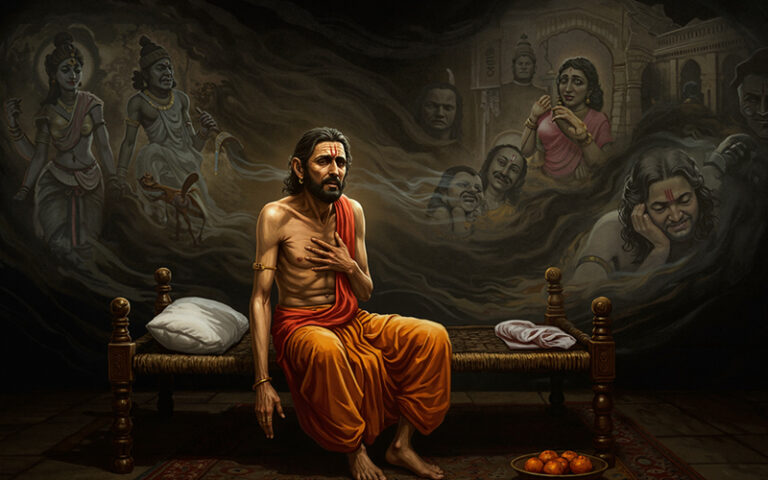

Welcome to Vibes of Divinity. Though it is the shortest chapter of the Gita at just 20 verses, Bhagavad Gita Chapter 12 (Bhakti Yoga) is one of the most cherished and regularly chanted chapters by seekers worldwide—answering how to build a warm, living relationship with the Divine.
- Chapter Name: भक्तियोग (Bhakti Yoga)
- Section: Section 2: Divine Knowledge & Devotion (Chapters 7–12)
- Complete Text Included: All 20 Sanskrit shlokas with IAST transliteration & English translation
- Series Index: Bhagavad Gita Complete Guide (All 18 Chapters & 701 Shlokas)
Chapter 12 Summary & Context on Kurukshetra
Arjuna opens by asking: between devotees who worship Krishna’s personal divine form and contemplatives who meditate on the unmanifest Absolute, who is more accomplished in yoga? Krishna answers that both reach Him, yet worship of the personal Divine is far easier and more natural for embodied human hearts.
Understanding that not everyone can absorb their mind in pure contemplation overnight, Krishna gently offers a step-by-step ladder (12.8–12.11): fix your mind on Me; if you cannot, practice steady remembrance (Abhyasa Yoga); if that feels hard, work in service of Me; and if even that is difficult, calmly surrender the fruits of your daily work.
In verses 13–20, Krishna paints a luminous portrait of the devotee dearest to Him—someone free from malice, compassionate to all, forgiving, content, fearless, and balanced in praise or insult.
Highlighted Shlokas & Spiritual Reflections (Chapter 12)
Shloka 12.2 — Steady Devotion Is Supreme
मय्यावेश्य मनो ये मां नित्ययुक्ता उपासते । श्रद्धया परयोपेतास्ते मे युक्ततमा मताः ॥
Mayy āveśya mano ye māṁ nitya-yuktā upāsate | Śraddhayā parayopetās te me yuktatamā matāḥ ||
Meaning: Those who fix their minds on Me, remaining ever steadfast and endowed with supreme faith, are considered by Me to be the most accomplished in Yoga.
Heartfelt love and steadiness outweigh dry intellectual complexity.
Shloka 12.13 — Compassionate & Free from Malice
अद्वेष्टा सर्वभूतानां मैत्रः करुण एव च । निर्ममो निरहङ्कारः समदुःखसुखः क्षमी ॥
Adveṣṭā sarva-bhūtānāṁ maitraḥ karuṇa eva ca | Nirmamo nirahaṅkāraḥ sama-duḥkha-sukhaḥ kṣamī ||
Meaning: One who bears hatred toward no being, who is friendly and compassionate to all, free from possessiveness and ego, balanced in sorrow and joy, and forgiving—is dear to Me.
Notice how Krishna defines a true devotee not by outward badges, but by kindness, forgiveness, and humility.
Shloka 12.15 — Neither Disturbing Nor Disturbed
यस्मान्नोद्विजते लोको लोकान्नोद्विजते च यः । हर्षामर्षभयोद्वेगैर्मुक्तो यः स च मे प्रियः ॥
Yasmān nodvijate loko lokān nodvijate ca yaḥ | Harṣāmarṣa-bhayodvegair mukto yaḥ sa ca me priyaḥ ||
Meaning: One by whom the world is not agitated and who is not agitated by the world—who is free from euphoria, anger, fear, and anxiety—is very dear to Me.
Emotional steadiness and harmlessness create peace both inside your home and within your own soul.
Complete Verse-by-Verse Bhagavad Gita Chapter 12 (All 20 Shlokas)
Read all 20 original Sanskrit verses of Chapter 12 below with Roman IAST transliteration and clear English meaning:
Verse 12.1
अर्जुन उवाच |
एवं सततयुक्ता ये भक्तास्त्वां पर्युपासते |
ये चाप्यक्षरमव्यक्तं तेषां के योगवित्तमाः ||१२-१||
arjuna uvāca .
evaṃ satatayuktā ye bhaktāstvāṃ paryupāsate .
ye cāpyakṣaramavyaktaṃ teṣāṃ ke yogavittamāḥ ||12-1||
Meaning: Arjuna asked: My Lord! Which are the better devotees who worship Thee, those who try to know Thee as a Personal God, or those who worship Thee as Impersonal and Indestructible?
Verse 12.2
श्रीभगवानुवाच |
मय्यावेश्य मनो ये मां नित्ययुक्ता उपासते |
श्रद्धया परयोपेताः ते मे युक्ततमा मताः ||१२-२||
śrībhagavānuvāca .
mayyāveśya mano ye māṃ nityayuktā upāsate .
śraddhayā parayopetāḥ te me yuktatamā matāḥ ||12-2||
Meaning: Lord Shri Krishna replied: Those who keep their minds fixed on Me, who worship Me always with unwavering faith and concentration; these are the very best.
Verse 12.3
ये त्वक्षरमनिर्देश्यमव्यक्तं पर्युपासते |
सर्वत्रगमचिन्त्यञ्च कूटस्थमचलन्ध्रुवम् ||१२-३||
ye tvakṣaramanirdeśyamavyaktaṃ paryupāsate .
sarvatragamacintyañca kūṭasthamacalandhruvam ||12-3||
Meaning: Shri Purohit Swami did not comment on this sloka
Verse 12.4
सन्नियम्येन्द्रियग्रामं सर्वत्र समबुद्धयः |
ते प्राप्नुवन्ति मामेव सर्वभूतहिते रताः ||१२-४||
sanniyamyendriyagrāmaṃ sarvatra samabuddhayaḥ .
te prāpnuvanti māmeva sarvabhūtahite ratāḥ ||12-4||
Meaning: Subduing their senses, viewing all conditions of life with the same eye, and working for the welfare of all beings, assuredly they come to Me.
Verse 12.5
क्लेशोऽधिकतरस्तेषामव्यक्तासक्तचेतसाम् |
अव्यक्ता हि गतिर्दुःखं देहवद्भिरवाप्यते ||१२-५||
kleśo.adhikatarasteṣāmavyaktāsaktacetasām ||
avyaktā hi gatirduḥkhaṃ dehavadbhiravāpyate ||12-5||
Meaning: But they who thus fix their attention on the Absolute and Impersonal encounter greater hardships, for it is difficult for those who possess a body to realise Me as without one.
Verse 12.6
ये तु सर्वाणि कर्माणि मयि संन्यस्य मत्परः |
अनन्येनैव योगेन मां ध्यायन्त उपासते ||१२-६||
ye tu sarvāṇi karmāṇi mayi saṃnyasya matparaḥ .
ananyenaiva yogena māṃ dhyāyanta upāsate ||12-6||
Meaning: Verily, those who surrender their actions to Me, who muse on Me, worship Me and meditate on Me alone, with no thought save of Me,
Verse 12.7
तेषामहं समुद्धर्ता मृत्युसंसारसागरात् |
भवामि नचिरात्पार्थ मय्यावेशितचेतसाम् ||१२-७||
teṣāmahaṃ samuddhartā mṛtyusaṃsārasāgarāt .
bhavāmi nacirātpārtha mayyāveśitacetasām ||12-7||
Meaning: O Arjuna! I rescue them from the ocean of life and death, for their minds are fixed on Me.
Verse 12.8
मय्येव मन आधत्स्व मयि बुद्धिं निवेशय |
निवसिष्यसि मय्येव अत ऊर्ध्वं न संशयः ||१२-८||
mayyeva mana ādhatsva mayi buddhiṃ niveśaya .
nivasiṣyasi mayyeva ata ūrdhvaṃ na saṃśayaḥ ||12-8||
Meaning: Then let thy mind cling only to Me, let thy intellect abide in Me; and without doubt thou shalt live hereafter in Me alone.
Verse 12.9
अथ चित्तं समाधातुं न शक्नोषि मयि स्थिरम् |
अभ्यासयोगेन ततो मामिच्छाप्तुं धनञ्जय ||१२-९||
atha cittaṃ samādhātuṃ na śaknoṣi mayi sthiram .
abhyāsayogena tato māmicchāptuṃ dhanañjaya ||12-9||
Meaning: But if thou canst not fix thy mind firmly on Me, then, My beloved friend, try to do so by constant practice.
Verse 12.10
अभ्यासेऽप्यसमर्थोऽसि मत्कर्मपरमो भव |
मदर्थमपि कर्माणि कुर्वन्सिद्धिमवाप्स्यसि ||१२-१०||
abhyāse.apyasamartho.asi matkarmaparamo bhava .
madarthamapi karmāṇi kurvansiddhimavāpsyasi ||12-10||
Meaning: And if thou are not strong enough to practise concentration, then devote thyself to My service, do all thine acts for My sake, and thou shalt still attain the goal.
Verse 12.11
अथैतदप्यशक्तोऽसि कर्तुं मद्योगमाश्रितः |
सर्वकर्मफलत्यागं ततः कुरु यतात्मवान् ||१२-११||
athaitadapyaśakto.asi kartuṃ madyogamāśritaḥ .
sarvakarmaphalatyāgaṃ tataḥ kuru yatātmavān ||12-11||
Meaning: And if thou art too weak even for this, then seek refuge in union with Me, and with perfect self-control renounce the fruit of thy action.
Verse 12.12
श्रेयो हि ज्ञानमभ्यासाज्ज्ञानाद्ध्यानं विशिष्यते |
ध्यानात्कर्मफलत्यागस्त्यागाच्छान्तिरनन्तरम् ||१२-१२||
śreyo hi jñānamabhyāsājjñānāddhyānaṃ viśiṣyate .
dhyānātkarmaphalatyāgastyāgācchāntiranantaram ||12-12||
Meaning: Knowledge is superior to blind action, meditation to mere knowledge, renunciation of the fruit of action to meditation, and where there is renunciation peace will follow.
Verse 12.13
अद्वेष्टा सर्वभूतानां मैत्रः करुण एव च |
निर्ममो निरहङ्कारः समदुःखसुखः क्षमी ||१२-१३||
adveṣṭā sarvabhūtānāṃ maitraḥ karuṇa eva ca .
nirmamo nirahaṅkāraḥ samaduḥkhasukhaḥ kṣamī ||12-13||
Meaning: He who is incapable of hatred towards any being, who is kind and compassionate, free from selfishness, without pride, equable in pleasure and in pain, and forgiving,
Verse 12.14
सन्तुष्टः सततं योगी यतात्मा दृढनिश्चयः |
मय्यर्पितमनोबुद्धिर्यो मद्भक्तः स मे प्रियः ||१२-१४||
santuṣṭaḥ satataṃ yogī yatātmā dṛḍhaniścayaḥ .
mayyarpitamanobuddhiryo madbhaktaḥ sa me priyaḥ ||12-14||
Meaning: Always contented, self-centred, self-controlled, resolute, with mind and reason dedicated to Me, such a devotee of Mine is My beloved.
Verse 12.15
यस्मान्नोद्विजते लोको लोकान्नोद्विजते च यः |
हर्षामर्षभयोद्वेगैर्मुक्तो यः स च मे प्रियः ||१२-१५||
yasmānnodvijate loko lokānnodvijate ca yaḥ .
harṣāmarṣabhayodvegairmukto yaḥ sa ca me priyaḥ ||12-15||
Meaning: He who does not harm the world, and whom the world cannot harm, who is not carried away by any impulse of joy, anger or fear, such a one is My beloved.
Verse 12.16
अनपेक्षः शुचिर्दक्ष उदासीनो गतव्यथः |
सर्वारम्भपरित्यागी यो मद्भक्तः स मे प्रियः ||१२-१६||
anapekṣaḥ śucirdakṣa udāsīno gatavyathaḥ .
sarvārambhaparityāgī yo madbhaktaḥ sa me priyaḥ ||12-16||
Meaning: He who expects nothing, who is pure, watchful, indifferent, unruffled, and who renounces all initiative, such a one is My beloved.
Verse 12.17
यो न हृष्यति न द्वेष्टि न शोचति न काङ्क्षति |
शुभाशुभपरित्यागी भक्तिमान्यः स मे प्रियः ||१२-१७||
yo na hṛṣyati na dveṣṭi na śocati na kāṅkṣati .
śubhāśubhaparityāgī bhaktimānyaḥ sa me priyaḥ ||12-17||
Meaning: He who is beyond joy and hate, who neither laments nor desires, to whom good and evil fortunes are the same, such a one is My beloved.
Verse 12.18
समः शत्रौ च मित्रे च तथा मानापमानयोः |
शीतोष्णसुखदुःखेषु समः सङ्गविवर्जितः ||१२-१८||
samaḥ śatrau ca mitre ca tathā mānāpamānayoḥ .
śītoṣṇasukhaduḥkheṣu samaḥ saṅgavivarjitaḥ ||12-18||
Meaning: Shri Purohit Swami did not comment on this sloka
Verse 12.19
तुल्यनिन्दास्तुतिर्मौनी सन्तुष्टो येन केनचित् |
अनिकेतः स्थिरमतिर्भक्तिमान्मे प्रियो नरः ||१२-१९||
tulyanindāstutirmaunī santuṣṭo yena kenacit .
aniketaḥ sthiramatirbhaktimānme priyo naraḥ ||12-19||
Meaning: Who is indifferent to praise and censure, who enjoys silence, who is contented with every fate, who has no fixed abode, who is steadfast in mind, and filled with devotion, such a one is My beloved.
Verse 12.20
ये तु धर्म्यामृतमिदं यथोक्तं पर्युपासते |
श्रद्दधाना मत्परमा भक्तास्तेऽतीव मे प्रियाः ||१२-२०||
ye tu dharmyāmṛtamidaṃ yathoktaṃ paryupāsate .
śraddadhānā matparamā bhaktāste.atīva me priyāḥ ||12-20||
Meaning: Verily those who love the spiritual wisdom as I have taught, whose faith never fails, and who concentrate their whole nature on Me, they indeed are My most beloved.
Timeless Life Lessons for Modern Seekers
- Start on the Step You Can Reach: Krishna gives multiple rungs on the spiritual ladder—never feel discouraged if deep meditation takes time.
- Measure Faith by Compassion: Kindness, friendliness, and forgiveness are the true signs of spiritual progress.
- Protect Inner Equanimity: Refuse to pass anxiety onto others, and avoid letting outer noise shake your inner calm.
- Practice Non-Possessiveness: Holding relationships and achievements lightly lets love flow without clinging.
Frequently Asked Questions — Bhagavad Gita Chapter 12
Which is easier in Gita Chapter 12: worshipping a personal form or the formless Absolute?
Krishna explains in 12.5 that focusing on the unmanifest, formless Absolute is much harder for embodied beings, making loving devotion (Bhakti) the most accessible and joyful path.
What does Krishna’s spiritual ladder in verses 12.8–12.11 teach?
It moves step-by-step from unbroken absorption in God → regular practice (Abhyasa) → dedicated work → relinquishing selfish attachment to results.
How many verses are in Gita Chapter 12?
Bhagavad Gita Chapter 12 has 20 verses.
Continue Your Bhagavad Gita Journey
← Previous: Chapter 11 | All 18 Gita Chapters | Next: Chapter 13 →
To explore more Bhagavad Gita teachings, Puranic stories, and sacred chants and timeless wisdom from Hindu scriptures, visit and subscribe to our official Vibes of Divinity YouTube channel.
Which shloka from this chapter touches your heart most today? Share your reflection in the comments below.