Physical Address
Empirical System, 105 First Floor Pitru Krupa, Opp. R.K. Desai College, Koparli Road, Vapi (Gujarat) 396 191
Physical Address
Empirical System, 105 First Floor Pitru Krupa, Opp. R.K. Desai College, Koparli Road, Vapi (Gujarat) 396 191


Kali Yuga Prophecies: The 5 Places Evil Resides & The End of Dharma
Have you ever wondered what the world sounded like the exact moment the Divine left the earth? We look around us today—at the wars flashing on our screens, the confusion clouding our minds, and the endless greed in our systems—and we accept the chaos as our fate. We whisper, “This is just Kali Yuga. It is what it is”.
But this silence did not fall by accident. There was a specific moment when the balance tipped. Ancient scriptures reveal that Kali—the personification of the Dark Age—was already lurking at the borders of the world while Lord Krishna was present, but he was trembling. As long as Lord Krishna’s lotus feet touched this soil, the darkness dared not enter. The light was simply too strong.
It was only when the Lord departed that the shield was lifted, and the Era of Quarrel began. To understand the chaos of today, we must revisit the aftermath of the Mahabharata and the reign of the last great Emperor who confronted the Demon of Time.
The Broken Bull and the weeping Earth
Following the tragic destruction of the Yadava clan and the ascension of Lord Krishna, the throne of Hastinapura passed to King Parikshit, the grandson of Arjuna. Parikshit was a warrior of the old guard who had seen the face of God. He believed that Dharma (Divine Law) must rule, even in the Lord’s absence.
But as he toured his kingdom near the banks of the river Saraswati, he witnessed a sight that shattered his heart.
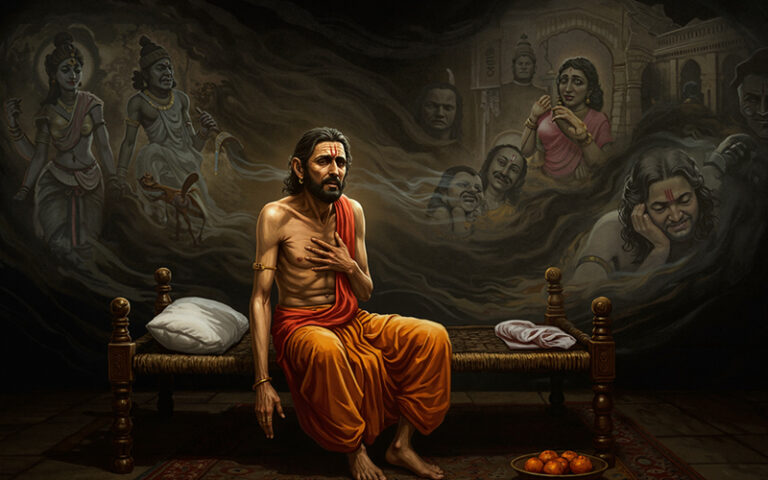
He saw a Bull, white as a lotus. This was no ordinary animal; he was Dharma personified. Yet, he stood trembling, resting on only one leg. Beside him stood a Cow—Bhoomi Devi (Mother Earth)—weeping, her eyes filled with tears, feeling abandoned by the Lord.
The Bull explained the tragedy of time to the King. In the Satya Yuga (Golden Age), Dharma stood on four strong legs:
But as the ages passed through Treta and Dvapara, the legs of Compassion, Discipline, and Cleanliness were shattered by pride, attachment, and intoxication. Now, at the dawn of this new age, only one leg remained to support the world: Truth.
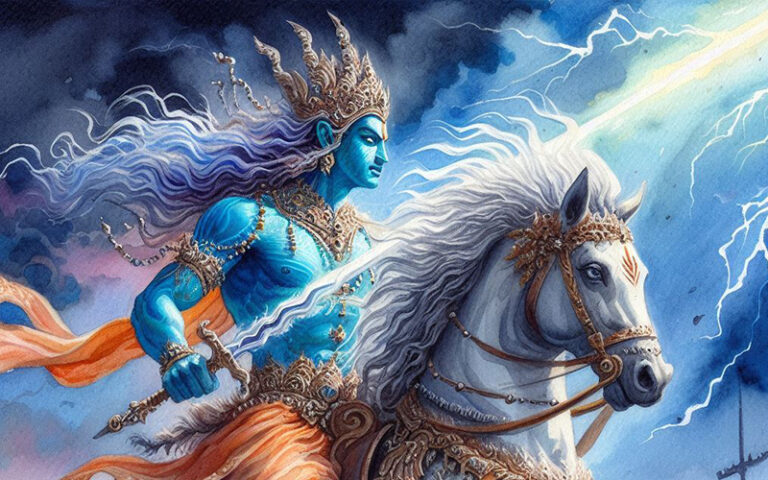
And then, Parikshit saw him. A man of dark complexion, dressed in royal robes, beating the helpless Bull with a club to break that final leg. This was Kali.
The Five Places of Corruption
King Parikshit roared like a lion, drawing his sword to strike down the agent of evil. But Kali is not a warrior; he survives through manipulation and weakness. He immediately threw away his weapon, surrendered, and begged for mercy. Bound by the code of the old Dharma, the King could not kill a surrendered soul.
Instead, he banished him. But Kali asked, “My Lord, wherever I look, I see your kingdom. You must give me a place to live”.
Parikshit granted Kali four specific places to reside. These are the four pillars that define the downfall of modern society:
But Kali, cunning and insatiable, asked for one more place—a master key. So, King Parikshit granted him Gold. Why? Because wherever wealth is hoarded, all four of Kali’s evils—lying, intoxication, lust, and violence—naturally gather and thrive.
The Srimad Bhagavatam Prophecies: A Mirror to Now
Once Kali entered these places, the Age of Darkness truly began. The Srimad Bhagavatam, Canto 12, written thousands of years ago, lists prophecies that read less like ancient history and more like today’s headlines.
1. The Decline of Human Quality
The text predicts that as the age advances, memory, physical strength, and lifespan will steadily decline. Despite our medical advances, we see rising stress and mental health crises. We have access to infinite information, yet our ability to retain wisdom is fading. Bodies will become smaller, weaker, and frequently ill.
2. Wealth as the Only Virtue
In this age, wealth defines virtue. The rich are considered noble regardless of their character, and the poor are assumed to be immoral. Justice is available only to those who can pay for it, while power defines what is “true”.
3. The Collapse of Relationships
Marriage is no longer based on family or values, but solely on physical attraction and mutual approval. A person’s “greatness” is measured by their sexual ability rather than their restraint. Bonds with wider family fade, and only those related by marriage are considered family.
4. Hypocrisy in Leadership and Religion
Politics becomes a field for bandits. Rulers will be cruel, indistinguishable from thieves, plundering their own people through constant taxation. In spirituality, external symbols replace inner worth; a thread defines a Brahmin, and robes define a monk, not their knowledge or renunciation. Those who can argue boldly and deceive with words are hailed as scholars.
The Spiritual Significance: The Secret Door
The diagnosis is heavy. It feels like we are trapped in a machine we cannot stop. But the Sages who wrote these texts were compassionate; they did not just leave us with the disease, they provided the cure.
“Although Kali-yuga is an ocean of faults, there is one great quality. In this age, deliverance is found simply through Kirtan—chanting the names of the Divine.”
In previous ages, spiritual perfection required thousands of years of penance or massive fire sacrifices. In this age, the method is simplified. The darkness is heavy, which means even a small candle shines very brightly.
We cannot stop the Yuga from changing outside, but we can stop it from entering our hearts. By guarding ourselves against the five places of corruption and holding to the name of the Lord, we remain untouched by the decay of time.