Physical Address
Empirical System, 105 First Floor Pitru Krupa, Opp. R.K. Desai College, Koparli Road, Vapi (Gujarat) 396 191
Physical Address
Empirical System, 105 First Floor Pitru Krupa, Opp. R.K. Desai College, Koparli Road, Vapi (Gujarat) 396 191

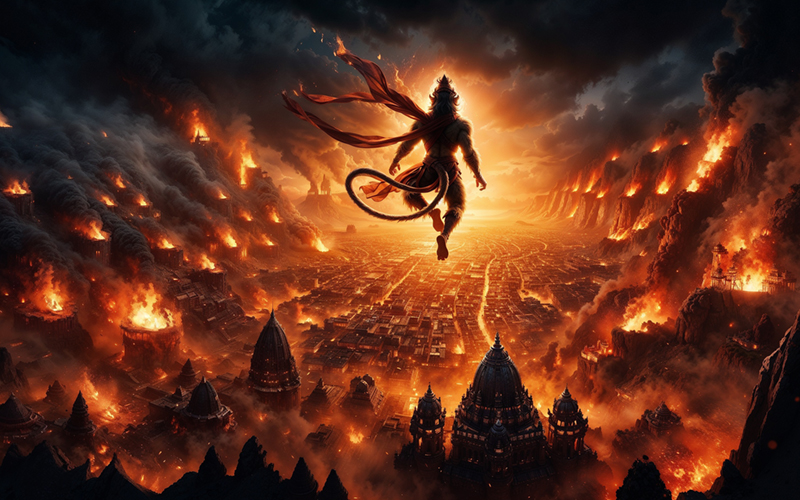
The image is etched into our collective consciousness: a mighty vanara, his tail a blazing torch, leaping across a golden city, setting it aflame. We know that Hanuman burned Lanka. But why? Was it a simple act of rage? A warrior’s retaliation?
Or was there a deeper, divine purpose at play? Let’s journey with the son of Vayu to uncover the profound spiritual significance of this fiery spectacle.
On the shores of the vast ocean, Hanuman stood, his gaze fixed on the distant, glittering island of Lanka. It was a city of unparalleled beauty, but for Hanuman, it was a fortress of adharma, a golden cage holding the divine Mother Sita.
With the name of Lord Rama on his lips and in his heart, Hanuman took a monumental leap. The scriptures say the very mountains and seas marveled at his flight, a testament not just to his physical strength, but to the boundless power of his devotion.
Upon reaching Lanka, Hanuman was met by its formidable guardian, the demoness Lankini. She blocked his path, a fierce protector of her city. But Hanuman, on a mission of Dharma, was not to be stopped.
He overpowered her not with brute force alone, but with the strength of his divine purpose. As Lankini fell, she remembered an ancient prophecy: “When a monkey defeats you, know that Lanka’s doom is near.” Humbled and terrified, she let him pass, unknowingly welcoming the first harbinger of her city’s destruction.
Disguised as a tiny monkey, Hanuman navigated the opulent city, his heart heavy with the decadence born of Ravana’s pride. Finally, in the serene Ashoka Vatika, he found her. There sat Sita, surrounded by beauty but imprisoned by sorrow, her divine radiance dimmed but not extinguished.
With reverence, Hanuman approached, offering Rama’s ring as a symbol of hope. “Devi,” he whispered, “I am Hanuman, servant of Lord Rama. He has not forgotten you. He is coming.”
Tears of relief and joy streamed down Sita’s face. She blessed Hanuman, her faith in Rama rekindled. Her message of love and resilience was now ready to be carried back.
Before leaving, Hanuman had a dual mission: to deliver a warning and to test the enemy’s strength. He began to destroy the Ashoka Vatika, easily overpowering the guards sent to stop him. He allowed himself to be captured and brought before the mighty Ravana.
In the grand, intimidating court, Hanuman stood tall, his divine aura radiating fearlessly.
“Who are you, foolish monkey, to dare enter my kingdom?” Ravana boomed, his voice dripping with arrogance.
Hanuman met his gaze, his own voice calm but firm. “I am Hanuman, servant of the great Lord Rama. I come as a messenger of Dharma. Return Mother Sita with honor, or face the wrath of a righteous king.”
Ravana roared with laughter. “I am Ravana, conqueror of the three worlds! No mortal can challenge me!”
Hanuman replied with profound wisdom, “Your power, O King, is built on a foundation of adharma. And anything built on adharma is destined to crumble.”
Infuriated, Ravana ordered Hanuman’s execution. But Vibhishana, Ravana’s righteous brother, intervened, reminding him that it is against Dharma to kill a messenger. Thwarted, Ravana devised a humiliating punishment instead.
“Set his tail on fire!” he commanded. “Let this monkey carry the mark of his insolence back to his master.”
The demons wrapped Hanuman’s tail in oil-soaked cloth and set it ablaze. But as the flames rose, a divine energy surged through Hanuman. Chanting Rama’s name, he broke his bonds, grew to a colossal size, and took to the rooftops.
This was the moment. With his tail as a divine torch, he began to leap from palace to palace, tower to tower. The golden city, a symbol of Ravana’s material pride and spiritual bankruptcy, was engulfed in a purifying fire.
This was not an act of mindless rage. Each flame was a direct consequence of Ravana’s actions.
Hanuman was merely the divine instrument. The burning of Lanka was a powerful message from the cosmos: pride, arrogance, and injustice will inevitably lead to their own destruction. It was a divine warning, a physical manifestation of the consequences of straying from the path of Dharma.
The burning of Lanka is one of the most visually stunning and spiritually significant events in the Ramayana. To truly grasp its power, we invite you to watch our special video on the Vibes of Divinity YouTube channel.
Experience the devotion, the confrontation, and the divine justice in a way that will stay with you forever.
[Click here to watch: Was Hanuman’s Burning of Lanka an Act of Anger?]
Don’t forget to like, subscribe, and hit the notification bell to continue your journey into the heart of these timeless stories!
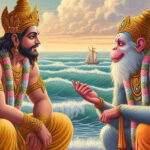
After reducing the city of adharma to ashes, Hanuman calmly extinguished the flames on his tail in the ocean and returned to Lord Rama. He delivered Sita’s message and recounted the events, confirming that while Lanka was mighty in appearance, its moral foundation was hollow.
The stage was now set. The burning of Lanka was not just an act of destruction; it was a divine proclamation. It was the first trumpet call of a war that would restore Dharma to the world. It showed that even one devoted soul, armed with righteousness and the name of God, can bring an empire of evil to its knees.
What does Hanuman’s burning of Lanka symbolize for you? Share your reflections in the comments below!