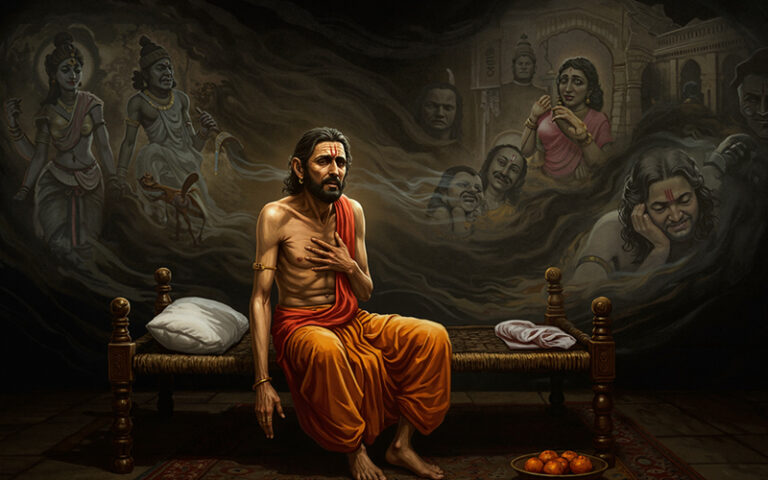

Welcome to Vibes of Divinity. After hearing Krishna praise wisdom in Chapter 2, Arjuna asks a natural question: if knowledge is superior to action, why should he engage in a terrible war? In Bhagavad Gita Chapter 3 (Karma Yoga), Lord Krishna resolves this apparent contradiction and reveals how everyday work itself becomes a sacred path to liberation.
- Chapter Name: कर्मयोग (Karma Yoga)
- Section: Section 1: The Path of Selfless Action & Discipline (Chapters 1–6)
- Complete Text Included: All 43 Sanskrit shlokas with IAST transliteration & English translation
- Series Index: Bhagavad Gita Complete Guide (All 18 Chapters & 701 Shlokas)
Chapter 3 Summary & Context on Kurukshetra
Krishna explains that no human being can remain completely inactive even for a moment, because the three qualities of nature (gunas) constantly impel us to act. Sitting outwardly still while the mind craves sensory pleasures is hypocrisy—true strength lies in performing one’s rightful duties cleanly without selfish attachment.
Action done as Yajna (an offering for the welfare of all) keeps the cosmic cycle harmonious. Leaders especially must set a righteous example, because society follows the standards set by those it looks up to.
Near the close of the chapter, Arjuna asks what drives people to commit wrong even against their better judgment. Krishna identifies the culprit: Kama (uncontrolled selfish desire) and its twin, Krodha (anger). (For a deep dive into those closing verses, read our dedicated guide: Lust is the Enemy of the Wise.)
Highlighted Shlokas & Spiritual Reflections (Chapter 3)
Shloka 3.19 — Performing Duty Without Attachment
तस्मादसक्तः सततं कार्यं कर्म समाचर । असक्तो ह्याचरन्कर्म परमाप्नोति पूरुषः ॥
Tasmād asaktaḥ satataṁ kāryaṁ karma samācara | Asakto hy ācaran karma param āpnoti pūruṣaḥ ||
Meaning: Therefore, without attachment, constantly perform the work that ought to be done; for by performing action without selfish attachment, a person attains the Supreme.
You do not need to abandon your family or career to walk a spiritual path—transforming your intention while working turns ordinary effort into spiritual elevation.
Shloka 3.21 — Leadership by Example
यद्यदाचरति श्रेष्ठस्तत्तदेवेतरो जनः । स यत्प्रमाणं कुरुते लोकस्तदनुवर्तते ॥
Yad yad ācarati śreṣṭhas tat tad evetaro janaḥ | Sa yat pramāṇaṁ kurute lokas tad anuvartate ||
Meaning: Whatever a noble leader does, others follow; whatever standard they set by their conduct, the world emulates.
Integrity matters most when others look up to us—parents, teachers, creators, and leaders shape culture through deeds more than speeches.
Shloka 3.35 — Walking Your Own Dharma
श्रेयान्स्वधर्मो विगुणः परधर्मात्स्वनुष्ठितात् । स्वधर्मे निधनं श्रेयः परधर्मो भयावहः ॥
Śreyān sva-dharmo viguṇaḥ para-dharmāt sv-anuṣṭhitāt | Sva-dharme nidhanaṁ śreyaḥ para-dharmo bhayāvahaḥ ||
Meaning: Better is one’s own duty, though imperfectly performed, than the duty of another well performed. Better is death in one’s own duty; another’s path is fraught with fear.
Stop comparing your calling to someone else’s path. Authentic growth happens when you honor your own true nature and responsibilities.
Complete Verse-by-Verse Bhagavad Gita Chapter 3 (All 43 Shlokas)
Read all 43 original Sanskrit verses of Chapter 3 below with Roman IAST transliteration and clear English meaning:
Verse 3.1
अर्जुन उवाच |
ज्यायसी चेत्कर्मणस्ते मता बुद्धिर्जनार्दन |
तत्किं कर्मणि घोरे मां नियोजयसि केशव ||३-१||
arjuna uvāca .
jyāyasī cetkarmaṇaste matā buddhirjanārdana .
tatkiṃ karmaṇi ghore māṃ niyojayasi keśava ||3-1||
Meaning: Arjuna questioned: My Lord! If Wisdom is above action, why dost Thou advise me to engage in this terrible fight?
Verse 3.2
व्यामिश्रेणेव वाक्येन बुद्धिं मोहयसीव मे |
तदेकं वद निश्चित्य येन श्रेयोऽहमाप्नुयाम् ||३-२||
vyāmiśreṇeva vākyena buddhiṃ mohayasīva me .
tadekaṃ vada niścitya yena śreyo.ahamāpnuyām ||3-2||
Meaning: Thy language perplexes me and confuses my reason. Therefore please tell me the only way by which I may, without doubt, secure my spiritual welfare.
Verse 3.3
श्रीभगवानुवाच |
लोकेऽस्मिन् द्विविधा निष्ठा पुरा प्रोक्ता मयानघ |
ज्ञानयोगेन साङ्ख्यानां कर्मयोगेन योगिनाम् ||३-३||
śrībhagavānuvāca .
loke.asmina dvividhā niṣṭhā purā proktā mayānagha .
jñānayogena sāṅkhyānāṃ karmayogena yoginām ||3-3||
Meaning: Lord Shri Krishna replied: In this world, as I have said, there is a twofold path, O Sinless One! There is the Path of Wisdom for those who meditate, and the Path of Action for those who work.
Verse 3.4
न कर्मणामनारम्भान्नैष्कर्म्यं पुरुषोऽश्नुते |
न च संन्यसनादेव सिद्धिं समधिगच्छति ||३-४||
na karmaṇāmanārambhānnaiṣkarmyaṃ puruṣo.aśnute .
na ca saṃnyasanādeva siddhiṃ samadhigacchati ||3-4||
Meaning: No man can attain freedom from activity by refraining from action; nor can he reach perfection by merely refusing to act.
Verse 3.5
न हि कश्चित्क्षणमपि जातु तिष्ठत्यकर्मकृत् |
कार्यते ह्यवशः कर्म सर्वः प्रकृतिजैर्गुणैः ||३-५||
na hi kaścitkṣaṇamapi jātu tiṣṭhatyakarmakṛt .
kāryate hyavaśaḥ karma sarvaḥ prakṛtijairguṇaiḥ ||3-5||
Meaning: He cannot even for a moment remain really inactive, for the Qualities of Nature will compel him to act whether he will or no.
Verse 3.6
कर्मेन्द्रियाणि संयम्य य आस्ते मनसा स्मरन् |
इन्द्रियार्थान्विमूढात्मा मिथ्याचारः स उच्यते ||३-६||
karmendriyāṇi saṃyamya ya āste manasā smaran .
indriyārthānvimūḍhātmā mithyācāraḥ sa ucyate ||3-6||
Meaning: He who remains motionless, refusing to act, but all the while brooding over sensuous object, that deluded soul is simply a hypocrite.
Verse 3.7
यस्त्विन्द्रियाणि मनसा नियम्यारभतेऽर्जुन |
कर्मेन्द्रियैः कर्मयोगमसक्तः स विशिष्यते ||३-७||
yastvindriyāṇi manasā niyamyārabhate.arjuna .
karmendriyaiḥ karmayogamasaktaḥ sa viśiṣyate ||3-7||
Meaning: But, O Arjuna! All honour to him whose mind controls his senses, for he is thereby beginning to practise Karma-Yoga, the Path of Right Action, keeping himself always unattached.
Verse 3.8
नियतं कुरु कर्म त्वं कर्म ज्यायो ह्यकर्मणः |
शरीरयात्रापि च ते न प्रसिद्ध्येदकर्मणः ||३-८||
niyataṃ kuru karma tvaṃ karma jyāyo hyakarmaṇaḥ .
śarīrayātrāpi ca te na prasiddhyedakarmaṇaḥ ||3-8||
Meaning: Do thy duty as prescribed, for action for duty's sake is superior to inaction. Even the maintenance of the body would be impossible if man remained inactive.
Verse 3.9
यज्ञार्थात्कर्मणोऽन्यत्र लोकोऽयं कर्मबन्धनः |
तदर्थं कर्म कौन्तेय मुक्तसङ्गः समाचर ||३-९||
yajñārthātkarmaṇo.anyatra loko.ayaṃ karmabandhanaḥ .
tadarthaṃ karma kaunteya muktasaṅgaḥ samācara ||3-9||
Meaning: In this world people are fettered by action, unless it is performed as a sacrifice. Therefore, O Arjuna, let thy acts be done without attachment, as sacrifice only.
Verse 3.10
सहयज्ञाः प्रजाः सृष्ट्वा पुरोवाच प्रजापतिः |
अनेन प्रसविष्यध्वमेष वोऽस्त्विष्टकामधुक् ||३-१०||
sahayajñāḥ prajāḥ sṛṣṭvā purovāca prajāpatiḥ .
anena prasaviṣyadhvameṣa vo.astviṣṭakāmadhuk ||3-10||
Meaning: In the beginning, when God created all beings by the sacrifice of Himself, He said unto them: Through sacrifice you can procreate, and it shall satisfy all your desires.
Verse 3.11
देवान्भावयतानेन ते देवा भावयन्तु वः |
परस्परं भावयन्तः श्रेयः परमवाप्स्यथ ||३-११||
devānbhāvayatānena te devā bhāvayantu vaḥ .
parasparaṃ bhāvayantaḥ śreyaḥ paramavāpsyatha ||3-11||
Meaning: Worship the Powers of Nature thereby, and let them nourish you in return; thus supporting each other, you shall attain your highest welfare.
Verse 3.12
इष्टान्भोगान्हि वो देवा दास्यन्ते यज्ञभाविताः |
तैर्दत्तानप्रदायैभ्यो यो भुङ्क्ते स्तेन एव सः ||३-१२||
iṣṭānbhogānhi vo devā dāsyante yajñabhāvitāḥ .
tairdattānapradāyaibhyo yo bhuṅkte stena eva saḥ ||3-12||
Meaning: For, fed, on sacrifice, nature will give you all the enjoyment you can desire. But he who enjoys what she gives without returning is, indeed, a robber.'
Verse 3.13
यज्ञशिष्टाशिनः सन्तो मुच्यन्ते सर्वकिल्बिषैः |
भुञ्जते ते त्वघं पापा ये पचन्त्यात्मकारणात् ||३-१३||
yajñaśiṣṭāśinaḥ santo mucyante sarvakilbiṣaiḥ .
bhuñjate te tvaghaṃ pāpā ye pacantyātmakāraṇāt ||3-13||
Meaning: The sages who enjoy the food that remains after the sacrifice is made are freed from all sin; but the selfish who spread their feast only for themselves feed on sin only.
Verse 3.14
अन्नाद्भवन्ति भूतानि पर्जन्यादन्नसम्भवः |
यज्ञाद्भवति पर्जन्यो यज्ञः कर्मसमुद्भवः ||३-१४||
annādbhavanti bhūtāni parjanyādannasambhavaḥ .
yajñādbhavati parjanyo yajñaḥ karmasamudbhavaḥ ||3-14||
Meaning: All creatures are the product of food, food is the product of rain, rain comes by sacrifice, and sacrifice is the noblest form of action.
Verse 3.15
कर्म ब्रह्मोद्भवं विद्धि ब्रह्माक्षरसमुद्भवम् |
तस्मात्सर्वगतं ब्रह्म नित्यं यज्ञे प्रतिष्ठितम् ||३-१५||
karma brahmodbhavaṃ viddhi brahmākṣarasamudbhavam .
tasmātsarvagataṃ brahma nityaṃ yajñe pratiṣṭhitam ||3-15||
Meaning: All action originates in the Supreme Spirit, which is Imperishable, and in sacrificial action the all-pervading Spirit is consciously present.
Verse 3.16
एवं प्रवर्तितं चक्रं नानुवर्तयतीह यः |
अघायुरिन्द्रियारामो मोघं पार्थ स जीवति ||३-१६||
evaṃ pravartitaṃ cakraṃ nānuvartayatīha yaḥ .
aghāyurindriyārāmo moghaṃ pārtha sa jīvati ||3-16||
Meaning: Thus he who does not help the revolving wheel of sacrifice, but instead leads a sinful life, rejoicing in the gratification of his senses, O Arjuna, he breathes in vain.
Verse 3.17
यस्त्वात्मरतिरेव स्यादात्मतृप्तश्च मानवः |
आत्मन्येव च सन्तुष्टस्तस्य कार्यं न विद्यते ||३-१७||
yastvātmaratireva syādātmatṛptaśca mānavaḥ .
ātmanyeva ca santuṣṭastasya kāryaṃ na vidyate ||3-17||
Meaning: On the other hand, the soul who meditates on the Self is content to serve the Self and rests satisfied within the Self; there remains nothing more for him to accomplish.
Verse 3.18
नैव तस्य कृतेनार्थो नाकृतेनेह कश्चन |
न चास्य सर्वभूतेषु कश्चिदर्थव्यपाश्रयः ||३-१८||
naiva tasya kṛtenārtho nākṛteneha kaścana .
na cāsya sarvabhūteṣu kaścidarthavyapāśrayaḥ ||3-18||
Meaning: He has nothing to gain by the performance or non-performance of action. His welfare depends not on any contribution that an earthly creature can make.
Verse 3.19
तस्मादसक्तः सततं कार्यं कर्म समाचर |
असक्तो ह्याचरन्कर्म परमाप्नोति पूरुषः ||३-१९||
tasmādasaktaḥ satataṃ kāryaṃ karma samācara .
asakto hyācarankarma paramāpnoti pūruṣaḥ ||3-19||
Meaning: Therefore do thy duty perfectly, without care for the results, for he who does his duty disinterestedly attains the Supreme.
Verse 3.20
कर्मणैव हि संसिद्धिमास्थिता जनकादयः |
लोकसंग्रहमेवापि सम्पश्यन्कर्तुमर्हसि ||३-२०||
karmaṇaiva hi saṃsiddhimāsthitā janakādayaḥ .
lokasaṃgrahamevāpi sampaśyankartumarhasi ||3-20||
Meaning: King Janaka and others attained perfection through action alone. Even for the sake of enlightening the world, it is thy duty to act;
Verse 3.21
यद्यदाचरति श्रेष्ठस्तत्तदेवेतरो जनः |
स यत्प्रमाणं कुरुते लोकस्तदनुवर्तते ||३-२१||
yadyadācarati śreṣṭhastattadevetaro janaḥ .
sa yatpramāṇaṃ kurute lokastadanuvartate ||3-21||
Meaning: For whatever a great man does, others imitate. People conform to the standard which he has set.
Verse 3.22
न मे पार्थास्ति कर्तव्यं त्रिषु लोकेषु किञ्चन |
नानवाप्तमवाप्तव्यं वर्त एव च कर्मणि ||३-२२||
na me pārthāsti kartavyaṃ triṣu lokeṣu kiñcana .
nānavāptamavāptavyaṃ varta eva ca karmaṇi ||3-22||
Meaning: There is nothing in this universe, O Arjuna, that I am compelled to do, nor anything for Me to attain; yet I am persistently active.
Verse 3.23
यदि ह्यहं न वर्तेयं जातु कर्मण्यतन्द्रितः |
मम वर्त्मानुवर्तन्ते मनुष्याः पार्थ सर्वशः ||३-२३||
yadi hyahaṃ na varteyaṃ jātu karmaṇyatandritaḥ .
mama vartmānuvartante manuṣyāḥ pārtha sarvaśaḥ ||3-23||
Meaning: For were I not to act without ceasing, O prince, people would be glad to do likewise.
Verse 3.24
उत्सीदेयुरिमे लोका न कुर्यां कर्म चेदहम् |
सङ्करस्य च कर्ता स्यामुपहन्यामिमाः प्रजाः ||३-२४||
utsīdeyurime lokā na kuryāṃ karma cedaham .
saṅkarasya ca kartā syāmupahanyāmimāḥ prajāḥ ||3-24||
Meaning: And if I were to refrain from action, the human race would be ruined; I should lead the world to chaos, and destruction would follow.
Verse 3.25
सक्ताः कर्मण्यविद्वांसो यथा कुर्वन्ति भारत |
कुर्याद्विद्वांस्तथासक्तश्चिकीर्षुर्लोकसंग्रहम् ||३-२५||
saktāḥ karmaṇyavidvāṃso yathā kurvanti bhārata .
kuryādvidvāṃstathāsaktaścikīrṣurlokasaṃgraham ||3-25||
Meaning: As the ignorant act, because of their fondness for action, so should the wise act without such attachment, fixing their eyes, O Arjuna, only on the welfare of the world.
Verse 3.26
न बुद्धिभेदं जनयेदज्ञानां कर्मसङ्गिनाम् |
जोषयेत्सर्वकर्माणि विद्वान्युक्तः समाचरन् ||३-२६||
na buddhibhedaṃ janayedajñānāṃ karmasaṅginām .
joṣayetsarvakarmāṇi vidvānyuktaḥ samācaran ||3-26||
Meaning: But a wise man should not perturb the minds of the ignorant, who are attached to action; let him perform his own actions in the right spirit, with concentration on Me, thus inspiring all to do the same.
Verse 3.27
प्रकृतेः क्रियमाणानि गुणैः कर्माणि सर्वशः |
अहङ्कारविमूढात्मा कर्ताहमिति मन्यते ||३-२७||
prakṛteḥ kriyamāṇāni guṇaiḥ karmāṇi sarvaśaḥ .
ahaṅkāravimūḍhātmā kartāhamiti manyate ||3-27||
Meaning: Action is the product of the Qualities inherent in Nature. It is only the ignorant man who, misled by personal egotism, says: I am the doer.'
Verse 3.28
तत्त्ववित्तु महाबाहो गुणकर्मविभागयोः |
गुणा गुणेषु वर्तन्त इति मत्वा न सज्जते ||३-२८||
tattvavittu mahābāho guṇakarmavibhāgayoḥ .
guṇā guṇeṣu vartanta iti matvā na sajjate ||3-28||
Meaning: But he, O Mighty One, who understands correctly the relation of the Qualities to action, is not attached to the act for he perceives that it is merely the action and reaction of the Qualities among themselves.
Verse 3.29
प्रकृतेर्गुणसम्मूढाः सज्जन्ते गुणकर्मसु |
तानकृत्स्नविदो मन्दान्कृत्स्नविन्न विचालयेत् ||३-२९||
prakṛterguṇasammūḍhāḥ sajjante guṇakarmasu .
tānakṛtsnavido mandānkṛtsnavinna vicālayet ||3-29||
Meaning: Those who do not understand the Qualities are interested in the act. Still, the wise man who knows the truth should not disturb the mind of him who does not.
Verse 3.30
मयि सर्वाणि कर्माणि संन्यस्याध्यात्मचेतसा |
निराशीर्निर्ममो भूत्वा युध्यस्व विगतज्वरः ||३-३०||
mayi sarvāṇi karmāṇi saṃnyasyādhyātmacetasā .
nirāśīrnirmamo bhūtvā yudhyasva vigatajvaraḥ ||3-30||
Meaning: Therefore, surrendering thy actions unto Me, thy thoughts concentrated on the Absolute, free from selfishness and without anticipation of reward, with mind devoid of excitement, begin thou to fight.
Verse 3.31
ये मे मतमिदं नित्यमनुतिष्ठन्ति मानवाः |
श्रद्धावन्तोऽनसूयन्तो मुच्यन्ते तेऽपि कर्मभिः ||३-३१||
ye me matamidaṃ nityamanutiṣṭhanti mānavāḥ .
śraddhāvanto.anasūyanto mucyante te.api karmabhiḥ ||3-31||
Meaning: Those who always act in accordance with My precepts, firm in faith and without cavilling, they too are freed from the bondage of action.
Verse 3.32
ये त्वेतदभ्यसूयन्तो नानुतिष्ठन्ति मे मतम् |
सर्वज्ञानविमूढांस्तान्विद्धि नष्टानचेतसः ||३-३२||
ye tvetadabhyasūyanto nānutiṣṭhanti me matam .
sarvajñānavimūḍhāṃstānviddhi naṣṭānacetasaḥ ||3-32||
Meaning: But they who ridicule My word and do not keep it, are ignorant, devoid of wisdom and blind. They seek but their own destruction.
Verse 3.33
सदृशं चेष्टते स्वस्याः प्रकृतेर्ज्ञानवानपि |
प्रकृतिं यान्ति भूतानि निग्रहः किं करिष्यति ||३-३३||
sadṛśaṃ ceṣṭate svasyāḥ prakṛterjñānavānapi .
prakṛtiṃ yānti bhūtāni nigrahaḥ kiṃ kariṣyati ||3-33||
Meaning: Even the wise man acts in character with his nature; indeed, all creatures act according to their natures. What is the use of compulsion then?
Verse 3.34
इन्द्रियस्येन्द्रियस्यार्थे रागद्वेषौ व्यवस्थितौ |
तयोर्न वशमागच्छेत्तौ ह्यस्य परिपन्थिनौ ||३-३४||
indriyasyendriyasyārthe rāgadveṣau vyavasthitau .
tayorna vaśamāgacchettau hyasya paripanthinau ||3-34||
Meaning: The love and hate which are aroused by the objects of sense arise from Nature; do not yield to them. They only obstruct the path.
Verse 3.35
श्रेयान्स्वधर्मो विगुणः परधर्मात्स्वनुष्ठितात् |
स्वधर्मे निधनं श्रेयः परधर्मो भयावहः ||३-३५||
śreyānsvadharmo viguṇaḥ paradharmātsvanuṣṭhitāt .
svadharme nidhanaṃ śreyaḥ paradharmo bhayāvahaḥ ||3-35||
Meaning: It is better to do thine own duty, however lacking in merit, than to do that of another, even though efficiently. It is better to die doing one's own duty, for to do the duty of another is fraught with danger.
Verse 3.36
अर्जुन उवाच |
अथ केन प्रयुक्तोऽयं पापं चरति पूरुषः |
अनिच्छन्नपि वार्ष्णेय बलादिव नियोजितः ||३-३६||
arjuna uvāca .
atha kena prayukto.ayaṃ pāpaṃ carati pūruṣaḥ .
anicchannapi vārṣṇeya balādiva niyojitaḥ ||3-36||
Meaning: Arjuna asked: My Lord! Tell me, what is it that drives a man to sin, even against his will and as if by compulsion?
Verse 3.37
श्रीभगवानुवाच |
काम एष क्रोध एष रजोगुणसमुद्भवः |
महाशनो महापाप्मा विद्ध्येनमिह वैरिणम् ||३-३७||
śrībhagavānuvāca .
kāma eṣa krodha eṣa rajoguṇasamudbhavaḥ .
mahāśano mahāpāpmā viddhyenamiha vairiṇam ||3-37||
Meaning: Lord Shri Krishna: It is desire, it is aversion, born of passion. Desire consumes and corrupts everything. It is man's greatest enemy.
Verse 3.38
धूमेनाव्रियते वह्निर्यथादर्शो मलेन च |
यथोल्बेनावृतो गर्भस्तथा तेनेदमावृतम् ||३-३८||
dhūmenāvriyate vahniryathādarśo malena ca .
yatholbenāvṛto garbhastathā tenedamāvṛtam ||3-38||
Meaning: As fire is shrouded in smoke, a mirror by dust and a child by the womb, so is the universe enveloped in desire.
Verse 3.39
आवृतं ज्ञानमेतेन ज्ञानिनो नित्यवैरिणा |
कामरूपेण कौन्तेय दुष्पूरेणानलेन च ||३-३९||
āvṛtaṃ jñānametena jñānino nityavairiṇā .
kāmarūpeṇa kaunteya duṣpūreṇānalena ca ||3-39||
Meaning: It is the wise man's constant enemy; it tarnishes the face of wisdom. It is as insatiable as a flame of fire.
Verse 3.40
इन्द्रियाणि मनो बुद्धिरस्याधिष्ठानमुच्यते |
एतैर्विमोहयत्येष ज्ञानमावृत्य देहिनम् ||३-४०||
indriyāṇi mano buddhirasyādhiṣṭhānamucyate .
etairvimohayatyeṣa jñānamāvṛtya dehinam ||3-40||
Meaning: It works through the senses, the mind and the reason; and with their help destroys wisdom and confounds the soul.
Verse 3.41
तस्मात्त्वमिन्द्रियाण्यादौ नियम्य भरतर्षभ |
पाप्मानं प्रजहि ह्येनं ज्ञानविज्ञाननाशनम् ||३-४१||
tasmāttvamindriyāṇyādau niyamya bharatarṣabha .
pāpmānaṃ prajahi hyenaṃ jñānavijñānanāśanam ||3-41||
Meaning: Therefore, O Arjuna, first control thy senses and then slay desire, for it is full of sin, and is the destroyer of knowledge and of wisdom.
Verse 3.42
इन्द्रियाणि पराण्याहुरिन्द्रियेभ्यः परं मनः |
मनसस्तु परा बुद्धिर्यो बुद्धेः परतस्तु सः ||३-४२||
indriyāṇi parāṇyāhurindriyebhyaḥ paraṃ manaḥ .
manasastu parā buddhiryo buddheḥ paratastu saḥ ||3-42||
Meaning: It is said that the senses are powerful. But beyond the senses is the mind, beyond the mind is the intellect, and beyond and greater than intellect is He.
Verse 3.43
एवं बुद्धेः परं बुद्ध्वा संस्तभ्यात्मानमात्मना |
जहि शत्रुं महाबाहो कामरूपं दुरासदम् ||३-४३||
evaṃ buddheḥ paraṃ buddhvā saṃstabhyātmānamātmanā .
jahi śatruṃ mahābāho kāmarūpaṃ durāsadam ||3-43||
Meaning: Thus, O Mighty-in-Arms, knowing Him to be beyond the intellect and, by His help, subduing thy personal egotism, kill thine enemy, Desire, extremely difficult though it be.
Timeless Life Lessons for Modern Seekers
- Work as an Offering (Yajna): Dedicate your daily tasks—study, career, caregiving—to a higher purpose instead of pure ego gratification.
- Avoid Escapism: Spiritual maturity means facing your duties courageously rather than running away under the guise of detachment.
- Lead with Integrity: Remember that your daily habits silently teach everyone around you.
- Guard Against Unchecked Desires: Discipline the senses and mind early, before selfish craving turns into destructive anger.
Frequently Asked Questions — Bhagavad Gita Chapter 3
What is the core message of Bhagavad Gita Chapter 3?
Chapter 3 teaches Karma Yoga: fulfilling one’s rightful duties sincerely as an offering to the Divine and society, free from ego and selfish attachment.
Does Karma Yoga mean working without goals?
No. Karma Yoga encourages clear purpose and dedicated effort, while freeing your inner peace from obsessive anxiety over outcomes.
How many verses are in Gita Chapter 3?
Bhagavad Gita Chapter 3 consists of 43 Sanskrit verses.
Continue Your Bhagavad Gita Journey
← Previous: Chapter 2 | All 18 Gita Chapters | Next: Chapter 4 →
To explore more Bhagavad Gita teachings, Puranic stories, and sacred chants and timeless wisdom from Hindu scriptures, visit and subscribe to our official Vibes of Divinity YouTube channel.
Which shloka from this chapter touches your heart most today? Share your reflection in the comments below.