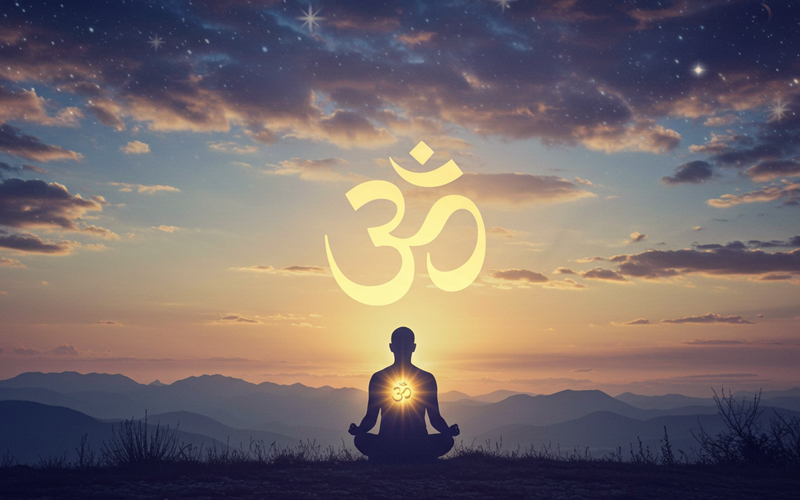

Welcome to Vibes of Divinity. Below is the complete, unabridged 12-mantra text of the Mandukya Upanishad from the Atharvaveda—exploring Om and the four states of human consciousness (Waking, Dreaming, Deep Sleep, and Turiya) with every mantra in Devanagari, IAST, and English.
- Total Mantras Included: All 12 original Sanskrit mantras complete with IAST transliteration & English translation
- Series Index: All 12 Principal Upanishads (Divine Wisdom Hub)
Opening Shanti Mantra (Peace Invocation)
ॐ भद्रं कर्णेभिः शृणुयाम देवाः भद्रं पश्येमाक्षभिर्यजत्राः । स्थिरैरङ्गैस्तुष्टुवांसस्तनूभिर्व्यशेम देवहितं यदायुः ॥ ॐ शान्तिः शान्तिः शान्तिः ॥
Oṁ bhadraṁ karṇebhiḥ śṛṇuyāma devāḥ bhadraṁ paśyemākṣabhir yajatrāḥ | Sthirair aṅgais tuṣṭuvāṁsas tanūbhir vyaśema devahitaṁ yad āyuḥ || Oṁ Śāntiḥ Śāntiḥ Śāntiḥ ||
Meaning: May we hear what is auspicious with our ears, behold what is auspicious with our eyes, and live out our allotted span in steady health and gratitude. Om Peace, Peace, Peace.
Complete Verse-by-Verse Text (12 Mantras)
Mantra 1 — Everything Is Om
ओमित्येतदक्षरमिदं सर्वं तस्योपव्याख्यानं भूतं भवद्भविष्यदिति सर्वमोङ्कार एव । यच्चान्यत् त्रिकालातीतं तदप्योङ्कार एव ॥
Om ity etad akṣaram idaṁ sarvaṁ tasyopavyākhyānaṁ bhūtaṁ bhavad bhaviṣyad iti sarvam oṅkāra eva | Yac cānyat trikālātītaṁ tad apy oṅkāra eva ||
Meaning: Om—this imperishable syllable—is indeed this entire universe. Past, present, and future, all is Om; and whatever transcends threefold time, that too is Om alone.
Mantra 2 — Four Quarters of the Self
सर्वं ह्येतद् ब्रह्मायमात्मा ब्रह्म सोऽयमात्मा चतुष्पात् ॥
Sarvaṁ hy etad brahmāyam ātmā brahma so ’yam ātmā catuṣpāt ||
Meaning: All this universe is verily Brahman; this Atman (Self) is Brahman; and this same Self shines through four quarters (states of experience).
Mantra 3 — First Quarter: Vaishvanara (Waking State)
जागरितस्थानो बहिष्प्रज्ञः सप्ताङ्ग एकोनविंशतिमुखः स्थूलभुग्वैश्वानरः प्रथमः पादः ॥
Jāgarita-sthāno bahiṣ-prajñaḥ saptāṅga ekonaviṁśati-mukhaḥ sthūla-bhug vaiśvānaraḥ prathamaḥ pādaḥ ||
Meaning: The first quarter is Vaishvanara, stationed in the waking state, outward-conscious, experiencing physical objects through the senses and mind.
Mantra 4 — Second Quarter: Taijasa (Dreaming State)
स्वप्नस्थानोऽन्तःप्रज्ञः सप्ताङ्ग एकोनविंशतिमुखः प्रविविक्तभुक्तैजसो द्वितीयः पादः ॥
Svapna-sthāno ’ntaḥ-prajñaḥ saptāṅga ekonaviṁśati-mukhaḥ pravivikta-bhuk taijaso dvitīyaḥ pādaḥ ||
Meaning: The second quarter is Taijasa, stationed in the dreaming state, inward-conscious, experiencing subtle mental impressions created by memory and imagination.
Mantra 5 — Third Quarter: Prajna (Deep Dreamless Sleep)
यत्र सुप्तो न कञ्चन कामं कामयते न कञ्चन स्वप्नं पश्यति तत् सुषुप्तम् । सुषुप्तस्थान एकीभूतः प्रज्ञानघन एवानन्दमयो ह्यानन्दभुक् चेतोमुखः प्राज्ञस्तृतीयः पादः ॥
Yatra supto na kañcana kāmaṁ kāmayate na kañcana svapnaṁ paśyati tat suṣuptam | Suṣupta-sthāna ekībhūtaḥ prajñāna-ghana evānandamayo hy ānanda-bhuk ceto-mukhaḥ prājñas tṛtīyaḥ pādaḥ ||
Meaning: That state wherein the sleeper desires no craving and sees no dream is deep sleep (Sushupti). The third quarter is Prajna—unified, concentrated awareness overflowing with serene peace.
Mantra 6 — The Inner Lord of All
एष सर्वेश्वर एष सर्वज्ञ एषोऽन्तर्याम्येष योनिः सर्वस्य प्रभवाप्ययौ हि भूतानाम् ॥
Eṣa sarveśvara eṣa sarvajña eṣo ’ntaryāmy eṣa yoniḥ sarvasya prabhavāpyayau hi bhūtānām ||
Meaning: This is the Lord of all, all-knowing, the Indwelling Witness, the source of the universe—from whom all beings originate and into whom they resolve.
Mantra 7 — Fourth State: Turiya (Pure Witnessing Consciousness)
नान्तःप्रज्ञं न बहिष्प्रज्ञं नोभयतःप्रज्ञं न प्रज्ञानघनं न प्रज्ञं नाप्रज्ञम् । अदृष्टमव्यवहार्यमग्राह्यमलक्षणमचिन्त्यमव्यपदेश्यमेकात्मप्रत्ययसारं प्रपञ्चोपशमं शान्तं शिवमद्वैतं चतुर्थं मन्यन्ते स आत्मा स विज्ञेयः ॥
Nāntaḥ-prajñaṁ na bahiṣ-prajñaṁ nobhayataḥ-prajñaṁ na prajñāna-ghanaṁ na prajñaṁ nāprajñam | Adṛṣṭam avyavahāryam agrāhyam alakṣaṇam acintyam avyapadeśyam ekātma-pratyaya-sāraṁ prapañcopaśamaṁ śāntaṁ śivam advaitaṁ caturthaṁ manyante sa ātmā sa vijñeyaḥ ||
Meaning: Neither inward-grasping nor outward-grasping nor mere blankness—unseen, beyond sensory grasp, unthinkable, indescribable, pure Self-awareness, the peaceful cessation of multiplicity, utterly serene, auspicious, and non-dual: this is known as the Fourth (Turiya). That is the true Self; That alone is to be realized.
Mantra 8 — Mapping Om (A-U-M) to the Self
सोऽयमात्माध्यक्षरमोङ्कारोऽधिमात्रं पादा मात्रा मात्राश्च पादा अकार उकारो मकार इति ॥
So ’yam ātmādhyakṣaram oṅkāro ’dhimātraṁ pādā mātrā mātrāś ca pādā akāra ukāro makāra iti ||
Meaning: This very Self corresponds to the sacred syllable Om and its three component sounds—A (Akara), U (Ukara), and M (Makara)—whose letters mirror the states of consciousness.
Mantra 9 — Sound ‘A’ (Akara) & Waking State
जागरितस्थानो वैश्वानरोऽकारः प्रथमा मात्राऽऽप्तेरादिमत्त्वाद् वाप्नोति ह वै सर्वान् कामानादिश्च भवति य एवं वेद ॥
Jāgarita-sthāno vaiśvānaro ’kāraḥ prathamā mātrā ’’pter ādimattvād vāpnoti ha vai sarvān kāmān ādiś ca bhavati ya evaṁ veda ||
Meaning: Vaishvanara (waking state) is the first sound ‘A’, signifying pervasiveness and beginning; whoever understands this fulfills noble aspirations and leads with clarity.
Mantra 10 — Sound ‘U’ (Ukara) & Dream State
स्वप्नस्थानस्तैजस उकारो द्वितीया मात्रोत्कर्षादुभयत्वाद्वोत्कर्षति ह वै ज्ञानसन्ततिं समानश्च भवति नास्याब्रह्मवित्कुले भवति य एवं वेद ॥
Svapna-sthānas taijasa ukāro dvitīyā mātrotkarṣād ubhayatvād votkarṣati ha vai jñāna-santatiṁ samānaś ca bhavati nāsyābrahmavit kule bhavati ya evaṁ veda ||
Meaning: Taijasa (dreaming state) is the second sound ‘U’, signifying elevation and bridge between outer and inner; whoever realizes this deepens wisdom and lives equitably.
Mantra 11 — Sound ‘M’ (Makara) & Deep Sleep
सुषुप्तस्थानः प्राज्ञो मकारस्तृतीया मात्रा मितेरपीतेर्वा मिनोति ह वा इदं सर्वमपीतिश्च भवति य एवं वेद ॥
Suṣupta-sthānaḥ prājño makāras tṛtīyā mātrā miter apīter vā minoti ha vā idaṁ sarvam apītiś ca bhavati ya evaṁ veda ||
Meaning: Prajna (deep sleep) is the third sound ‘M’, signifying measure and absorption—wherein all multiplicity gathers peacefully inward.
Mantra 12 — Soundless Silence of Om (Amatra / Turiya)
अमात्रश्चतुर्थोऽव्यवहार्यः प्रपञ्चोपशमः शिवोऽद्वैत एवमोङ्कार आत्मैव संविशत्यात्मनाऽऽत्मानं य एवं वेद य एवं वेद ॥
Amātraś caturtho ’vyavahāryaḥ prapañcopaśamaḥ śivo ’dvaita evam oṅkāra ātmaiva saṁviśaty ātmanā ’’tmānaṁ ya evaṁ veda ya evaṁ veda ||
Meaning: Soundless silence is the Fourth (Amatra)—utterly peaceful, auspicious, non-dual. Thus Om is verily the Self alone; whoever truly knows this merges directly into the Supreme Self.
Key Life Lessons from This Upanishad
- Recognize All Four States (Mantras 3–7): Waking, dreaming, and deep sleep pass—Awareness (Turiya) stays peacefully steady.
- Listen to the Silence After Om (Mantra 12): True peace lives in the quiet stillness beyond words.
- Rest Without Fear: Every night’s deep sleep gives a gentle preview of desireless peace.
Explore more complete scriptures: Bhagavad Gita Guide | All 12 Principal Upanishads.
To explore more Upanishadic wisdom, complete Sanskrit chants, and spiritual storytelling and timeless wisdom from Hindu scriptures, visit and subscribe to our official Vibes of Divinity YouTube channel.