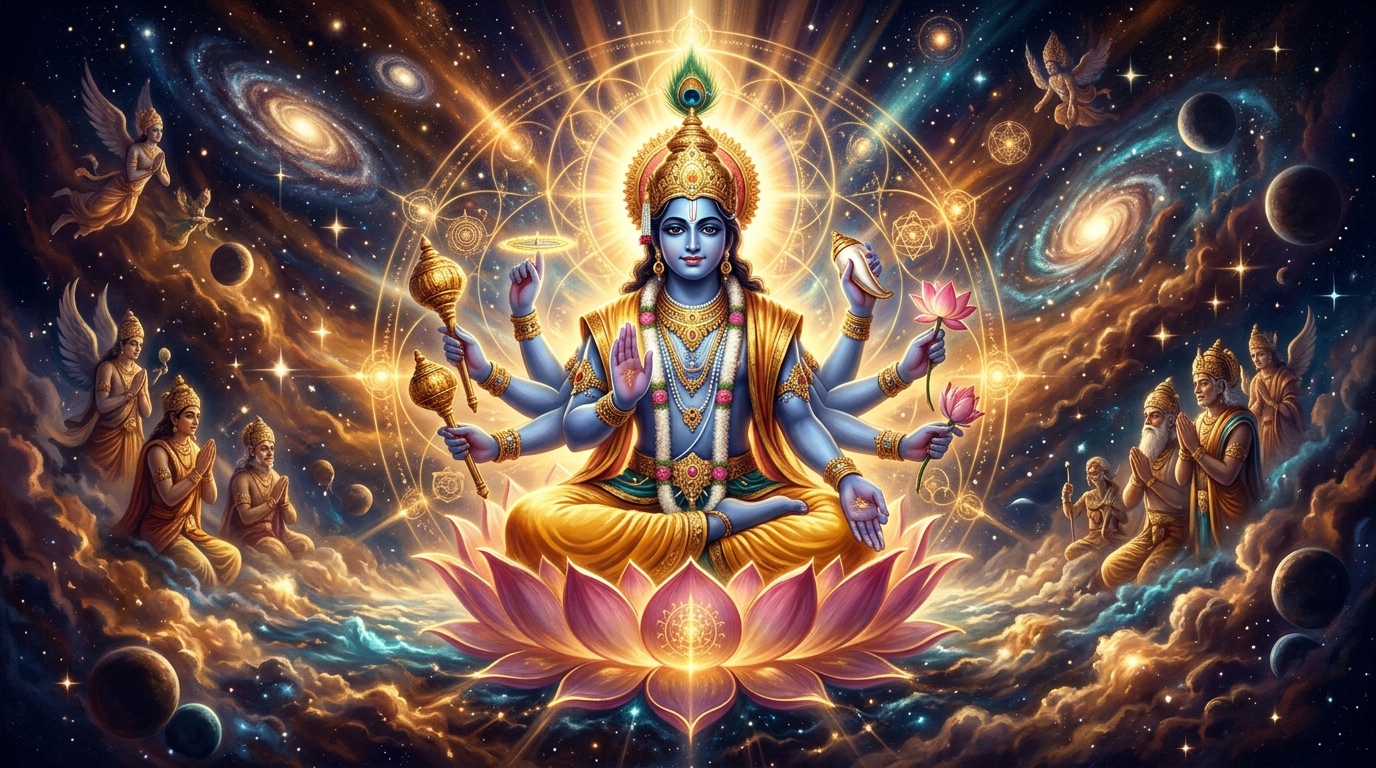

Welcome to Vibes of Divinity. Bhagavad Gita Chapter 11 (Vishwaroopa Darshana Yoga) contains one of the most dramatic, unforgettable moments in world literature: moving beyond words, Lord Krishna grants Arjuna divine sight (Divya Chakshu) to behold the entire universe simultaneously inside His infinite Cosmic Form.
- Chapter Name: विश्वरूपदर्शनयोग (Vishwaroopa Darshana Yoga)
- Section: Section 2: Divine Knowledge & Devotion (Chapters 7–12)
- Complete Text Included: All 55 Sanskrit shlokas with IAST transliteration & English translation
- Series Index: Bhagavad Gita Complete Guide (All 18 Chapters & 701 Shlokas)
Chapter 11 Summary & Context on Kurukshetra
Deeply moved by Krishna’s teachings, Arjuna humbly asks to see the Lord’s Universal Form. Since ordinary human eyes cannot comprehend infinity, Krishna bestows celestial vision upon Arjuna.
Suddenly, Arjuna sees countless faces, arms, galaxies, deities, and universes shining with the brilliance of a thousand suns rising together. He witnesses past, present, and future converging inside the Divine—including the warriors of both armies rushing toward destiny like moths toward flame.
Overwhelmed by awe and trembling reverence, Arjuna bows repeatedly and asks Krishna to return to His gentle four-armed and two-armed human form. Krishna comforts His friend, reminding him that this cosmic vision is rarely seen even by gods or ascetics—only pure, single-hearted devotion unlocks it.
Highlighted Shlokas & Spiritual Reflections (Chapter 11)
Shloka 11.12 — Brilliance of a Thousand Suns
दिवि सूर्यसहस्रस्य भवेद्युगपदुत्थिता । यदि भाः सदृशी सा स्याद्भासस्तस्य महात्मनः ॥
Divi sūrya-sahasrasya bhaved yugapad utthitā | Yadi bhāḥ sadṛśī sā syād bhāsas tasya mahātmanaḥ ||
Meaning: If the radiance of a thousand suns were to burst forth at once in the sky, that might vaguely resemble the splendor of that Mighty Cosmic Form.
Human language reaches its limit when describing the Infinite—Arjuna’s vision humbles every petty human ego.
Shloka 11.33 — Become an Instrument of Dharma
तस्मात्त्वमुत्तिष्ठ यशो लभस्व जित्वा शत्रून्भुङ्क्ष्व राज्यं समृद्धम् । मयैवैते निहताः पूर्वमेव निमित्तमात्रं भव सव्यसाचिन् ॥
Tasmāt tvam uttiṣṭha yaśo labhasva jitvā śatrūn bhuṅkṣva rājyaṁ samṛddham | Mayaivaite nihatāḥ pūrvam eva nimitta-mātraṁ bhava savyasācin ||
Meaning: Therefore arise, attain glory, conquer your foes, and enjoy a righteous kingdom! These warriors stand already slain by Me; be merely My instrument, O ambidextrous Arjuna.
Seeing the bigger cosmic picture frees us from paralyzing ego: do your duty courageously as a humble instrument of Dharma.
Shloka 11.55 — Pure Devotion Reaches the Supreme
मत्कर्मकृन्मत्परमो मद्भक्तः सङ्गवर्जितः । निर्वैरः सर्वभूतेषु यः स मामेति पाण्डव ॥
Mat-karma-kṛn mat-paramo mad-bhaktaḥ saṅga-varjitaḥ | Nirvairaḥ sarva-bhūteṣu yaḥ sa mām eti pāṇḍava ||
Meaning: One who works for Me, holds Me as the supreme goal, is devoted to Me, free from selfish attachment, and bears no hatred toward any being—comes unto Me, O Pandava.
After the cosmic spectacle ends, Krishna leaves us with a crystal-clear daily standard: devotion paired with zero hatred toward any creature.
Complete Verse-by-Verse Bhagavad Gita Chapter 11 (All 55 Shlokas)
Read all 55 original Sanskrit verses of Chapter 11 below with Roman IAST transliteration and clear English meaning:
Verse 11.1
अर्जुन उवाच |
मदनुग्रहाय परमं गुह्यमध्यात्मसंज्ञितम् |
यत्त्वयोक्तं वचस्तेन मोहोऽयं विगतो मम ||११-१||
arjuna uvāca .
madanugrahāya paramaṃ guhyamadhyātmasaṃjñitam .
yattvayoktaṃ vacastena moho.ayaṃ vigato mama ||11-1||
Meaning: Arjuna said: My Lord! Thy words concerning the Supreme Secret of Self, given for my blessing, have dispelled the illusions which surrounded me.
Verse 11.2
भवाप्ययौ हि भूतानां श्रुतौ विस्तरशो मया |
त्वत्तः कमलपत्राक्ष माहात्म्यमपि चाव्ययम् ||११-२||
bhavāpyayau hi bhūtānāṃ śrutau vistaraśo mayā .
tvattaḥ kamalapatrākṣa māhātmyamapi cāvyayam ||11-2||
Meaning: O Lord, whose eyes are like the lotus petal! Thou hast described in detail the origin and the dissolution of being, and Thine own Eternal Majesty.
Verse 11.3
एवमेतद्यथात्थ त्वमात्मानं परमेश्वर |
द्रष्टुमिच्छामि ते रूपमैश्वरं पुरुषोत्तम ||११-३||
evametadyathāttha tvamātmānaṃ parameśvara .
draṣṭumicchāmi te rūpamaiśvaraṃ puruṣottama ||11-3||
Meaning: I believe all as Thou hast declared it. I long now to have a vision of thy Divine Form, O Thou Most High!
Verse 11.4
मन्यसे यदि तच्छक्यं मया द्रष्टुमिति प्रभो |
योगेश्वर ततो मे त्वं दर्शयात्मानमव्ययम् ||११-४||
manyase yadi tacchakyaṃ mayā draṣṭumiti prabho .
yogeśvara tato me tvaṃ darśayātmānamavyayam ||11-4||
Meaning: If Thou thinkest that it can be made possible for me to see it, show me, O Lord of Lords, Thine own Eternal Self.
Verse 11.5
श्रीभगवानुवाच |
पश्य मे पार्थ रूपाणि शतशोऽथ सहस्रशः |
नानाविधानि दिव्यानि नानावर्णाकृतीनि च ||११-५||
śrībhagavānuvāca .
paśya me pārtha rūpāṇi śataśo.atha sahasraśaḥ .
nānāvidhāni divyāni nānāvarṇākṛtīni ca ||11-5||
Meaning: Lord Shri Krishna replied: Behold, O Arjuna! My celestial forms, by hundred and thousands, various in kind, in colour and in shape.
Verse 11.6
पश्यादित्यान्वसून्रुद्रानश्विनौ मरुतस्तथा |
बहून्यदृष्टपूर्वाणि पश्याश्चर्याणि भारत ||११-६||
paśyādityānvasūnrudrānaśvinau marutastathā .
bahūnyadṛṣṭapūrvāṇi paśyāścaryāṇi bhārata ||11-6||
Meaning: Behold thou the Powers of Nature: fire, earth, wind and sky; the sun, the heavens, the moon, the stars; all forces of vitality and of healing; and the roving winds. See the myriad wonders revealed to none but thee.
Verse 11.7
इहैकस्थं जगत्कृत्स्नं पश्याद्य सचराचरम् |
मम देहे गुडाकेश यच्चान्यद् द्रष्टुमिच्छसि ||११-७||
ihaikasthaṃ jagatkṛtsnaṃ paśyādya sacarācaram .
mama dehe guḍākeśa yaccānyad draṣṭumicchasi ||11-7||
Meaning: Here in Me living as one, O Arjuna, behold the whole universe, movable and immovable, and anything else that thou wouldst see!
Verse 11.8
न तु मां शक्यसे द्रष्टुमनेनैव स्वचक्षुषा |
दिव्यं ददामि ते चक्षुः पश्य मे योगमैश्वरम् ||११-८||
na tu māṃ śakyase draṣṭumanenaiva svacakṣuṣā .
divyaṃ dadāmi te cakṣuḥ paśya me yogamaiśvaram ||11-8||
Meaning: Yet since with mortal eyes thou canst not see Me, lo! I give thee the Divine Sight. See now the glory of My Sovereignty.
Verse 11.9
सञ्जय उवाच |
एवमुक्त्वा ततो राजन्महायोगेश्वरो हरिः |
दर्शयामास पार्थाय परमं रूपमैश्वरम् ||११-९||
sañjaya uvāca .
evamuktvā tato rājanmahāyogeśvaro hariḥ .
darśayāmāsa pārthāya paramaṃ rūpamaiśvaram ||11-9||
Meaning: Sanjaya continued: Having thus spoken, O King, the Lord Shri Krishna, the Almighty Prince of Wisdom, showed to Arjuna the Supreme Form of the Great God.
Verse 11.10
अनेकवक्त्रनयनमनेकाद्भुतदर्शनम् |
अनेकदिव्याभरणं दिव्यानेकोद्यतायुधम् ||११-१०||
anekavaktranayanamanekādbhutadarśanam .
anekadivyābharaṇaṃ divyānekodyatāyudham ||11-10||
Meaning: There were countless eyes and mouths, and mystic forms innumerable, with shining ornaments and flaming celestial weapons.
Verse 11.11
दिव्यमाल्याम्बरधरं दिव्यगन्धानुलेपनम् |
सर्वाश्चर्यमयं देवमनन्तं विश्वतोमुखम् ||११-११||
divyamālyāmbaradharaṃ divyagandhānulepanam .
sarvāścaryamayaṃ devamanantaṃ viśvatomukham ||11-11||
Meaning: Crowned with heavenly garlands, clothed in shining garments, anointed with divine unctions, He showed Himself as the Resplendent One, Marvellous, Boundless, Omnipresent.
Verse 11.12
दिवि सूर्यसहस्रस्य भवेद्युगपदुत्थिता |
यदि भाः सदृशी सा स्याद्भासस्तस्य महात्मनः ||११-१२||
divi sūryasahasrasya bhavedyugapadutthitā .
yadi bhāḥ sadṛśī sā syādbhāsastasya mahātmanaḥ ||11-12||
Meaning: Could a thousand suns blaze forth together it would be but a faint reflection of the radiance of the Lord God.
Verse 11.13
तत्रैकस्थं जगत्कृत्स्नं प्रविभक्तमनेकधा |
अपश्यद्देवदेवस्य शरीरे पाण्डवस्तदा ||११-१३||
tatraikasthaṃ jagatkṛtsnaṃ pravibhaktamanekadhā .
apaśyaddevadevasya śarīre pāṇḍavastadā ||11-13||
Meaning: In that vision Arjuna saw the universe, with its manifold shapes, all embraced in One, its Supreme Lord.
Verse 11.14
ततः स विस्मयाविष्टो हृष्टरोमा धनञ्जयः |
प्रणम्य शिरसा देवं कृताञ्जलिरभाषत ||११-१४||
tataḥ sa vismayāviṣṭo hṛṣṭaromā dhanañjayaḥ .
praṇamya śirasā devaṃ kṛtāñjalirabhāṣata ||11-14||
Meaning: Thereupon Arjuna, dumb with awe, his hair on end, his head bowed, his hands clasped in salutation, addressed the Lord thus:
Verse 11.15
अर्जुन उवाच |
पश्यामि देवांस्तव देव देहे
सर्वांस्तथा भूतविशेषसङ्घान् |
ब्रह्माणमीशं कमलासनस्थ-
मृषींश्च सर्वानुरगांश्च दिव्यान् ||११-१५||
arjuna uvāca .
paśyāmi devāṃstava deva dehe sarvāṃstathā bhūtaviśeṣasaṅghān .
brahmāṇamīśaṃ kamalāsanasthaṃ ṛṣīṃśca sarvānuragāṃśca divyān ||11-15||
Meaning: Arjuna said: O almighty God! I see in Thee the powers of Nature, the various creatures of the world, the Progenitor on his lotus throne, the Sages and the shining angels.
Verse 11.16
अनेकबाहूदरवक्त्रनेत्रं
पश्यामि त्वां सर्वतोऽनन्तरूपम् |
नान्तं न मध्यं न पुनस्तवादिं
पश्यामि विश्वेश्वर विश्वरूप ||११-१६||
anekabāhūdaravaktranetraṃ paśyāmi tvāṃ sarvato.anantarūpam .
nāntaṃ na madhyaṃ na punastavādiṃ paśyāmi viśveśvara viśvarūpa ||11-16||
Meaning: I see Thee, infinite in form, with, as it were, faces, eyes and limbs everywhere; no beginning, no middle, no end; O Thou Lord of the Universe, Whose Form is universal!
Verse 11.17
किरीटिनं गदिनं चक्रिणं च
तेजोराशिं सर्वतो दीप्तिमन्तम् |
पश्यामि त्वां दुर्निरीक्ष्यं समन्ताद्
दीप्तानलार्कद्युतिमप्रमेयम् ||११-१७||
kirīṭinaṃ gadinaṃ cakriṇaṃ ca tejorāśiṃ sarvato dīptimantam .
paśyāmi tvāṃ durnirīkṣyaṃ samantād dīptānalārkadyutimaprameyam ||11-17||
Meaning: I see thee with the crown, the sceptre and the discus; a blaze of splendour. Scarce can I gaze on thee, so radiant thou art, glowing like the blazing fire, brilliant as the sun, immeasurable.
Verse 11.18
त्वमक्षरं परमं वेदितव्यं
त्वमस्य विश्वस्य परं निधानम् |
त्वमव्ययः शाश्वतधर्मगोप्ता
सनातनस्त्वं पुरुषो मतो मे ||११-१८||
tvamakṣaraṃ paramaṃ veditavyaṃ tvamasya viśvasya paraṃ nidhānam .
tvamavyayaḥ śāśvatadharmagoptā sanātanastvaṃ puruṣo mato me ||11-18||
Meaning: Imperishable art Thou, the Sole One worthy to be known, the priceless Treasure-house of the universe, the immortal Guardian of the Life Eternal, the Spirit Everlasting.
Verse 11.19
अनादिमध्यान्तमनन्तवीर्य-
मनन्तबाहुं शशिसूर्यनेत्रम् |
पश्यामि त्वां दीप्तहुताशवक्त्रं
स्वतेजसा विश्वमिदं तपन्तम् ||११-१९||
anādimadhyāntamanantavīryam anantabāhuṃ śaśisūryanetram .
paśyāmi tvāṃ dīptahutāśavaktraṃ svatejasā viśvamidaṃ tapantam ||11-19||
Meaning: Without beginning, without middle and without end, infinite in power, Thine arms all-embracing, the sun and moon Thine eyes, Thy face beaming with the fire of sacrifice, flooding the whole universe with light.
Verse 11.20
द्यावापृथिव्योरिदमन्तरं हि
व्याप्तं त्वयैकेन दिशश्च सर्वाः |
दृष्ट्वाद्भुतं रूपमुग्रं तवेदं
लोकत्रयं प्रव्यथितं महात्मन् ||११-२०||
dyāvāpṛthivyoridamantaraṃ hi vyāptaṃ tvayaikena diśaśca sarvāḥ .
dṛṣṭvādbhutaṃ rūpamugraṃ tavedaṃ lokatrayaṃ pravyathitaṃ mahātman ||11-20||
Meaning: Alone thou fillest all the quarters of the sky, earth and heaven, and the regions between. O Almighty Lord! Seeing Thy marvellous and awe-inspiring Form, the spheres tremble with fear.
Verse 11.21
अमी हि त्वां सुरसङ्घा विशन्ति
केचिद्भीताः प्राञ्जलयो गृणन्ति |
स्वस्तीत्युक्त्वा महर्षिसिद्धसङ्घाः
स्तुवन्ति त्वां स्तुतिभिः पुष्कलाभिः ||११-२१||
amī hi tvāṃ surasaṅghā viśanti kecidbhītāḥ prāñjalayo gṛṇanti .
svastītyuktvā maharṣisiddhasaṅghāḥ stuvanti tvāṃ stutibhiḥ puṣkalābhiḥ ||11-21||
Meaning: The troops of celestial beings enter into Thee, some invoking Thee in fear, with folded palms; the Great Seers and Adepts sing hymns to Thy Glory, saying All Hail.'
Verse 11.22
रुद्रादित्या वसवो ये च साध्या
विश्वेऽश्विनौ मरुतश्चोष्मपाश्च |
गन्धर्वयक्षासुरसिद्धसङ्घा
वीक्षन्ते त्वां विस्मिताश्चैव सर्वे ||११-२२||
rudrādityā vasavo ye ca sādhyā viśve.aśvinau marutaścoṣmapāśca .
gandharvayakṣāsurasiddhasaṅghā vīkṣante tvāṃ vismitāścaiva sarve ||11-22||
Meaning: The Vital Forces, the Major stars, Fire, Earth, Air, Sky, Sun, Heaven, Moon and Planets; the Angels, the Guardians of the Universe, the divine Healers, the Winds, the Fathers, the Heavenly Singers; and hosts of Mammon-worshippers, demons as well as saints, are amazed.
Verse 11.23
रूपं महत्ते बहुवक्त्रनेत्रं
महाबाहो बहुबाहूरुपादम् |
बहूदरं बहुदंष्ट्राकरालं
दृष्ट्वा लोकाः प्रव्यथितास्तथाहम् ||११-२३||
rūpaṃ mahatte bahuvaktranetraṃ mahābāho bahubāhūrupādam .
bahūdaraṃ bahudaṃṣṭrākarālaṃ dṛṣṭvā lokāḥ pravyathitāstathāham ||11-23||
Meaning: Seeing Thy stupendous Form, O Most Mighty, with its myriad faces, its innumerable eyes and limbs and terrible jaws, I myself and all the worlds are overwhelmed with awe.
Verse 11.24
नभःस्पृशं दीप्तमनेकवर्णं
व्यात्ताननं दीप्तविशालनेत्रम् |
दृष्ट्वा हि त्वां प्रव्यथितान्तरात्मा
धृतिं न विन्दामि शमं च विष्णो ||११-२४||
nabhaḥspṛśaṃ dīptamanekavarṇaṃ vyāttānanaṃ dīptaviśālanetram .
dṛṣṭvā hi tvāṃ pravyathitāntarātmā dhṛtiṃ na vindāmi śamaṃ ca viṣṇo ||11-24||
Meaning: When I see Thee, touching the Heavens, glowing with colour, with open mouth and wide open fiery eyes, I am terrified. O My Lord! My courage and peace of mind desert me.
Verse 11.25
दंष्ट्राकरालानि च ते मुखानि
दृष्ट्वैव कालानलसन्निभानि |
दिशो न जाने न लभे च शर्म
प्रसीद देवेश जगन्निवास ||११-२५||
daṃṣṭrākarālāni ca te mukhāni dṛṣṭvaiva kālānalasannibhāni .
diśo na jāne na labhe ca śarma prasīda deveśa jagannivāsa ||11-25||
Meaning: When I see Thy mouths with their fearful jaws like glowing fires at the dissolution of creation, I lose all sense of place; I find no rest. Be merciful, O Lord in whom this universe abides!
Verse 11.26
अमी च त्वां धृतराष्ट्रस्य पुत्राः
सर्वे सहैवावनिपालसङ्घैः |
भीष्मो द्रोणः सूतपुत्रस्तथासौ
सहास्मदीयैरपि योधमुख्यैः ||११-२६||
amī ca tvāṃ dhṛtarāṣṭrasya putrāḥ sarve sahaivāvanipālasaṅghaiḥ .
bhīṣmo droṇaḥ sūtaputrastathāsau sahāsmadīyairapi yodhamukhyaiḥ ||11-26||
Meaning: All these sons of Dhritarashtra, with the hosts of princes, Bheeshma, Drona and Karna, as well as the other warrior chiefs belonging to our side;
Verse 11.27
वक्त्राणि ते त्वरमाणा विशन्ति
दंष्ट्राकरालानि भयानकानि |
केचिद्विलग्ना दशनान्तरेषु
सन्दृश्यन्ते चूर्णितैरुत्तमाङ्गैः ||११-२७||
vaktrāṇi te tvaramāṇā viśanti daṃṣṭrākarālāni bhayānakāni .
kecidvilagnā daśanāntareṣu sandṛśyante cūrṇitairuttamāṅgaiḥ ||11-27||
Meaning: 1 see them all rushing headlong into Thy mouths, with terrible tusks, horrible to behold. Some are mangled between thy jaws, with their heads crushed to atoms.
Verse 11.28
यथा नदीनां बहवोऽम्बुवेगाः
समुद्रमेवाभिमुखा द्रवन्ति |
तथा तवामी नरलोकवीरा
विशन्ति वक्त्राण्यभिविज्वलन्ति ||११-२८||
yathā nadīnāṃ bahavo.ambuvegāḥ samudramevābhimukhā dravanti .
tathā tavāmī naralokavīrā viśanti vaktrāṇyabhivijvalanti ||11-28||
Meaning: As rivers in flood surge furiously to the ocean, so these heroes, the greatest among men, fling themselves into Thy flaming mouths.
Verse 11.29
यथा प्रदीप्तं ज्वलनं पतङ्गा
विशन्ति नाशाय समृद्धवेगाः |
तथैव नाशाय विशन्ति लोकास्-
तवापि वक्त्राणि समृद्धवेगाः ||११-२९||
yathā pradīptaṃ jvalanaṃ pataṅgā viśanti nāśāya samṛddhavegāḥ .
tathaiva nāśāya viśanti lokāsa- tavāpi vaktrāṇi samṛddhavegāḥ ||11-29||
Meaning: As moths fly impetuously to the flame only to be killed, so these men rush into Thy mouths to court their own destruction.
Verse 11.30
लेलिह्यसे ग्रसमानः समन्ताल्-
लोकान्समग्रान्वदनैर्ज्वलद्भिः |
तेजोभिरापूर्य जगत्समग्रं
भासस्तवोग्राः प्रतपन्ति विष्णो ||११-३०||
lelihyase grasamānaḥ samantāl- lokānsamagrānvadanairjvaladbhiḥ .
tejobhirāpūrya jagatsamagraṃ bhāsastavogrāḥ pratapanti viṣṇo ||11-30||
Meaning: Thou seemest to swallow up the worlds, to lap them in flame. Thy glory fills the universe. Thy fierce rays beat down upon it irresistibly.
Verse 11.31
आख्याहि मे को भवानुग्ररूपो
नमोऽस्तु ते देववर प्रसीद |
विज्ञातुमिच्छामि भवन्तमाद्यं
न हि प्रजानामि तव प्रवृत्तिम् ||११-३१||
ākhyāhi me ko bhavānugrarūpo namo.astu te devavara prasīda .
vijñātumicchāmi bhavantamādyaṃ na hi prajānāmi tava pravṛttim ||11-31||
Meaning: Tell me then who Thou art, that wearest this dreadful Form? I bow before Thee, O Mighty One! Have mercy, I pray, and let me see Thee as Thou wert at first. I do not know what Thou intendest.
Verse 11.32
श्रीभगवानुवाच |
कालोऽस्मि लोकक्षयकृत्प्रवृद्धो
लोकान्समाहर्तुमिह प्रवृत्तः |
ऋतेऽपि त्वां न भविष्यन्ति सर्वे
येऽवस्थिताः प्रत्यनीकेषु योधाः ||११-३२||
śrībhagavānuvāca .
kālo.asmi lokakṣayakṛtpravṛddho lokānsamāhartumiha pravṛttaḥ .
ṛte.api tvāṃ na bhaviṣyanti sarve ye.avasthitāḥ pratyanīkeṣu yodhāḥ ||11-32||
Meaning: Lord Shri Krishna replied: I have shown myself to thee as the Destroyer who lays waste the world and whose purpose is destruction. In spite of thy efforts, all these warriors gathered for battle shall not escape death.
Verse 11.33
तस्मात्त्वमुत्तिष्ठ यशो लभस्व
जित्वा शत्रून् भुङ्क्ष्व राज्यं समृद्धम् |
मयैवैते निहताः पूर्वमेव
निमित्तमात्रं भव सव्यसाचिन् ||११-३३||
tasmāttvamuttiṣṭha yaśo labhasva jitvā śatrūn bhuṅkṣva rājyaṃ samṛddham .
mayaivaite nihatāḥ pūrvameva nimittamātraṃ bhava savyasācin ||11-33||
Meaning: Then gird up thy loins and conquer. Subdue thy foes and enjoy the kingdom in prosperity. I have already doomed them. Be thou my instrument, Arjuna!
Verse 11.34
द्रोणं च भीष्मं च जयद्रथं च
कर्णं तथान्यानपि योधवीरान् |
मया हतांस्त्वं जहि मा व्यथिष्ठा
युध्यस्व जेतासि रणे सपत्नान् ||११-३४||
droṇaṃ ca bhīṣmaṃ ca jayadrathaṃ ca karṇaṃ tathānyānapi yodhavīrān .
mayā hatāṃstvaṃ jahi mavyathiṣṭhā yudhyasva jetāsi raṇe sapatnān ||11-34||
Meaning: Drona and Bheeshma, Jayadratha and Karna, and other brave warriors – I have condemned them all. Destroy them; fight and fear not. Thy foes shall be crushed.
Verse 11.35
सञ्जय उवाच |
एतच्छ्रुत्वा वचनं केशवस्य
कृताञ्जलिर्वेपमानः किरीटी |
नमस्कृत्वा भूय एवाह कृष्णं
सगद्गदं भीतभीतः प्रणम्य ||११-३५||
sañjaya uvāca .
etacchrutvā vacanaṃ keśavasya kṛtāñjalirvepamānaḥ kirīṭī .
namaskṛtvā bhūya evāha kṛṣṇaṃ sagadgadaṃ bhītabhītaḥ praṇamya ||11-35||
Meaning: Sanjaya continued: Having heard these words from the Lord Shri Krishna, the Prince Arjuna, with folded hands trembling, prostrated himself and with choking voice, bowing down again and again, and overwhelmed with awe, once more addressed the Lord.
Verse 11.36
अर्जुन उवाच |
स्थाने हृषीकेश तव प्रकीर्त्या
जगत्प्रहृष्यत्यनुरज्यते च |
रक्षांसि भीतानि दिशो द्रवन्ति
सर्वे नमस्यन्ति च सिद्धसङ्घाः ||११-३६||
arjuna uvāca .
sthāne hṛṣīkeśa tava prakīrtyā jagatprahṛṣyatyanurajyate ca .
rakṣāṃsi bhītāni diśo dravanti sarve namasyanti ca siddhasaṅghāḥ ||11-36||
Meaning: Arjuna said: My Lord! It is natural that the world revels and rejoices when it sings the praises of Thy glory; the demons fly in fear and the saints offer Thee their salutations.
Verse 11.37
कस्माच्च ते न नमेरन्महात्मन्
गरीयसे ब्रह्मणोऽप्यादिकर्त्रे |
अनन्त देवेश जगन्निवास
त्वमक्षरं सदसत्तत्परं यत् ||११-३७||
kasmācca te na nameranmahātman garīyase brahmaṇo.apyādikartre .
ananta deveśa jagannivāsa tvamakṣaraṃ sadasattatparaṃ yat ||11-37||
Meaning: How should they do otherwise? O Thou Supremest Self, greater than the Powers of creation, the First Cause, Infinite, the Lord of Lords, the Home of the universe, Imperishable, Being and Not-Being, yet transcending both.
Verse 11.38
त्वमादिदेवः पुरुषः पुराणस्-
त्वमस्य विश्वस्य परं निधानम् |
वेत्तासि वेद्यं च परं च धाम
त्वया ततं विश्वमनन्तरूप ||११-३८||
tvamādidevaḥ puruṣaḥ purāṇasa- tvamasya viśvasya paraṃ nidhānam .
vettāsi vedyaṃ ca paraṃ ca dhāma tvayā tataṃ viśvamanantarūpa ||11-38||
Meaning: Thou art the Primal God, the Ancient, the Supreme Abode of this universe, the Knower, the Knowledge and the Final Home. Thou fillest everything. Thy form is infinite.
Verse 11.39
वायुर्यमोऽग्निर्वरुणः शशाङ्कः
प्रजापतिस्त्वं प्रपितामहश्च |
नमो नमस्तेऽस्तु सहस्रकृत्वः
पुनश्च भूयोऽपि नमो नमस्ते ||११-३९||
vāyuryamo.agnirvaruṇaḥ śaśāṅkaḥ prajāpatistvaṃ prapitāmahaśca .
namo namaste.astu sahasrakṛtvaḥ punaśca bhūyo.api namo namaste ||11-39||
Meaning: Thou art the Wind, Thou art Death, Thou art the Fire, the Water, the Moon, the Father and the Grandfather. Honour and glory to Thee a thousand and a thousand times! Again and again, salutation be to Thee, O my Lord!
Verse 11.40
नमः पुरस्तादथ पृष्ठतस्ते
नमोऽस्तु ते सर्वत एव सर्व |
अनन्तवीर्यामितविक्रमस्त्वं
सर्वं समाप्नोषि ततोऽसि सर्वः ||११-४०||
namaḥ purastādatha pṛṣṭhataste namo.astu te sarvata eva sarva .
anantavīryāmitavikramastvaṃ sarvaṃ samāpnoṣi tato.asi sarvaḥ ||11-40||
Meaning: Salutations to Thee in front and on every side, Thou who encompasseth me round about. Thy power is infinite; Thy majesty immeasurable; thou upholdest all things; yea,Thou Thyself art All.
Verse 11.41
सखेति मत्वा प्रसभं यदुक्तं
हे कृष्ण हे यादव हे सखेति |
अजानता महिमानं तवेदं
मया प्रमादात्प्रणयेन वापि ||११-४१||
sakheti matvā prasabhaṃ yaduktaṃ he kṛṣṇa he yādava he sakheti .
ajānatā mahimānaṃ tavedaṃ mayā pramādātpraṇayena vāpi ||11-41||
Meaning: Whatever I have said unto Thee in rashness, taking Thee only for a friend and addressing Thee as O Krishna! O Yadava! O Friend!' in thoughtless familiarity, no understanding Thy greatness;
Verse 11.42
यच्चावहासार्थमसत्कृतोऽसि
विहारशय्यासनभोजनेषु |
एकोऽथवाप्यच्युत तत्समक्षं
तत्क्षामये त्वामहमप्रमेयम् ||११-४२||
yaccāvahāsārthamasatkṛto.asi vihāraśayyāsanabhojaneṣu .
eko.athavāpyacyuta tatsamakṣaṃ tatkṣāmaye tvāmahamaprameyam ||11-42||
Meaning: Whatever insult I have offered to Thee in jest, in sport or in repose, in conversation or at the banquet, alone or in a multitude, I ask Thy forgiveness for them all, O Thou Who art without an equal!
Verse 11.43
पितासि लोकस्य चराचरस्य
त्वमस्य पूज्यश्च गुरुर्गरीयान् |
न त्वत्समोऽस्त्यभ्यधिकः कुतोऽन्यो
लोकत्रयेऽप्यप्रतिमप्रभाव ||११-४३||
pitāsi lokasya carācarasya tvamasya pūjyaśca gururgarīyān .
na tvatsamo.astyabhyadhikaḥ kuto.anyo lokatraye.apyapratimaprabhāva ||11-43||
Meaning: For Thou art the Father of all things movable and immovable, the Worshipful, the Master of Masters! In all the worlds there is none equal to Thee, how then superior, O Thou who standeth alone, Supreme.
Verse 11.44
तस्मात्प्रणम्य प्रणिधाय कायं
प्रसादये त्वामहमीशमीड्यम् |
पितेव पुत्रस्य सखेव सख्युः
प्रियः प्रियायार्हसि देव सोढुम् ||११-४४||
tasmātpraṇamya praṇidhāya kāyaṃ prasādaye tvāmahamīśamīḍyam .
piteva putrasya sakheva sakhyuḥ priyaḥ priyāyārhasi deva soḍhum ||11-44||
Meaning: Therefore I prostrate myself before Thee, O Lord! Most Adorable! I salute Thee, I ask Thy blessing. Only Thou canst be trusted to bear with me, as father to son, as friend to friend, as lover to his beloved.
Verse 11.45
अदृष्टपूर्वं हृषितोऽस्मि दृष्ट्वा
भयेन च प्रव्यथितं मनो मे |
तदेव मे दर्शय देव रूपं
प्रसीद देवेश जगन्निवास ||११-४५||
adṛṣṭapūrvaṃ hṛṣito.asmi dṛṣṭvā bhayena ca pravyathitaṃ mano me .
tadeva me darśaya deva rūpaṃ prasīda deveśa jagannivāsa ||11-45||
Meaning: I rejoice that I have seen what never man saw before; yet, O Lord! I am overwhelmed with fear. Please take again the Form I know. Be merciful, O Lord! thou Who are the Home of the whole universe.
Verse 11.46
किरीटिनं गदिनं चक्रहस्तं
इच्छामि त्वां द्रष्टुमहं तथैव |
तेनैव रूपेण चतुर्भुजेन
सहस्रबाहो भव विश्वमूर्ते ||११-४६||
kirīṭinaṃ gadinaṃ cakrahastaṃ icchāmi tvāṃ draṣṭumahaṃ tathaiva .
tenaiva rūpeṇa caturbhujena sahasrabāho bhava viśvamūrte ||11-46||
Meaning: I long to see Thee as thou wert before, with the crown, the sceptre and the discus in Thy hands; in Thy other Form, with Thy four hands, O Thou Whose arms are countless and Whose forms are infinite.
Verse 11.47
श्रीभगवानुवाच |
मया प्रसन्नेन तवार्जुनेदं
रूपं परं दर्शितमात्मयोगात् |
तेजोमयं विश्वमनन्तमाद्यं
यन्मे त्वदन्येन न दृष्टपूर्वम् ||११-४७||
śrībhagavānuvāca .
mayā prasannena tavārjunedaṃ rūpaṃ paraṃ darśitamātmayogāt .
tejomayaṃ viśvamanantamādyaṃ yanme tvadanyena na dṛṣṭapūrvam ||11-47||
Meaning: Lord Shri Krishna replied: My beloved friend! It is only through My grace and power that thou hast been able to see this vision of splendour, the Universal, the Infinite, the Original. Never has it been seen by any but thee.
Verse 11.48
न वेदयज्ञाध्ययनैर्न दानैर्-
न च क्रियाभिर्न तपोभिरुग्रैः |
एवंरूपः शक्य अहं नृलोके
द्रष्टुं त्वदन्येन कुरुप्रवीर ||११-४८||
na vedayajñādhyayanairna dānaira- na ca kriyābhirna tapobhirugraiḥ .
evaṃrūpaḥ śakya ahaṃ nṛloke draṣṭuṃ tvadanyena kurupravīra ||11-48||
Meaning: Not by study of the scriptures, not by sacrifice or gift, not by ritual or rigorous austerity, is it possible for man on earth to see what thou hast seen, O thou foremost hero of the Kuru-clan!
Verse 11.49
मा ते व्यथा मा च विमूढभावो
दृष्ट्वा रूपं घोरमीदृङ्ममेदम् |
व्यपेतभीः प्रीतमनाः पुनस्त्वं
तदेव मे रूपमिदं प्रपश्य ||११-४९||
mā te vyathā mā ca vimūḍhabhāvo dṛṣṭvā rūpaṃ ghoramīdṛṅmamedam .
vyapetabhīḥ prītamanāḥ punastvaṃ tadeva me rūpamidaṃ prapaśya ||11-49||
Meaning: Be not afraid or bewildered by the terrible vision. Put away thy fear and, with joyful mind, see Me once again in My usual Form.
Verse 11.50
सञ्जय उवाच |
इत्यर्जुनं वासुदेवस्तथोक्त्वा
स्वकं रूपं दर्शयामास भूयः |
आश्वासयामास च भीतमेनं
भूत्वा पुनः सौम्यवपुर्महात्मा ||११-५०||
sañjaya uvāca .
ityarjunaṃ vāsudevastathoktvā svakaṃ rūpaṃ darśayāmāsa bhūyaḥ .
āśvāsayāmāsa ca bhītamenaṃ bhūtvā punaḥ saumyavapurmahātmā ||11-50||
Meaning: Sanjaya continued: Having thus spoken to Arjuna, Lord Shri Krishna showed Himself again in His accustomed form; and the Mighty Lord, in gentle tones, softly consoled him who lately trembled with fear.
Verse 11.51
अर्जुन उवाच |
दृष्ट्वेदं मानुषं रूपं तव सौम्यं जनार्दन |
इदानीमस्मि संवृत्तः सचेताः प्रकृतिं गतः ||११-५१||
arjuna uvāca .
dṛṣṭvedaṃ mānuṣaṃ rūpaṃ tava saumyaṃ janārdana .
idānīmasmi saṃvṛttaḥ sacetāḥ prakṛtiṃ gataḥ ||11-51||
Meaning: Arjuna said: Seeing Thee in Thy gentle human form, my Lord, I am myself again, calm once more.
Verse 11.52
श्रीभगवानुवाच |
सुदुर्दर्शमिदं रूपं दृष्टवानसि यन्मम |
देवा अप्यस्य रूपस्य नित्यं दर्शनकाङ्क्षिणः ||११-५२||
śrībhagavānuvāca .
sudurdarśamidaṃ rūpaṃ dṛṣṭavānasi yanmama .
devā apyasya rūpasya nityaṃ darśanakāṅkṣiṇaḥ ||11-52||
Meaning: Lord Shri Krishna replied: It is hard to see this vision of Me that thou hast seen. Even the most powerful have longed for it in vain.
Verse 11.53
नाहं वेदैर्न तपसा न दानेन न चेज्यया |
शक्य एवंविधो द्रष्टुं दृष्टवानसि मां यथा ||११-५३||
nāhaṃ vedairna tapasā na dānena na cejyayā .
śakya evaṃvidho draṣṭuṃ dṛṣṭavānasi māṃ yathā ||11-53||
Meaning: Not by study of the scriptures, or by austerities, not by gifts or sacrifices, is it possible to see Me as thou hast done.
Verse 11.54
भक्त्या त्वनन्यया शक्य अहमेवंविधोऽर्जुन |
ज्ञातुं द्रष्टुं च तत्त्वेन प्रवेष्टुं च परन्तप ||११-५४||
bhaktyā tvananyayā śakya ahamevaṃvidho.arjuna .
jñātuṃ draṣṭuṃ ca tattvena praveṣṭuṃ ca parantapa ||11-54||
Meaning: Only by tireless devotion can I be seen and known; only thus can a man become one with Me, O Arjuna!
Verse 11.55
मत्कर्मकृन्मत्परमो मद्भक्तः सङ्गवर्जितः |
निर्वैरः सर्वभूतेषु यः स मामेति पाण्डव ||११-५५||
matkarmakṛnmatparamo madbhaktaḥ saṅgavarjitaḥ .
nirvairaḥ sarvabhūteṣu yaḥ sa māmeti pāṇḍava ||11-55||
Meaning: He whose every action is done for My sake, to whom I am the final goal, who loves Me only and hates no one – O My dearest son, only he can realize Me!
Timeless Life Lessons for Modern Seekers
- Practice Nimitta-Bhava (Being an Instrument): Work diligently while trusting the Divine with outcomes beyond your control.
- Drop Ego & Boastfulness: Remembering the vastness of cosmic order keeps humility alive in success.
- Live Without Enmity (Nirvaira): Stand firmly for justice without harboring personal hatred or bitterness.
- Devotion Outshines Ritualism: As Krishna notes in 11.54, pure loving devotion reveals truths that study or penance alone cannot reach.
Frequently Asked Questions — Bhagavad Gita Chapter 11
Why did Krishna give Arjuna ‘Divya Chakshu’ in Chapter 11?
Ordinary physical eyes can only perceive limited matter; Divya Chakshu (divine vision) enabled Arjuna to witness timeless cosmic reality directly.
What does ‘Nimitta Matram Bhava’ (11.33) mean?
It means ‘become merely an instrument’—reminding us that while we must act with courage and skill, cosmic destiny unfolds under Divine will.
How many verses are in Gita Chapter 11?
Bhagavad Gita Chapter 11 contains 55 verses.
Continue Your Bhagavad Gita Journey
← Previous: Chapter 10 | All 18 Gita Chapters | Next: Chapter 12 →
To explore more Bhagavad Gita teachings, Puranic stories, and sacred chants and timeless wisdom from Hindu scriptures, visit and subscribe to our official Vibes of Divinity YouTube channel.
Which shloka from this chapter touches your heart most today? Share your reflection in the comments below.