
Welcome to Vibes of Divinity. Curiosity leads Arjuna to ask seven razor-sharp questions at the start of Bhagavad Gita Chapter 8 (Akshara Brahma Yoga): What is Brahman? What is the Self? What is karma? And most importantly, how can a seeker remember the Divine at the final moment of life?
- Chapter Name: अक्षरब्रह्मयोग (Akshara Brahma Yoga)
- Section: Section 2: Divine Knowledge & Devotion (Chapters 7–12)
- Complete Text Included: All 28 Sanskrit shlokas with IAST transliteration & English translation
- Series Index: Bhagavad Gita Complete Guide (All 18 Chapters & 701 Shlokas)
Chapter 8 Summary & Context on Kurukshetra
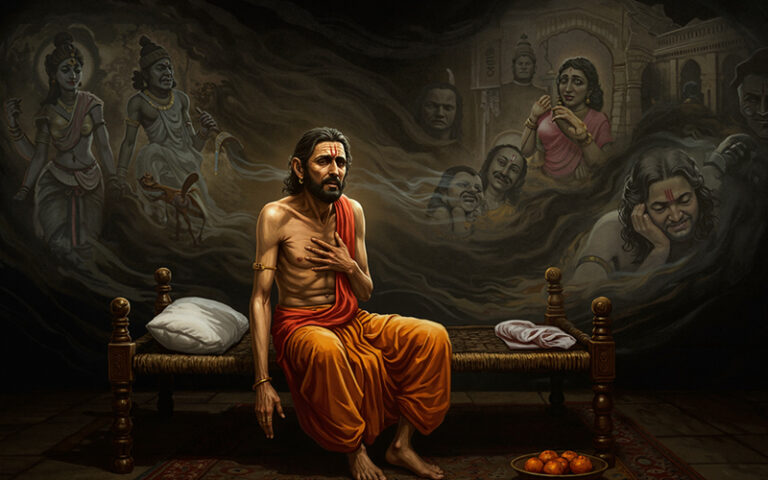
Lord Krishna answers every question concisely and then reveals a profound psychological law: whatever thought dominates a person’s consciousness at the moment of leaving the body shapes their next state of existence.
Because no one can suddenly manufacture pure awareness on their deathbed unless they have cultivated it daily, Krishna counsels Arjuna: ‘Remember Me at all times, and fight.’ Sacred remembrance is not meant to replace daily duty; it is meant to accompany it.
The chapter also explains the cosmic cycles of creation and dissolution (a single day and night of Brahma), the chanting of the imperishable syllable Om, and the two paths of departure—the path of light leading beyond rebirth, and the path of return.
Highlighted Shlokas & Spiritual Reflections (Chapter 8)
Shloka 8.5 — Remembering the Divine at the Final Hour
अन्तकाले च मामेव स्मरन्मुक्त्वा कलेवरम् । यः प्रयाति स मद्भावं याति नास्त्यत्र संशयः ॥
Anta-kāle ca mām eva smaran muktvā kalevaram | Yaḥ prayāti sa mad-bhāvaṁ yāti nāsty atra saṁśayaḥ ||
Meaning: Whoever at the time of death leaves the body while remembering Me alone attains My supreme state; of this there is no doubt.
What we consistently hold in our heart throughout life naturally rises to the surface in our final moments.
Shloka 8.6 — Consciousness Shapes Destiny
यं यं वापि स्मरन्भावं त्यजत्यन्ते कलेवरम् । तं तमेवैति कौन्तेय सदा तद्भावभावितः ॥
Yaṁ yaṁ vāpi smaran bhāvaṁ tyajaty ante kalevaram | Taṁ tam evaiti kaunteya sadā tad-bhāva-bhāvitaḥ ||
Meaning: Whatever state of being one remembers when quitting the body at the end, O son of Kunti, that very state one attains, being ever absorbed in its contemplation.
Every habit of thought we rehearse today quietly builds the consciousness we carry forward tomorrow.
Shloka 8.7 — Remember Me and Do Your Duty
तस्मात्सर्वेषु कालेषु मामनुस्मर युध्य च । मय्यर्पितमनोबुद्धिर्मामेवैष्यस्यसंशयम् ॥
Tasmāt sarveṣu kāleṣu mām anusmara yudhya ca | Mayy arpita-mano-buddhir mām evaiṣyasy asaṁśayam ||
Meaning: Therefore, remember Me at all times and fight. With your mind and intellect dedicated to Me, you shall surely come to Me.
Spiritual remembrance and courageous worldly action belong together—keep your heart anchored in the Divine while handling your duties.
Complete Verse-by-Verse Bhagavad Gita Chapter 8 (All 28 Shlokas)
Read all 28 original Sanskrit verses of Chapter 8 below with Roman IAST transliteration and clear English meaning:
Verse 8.1
अर्जुन उवाच |
किं तद् ब्रह्म किमध्यात्मं किं कर्म पुरुषोत्तम |
अधिभूतं च किं प्रोक्तमधिदैवं किमुच्यते ||८-१||
arjuna uvāca .
kiṃ tad brahma kimadhyātmaṃ kiṃ karma puruṣottama .
adhibhūtaṃ ca kiṃ proktamadhidaivaṃ kimucyate ||8-1||
Meaning: Shri Purohit Swami did not comment on this sloka
Verse 8.2
अधियज्ञः कथं कोऽत्र देहेऽस्मिन्मधुसूदन |
प्रयाणकाले च कथं ज्ञेयोऽसि नियतात्मभिः ||८-२||
adhiyajñaḥ kathaṃ ko.atra dehe.asminmadhusūdana .
prayāṇakāle ca kathaṃ jñeyo.asi niyatātmabhiḥ ||8-2||
Meaning: Who is it who rules the spirit sacrifice in many; and at the time of death how may those who have learned self-control come to the knowledge of Thee?
Verse 8.3
श्रीभगवानुवाच |
अक्षरं ब्रह्म परमं स्वभावोऽध्यात्ममुच्यते |
भूतभावोद्भवकरो विसर्गः कर्मसंज्ञितः ||८-३||
śrībhagavānuvāca .
akṣaraṃ brahma paramaṃ svabhāvo.adhyātmamucyate .
bhūtabhāvodbhavakaro visargaḥ karmasaṃjñitaḥ ||8-3||
Meaning: The Lord Shri Krishna replied: The Supreme Spirit is the Highest Imperishable Self, and Its Nature is spiritual consciousness. The worlds have been created and are supported by an emanation from the Spirit which is called the Law.
Verse 8.4
अधिभूतं क्षरो भावः पुरुषश्चाधिदैवतम् |
अधियज्ञोऽहमेवात्र देहे देहभृतां वर ||८-४||
adhibhūtaṃ kṣaro bhāvaḥ puruṣaścādhidaivatam .
adhiyajño.ahamevātra dehe dehabhṛtāṃ vara ||8-4||
Meaning: Matter consists of the forms that perish; Divinity is the Supreme Self; and He who inspires the spirit of sacrifice in man, O noblest of thy race, is I Myself, Who now stand in human form before thee.
Verse 8.5
अन्तकाले च मामेव स्मरन्मुक्त्वा कलेवरम् |
यः प्रयाति स मद्भावं याति नास्त्यत्र संशयः ||८-५||
antakāle ca māmeva smaranmuktvā kalevaram .
yaḥ prayāti sa madbhāvaṃ yāti nāstyatra saṃśayaḥ ||8-5||
Meaning: Whosoever at the time of death thinks only of Me, and thinking thus leaves the body and goes forth, assuredly he will know Me.
Verse 8.6
यं यं वापि स्मरन्भावं त्यजत्यन्ते कलेवरम् |
तं तमेवैति कौन्तेय सदा तद्भावभावितः ||८-६||
yaṃ yaṃ vāpi smaranbhāvaṃ tyajatyante kalevaram .
taṃ tamevaiti kaunteya sadā tadbhāvabhāvitaḥ ||8-6||
Meaning: On whatever sphere of being the mind of a man may be intent at the time of death, thither he will go.
Verse 8.7
तस्मात्सर्वेषु कालेषु मामनुस्मर युध्य च |
मय्यर्पितमनोबुद्धिर्मामेवैष्यस्यसंशयः (orसंशयम्) ||८-७||
tasmātsarveṣu kāleṣu māmanusmara yudhya ca .
mayyarpitamanobuddhirmāmevaiṣyasyasaṃśayaḥ ||8-7||
Meaning: Therefore meditate always on Me, and fight; if thy mind and thy reason be fixed on Me, to Me shalt thou surely come.
Verse 8.8
अभ्यासयोगयुक्तेन चेतसा नान्यगामिना |
परमं पुरुषं दिव्यं याति पार्थानुचिन्तयन् ||८-८||
orsaṃśayama abhyāsayogayuktena cetasā nānyagāminā .
paramaṃ puruṣaṃ divyaṃ yāti pārthānucintayan ||8-8||
Meaning: He whose mind does not wander, and who is engaged in constant meditation, attains the Supreme Spirit.
Verse 8.9
कविं पुराणमनुशासितार-
मणोरणीयंसमनुस्मरेद्यः |
सर्वस्य धातारमचिन्त्यरूप-
मादित्यवर्णं तमसः परस्तात् ||८-९||
kaviṃ purāṇamanuśāsitāraṃ aṇoraṇīyaṃsamanusmaredyaḥ .
sarvasya dhātāramacintyarūpaṃ ādityavarṇaṃ tamasaḥ parastāt ||8-9||
Meaning: Whoso meditates on the Omniscient, the Ancient, more minute than the atom, yet the Ruler and Upholder of all, Unimaginable, Brilliant like the Sun, Beyond the reach of darkness;
Verse 8.10
प्रयाणकाले मनसाऽचलेन
भक्त्या युक्तो योगबलेन चैव |
भ्रुवोर्मध्ये प्राणमावेश्य सम्यक्
स तं परं पुरुषमुपैति दिव्यम् ||८-१०||
prayāṇakāle manasā.acalena bhaktyā yukto yogabalena caiva .
bhruvormadhye prāṇamāveśya samyak sa taṃ paraṃ puruṣamupaiti divyam ||8-10||
Meaning: He who leaves the body with mind unmoved and filled with devotion, by the power of his meditation gathering between his eyebrows his whole vital energy, attains the Supreme.
Verse 8.11
यदक्षरं वेदविदो वदन्ति
विशन्ति यद्यतयो वीतरागाः |
यदिच्छन्तो ब्रह्मचर्यं चरन्ति
तत्ते पदं संग्रहेण प्रवक्ष्ये ||८-११||
yadakṣaraṃ vedavido vadanti viśanti yadyatayo vītarāgāḥ .
yadicchanto brahmacaryaṃ caranti tatte padaṃ saṃgraheṇa pravakṣye ||8-11||
Meaning: Now I will speak briefly of the imperishable goal, proclaimed by those versed in the scriptures, which the mystic attains when free from passion, and for which he is content to undergo the vow of continence.
Verse 8.12
सर्वद्वाराणि संयम्य मनो हृदि निरुध्य च |
मूध्न्यार्धायात्मनः प्राणमास्थितो योगधारणाम् ||८-१२||
sarvadvārāṇi saṃyamya mano hṛdi nirudhya ca .
mūdhnyā^^rdhāyātmanaḥ prāṇamāsthito yogadhāraṇām ||8-12||
Meaning: Closing the gates of the body, drawing the forces of his mind into the heart and by the power of meditation concentrating his vital energy in the brain;
Verse 8.13
ओमित्येकाक्षरं ब्रह्म व्याहरन्मामनुस्मरन् |
यः प्रयाति त्यजन्देहं स याति परमां गतिम् ||८-१३||
omityekākṣaraṃ brahma vyāharanmāmanusmaran .
yaḥ prayāti tyajandehaṃ sa yāti paramāṃ gatim ||8-13||
Meaning: Repeating Om, the Symbol of Eternity, holding Me always in remembrance, he who thus leaves his body and goes forth reaches the Spirit Supreme.
Verse 8.14
अनन्यचेताः सततं यो मां स्मरति नित्यशः |
तस्याहं सुलभः पार्थ नित्ययुक्तस्य योगिनः ||८-१४||
ananyacetāḥ satataṃ yo māṃ smarati nityaśaḥ .
tasyāhaṃ sulabhaḥ pārtha nityayuktasya yoginaḥ ||8-14||
Meaning: To him who thinks constantly of Me, and of nothing else, to such an ever-faithful devotee, O Arjuna, am I ever accessible.
Verse 8.15
मामुपेत्य पुनर्जन्म दुःखालयमशाश्वतम् |
नाप्नुवन्ति महात्मानः संसिद्धिं परमां गताः ||८-१५||
māmupetya punarjanma duḥkhālayamaśāśvatam .
nāpnuvanti mahātmānaḥ saṃsiddhiṃ paramāṃ gatāḥ ||8-15||
Meaning: Coming thus unto Me, these great souls go no more to the misery and death of earthly life, for they have gained perfection.
Verse 8.16
आब्रह्मभुवनाल्लोकाः पुनरावर्तिनोऽर्जुन |
मामुपेत्य तु कौन्तेय पुनर्जन्म न विद्यते ||८-१६||
ābrahmabhuvanāllokāḥ punarāvartino.arjuna .
māmupetya tu kaunteya punarjanma na vidyate ||8-16||
Meaning: The worlds, with the whole realm of creation, come and go; but, O Arjuna, whoso comes to Me, for him there is nor rebirth.
Verse 8.17
सहस्रयुगपर्यन्तमहर्यद् ब्रह्मणो विदुः |
रात्रिं युगसहस्रान्तां तेऽहोरात्रविदो जनाः ||८-१७||
sahasrayugaparyantamaharyad brahmaṇo viduḥ .
rātriṃ yugasahasrāntāṃ te.ahorātravido janāḥ ||8-17||
Meaning: Those who understand the cosmic day and cosmic night know that one day of creation is a thousand cycles, and that the night is of equal length.
Verse 8.18
अव्यक्ताद् व्यक्तयः सर्वाः प्रभवन्त्यहरागमे |
रात्र्यागमे प्रलीयन्ते तत्रैवाव्यक्तसंज्ञके ||८-१८||
avyaktād vyaktayaḥ sarvāḥ prabhavantyaharāgame .
rātryāgame pralīyante tatraivāvyaktasaṃjñake ||8-18||
Meaning: At the dawning of that day all objects in manifestation stream forth from the Unmanifest, and when evening falls they are dissolved into It again.
Verse 8.19
भूतग्रामः स एवायं भूत्वा भूत्वा प्रलीयते |
रात्र्यागमेऽवशः पार्थ प्रभवत्यहरागमे ||८-१९||
bhūtagrāmaḥ sa evāyaṃ bhūtvā bhūtvā pralīyate .
rātryāgame.avaśaḥ pārtha prabhavatyaharāgame ||8-19||
Meaning: The same multitude of beings, which have lived on earth so often, all are dissolved as the night of the universe approaches, to issue forth anew when morning breaks. Thus is it ordained.
Verse 8.20
परस्तस्मात्तु भावोऽन्योऽव्यक्तोऽव्यक्तात्सनातनः |
यः स सर्वेषु भूतेषु नश्यत्सु न विनश्यति ||८-२०||
parastasmāttu bhāvo.anyo.avyakto.avyaktātsanātanaḥ .
yaḥ sa sarveṣu bhūteṣu naśyatsu na vinaśyati ||8-20||
Meaning: In truth, therefore, there is the Eternal Unmanifest, which is beyond and above the Unmanifest Spirit of Creation, which is never destroyed when all these being perish.
Verse 8.21
अव्यक्तोऽक्षर इत्युक्तस्तमाहुः परमां गतिम् |
यं प्राप्य न निवर्तन्ते तद्धाम परमं मम ||८-२१||
avyakto.akṣara ityuktastamāhuḥ paramāṃ gatim .
yaṃ prāpya na nivartante taddhāma paramaṃ mama ||8-21||
Meaning: The wise say that the Unmanifest and Indestructible is the highest goal of all; when once That is reached, there is no return. That is My Blessed Home.
Verse 8.22
पुरुषः स परः पार्थ भक्त्या लभ्यस्त्वनन्यया |
यस्यान्तःस्थानि भूतानि येन सर्वमिदं ततम् ||८-२२||
puruṣaḥ sa paraḥ pārtha bhaktyā labhyastvananyayā .
yasyāntaḥsthāni bhūtāni yena sarvamidaṃ tatam ||8-22||
Meaning: O Arjuna! That Highest God, in Whom all beings abide, and Who pervades the entire universe, is reached only by wholehearted devotion. [The following material (between the asterisks) is an example of what may be a "doctored' inclusion. It does not jibe with the rest of the material because it is not presented as metaphor and clearly implies that worldly phenomena are spiritually determining. Maybe it was added by an individual or individuals who were less cognizant than the originating author. Or maybe was 'craftily' inserted to function as a sort of litmus test – those who get"taken in' by it may be recognized as not having "spiritual discernment'.]
Verse 8.23
यत्र काले त्वनावृत्तिमावृत्तिं चैव योगिनः |
प्रयाता यान्ति तं कालं वक्ष्यामि भरतर्षभ ||८-२३||
yatra kāle tvanāvṛttimāvṛttiṃ caiva yoginaḥ .
prayātā yānti taṃ kālaṃ vakṣyāmi bharatarṣabha ||8-23||
Meaning: *Now I will tell thee, O Arjuna, of the times at which, if the mystics go forth, they do not return, and at which they go forth only to return.
Verse 8.24
अग्निर्जोतिरहः शुक्लः षण्मासा उत्तरायणम् |
तत्र प्रयाता गच्छन्ति ब्रह्म ब्रह्मविदो जनाः ||८-२४||
agnirjotirahaḥ śuklaḥ ṣaṇmāsā uttarāyaṇam .
tatra prayātā gacchanti brahma brahmavido janāḥ ||8-24||
Meaning: If knowing the Supreme Spirit the sage goes forth with fire and light, in the daytime, in the fortnight of the waxing moon and in the six months before the Northern summer solstice, he will attain the Supreme.
Verse 8.25
धूमो रात्रिस्तथा कृष्णः षण्मासा दक्षिणायनम् |
तत्र चान्द्रमसं ज्योतिर्योगी प्राप्य निवर्तते ||८-२५||
dhūmo rātristathā kṛṣṇaḥ ṣaṇmāsā dakṣiṇāyanam .
tatra cāndramasaṃ jyotiryogī prāpya nivartate ||8-25||
Meaning: But if he departs in gloom, at night, during the fortnight of the waning moon and in the six months before the Southern solstice, then he reaches but lunar light and he will be born again.
Verse 8.26
शुक्लकृष्णे गती ह्येते जगतः शाश्वते मते |
एकया यात्यनावृत्तिमन्ययावर्तते पुनः ||८-२६||
śuklakṛṣṇe gatī hyete jagataḥ śāśvate mate .
ekayā yātyanāvṛttimanyayāvartate punaḥ ||8-26||
Meaning: These bright and dark paths out of the world have always existed. Whoso takes the former, returns not; he who chooses the latter, returns.*
Verse 8.27
नैते सृती पार्थ जानन्योगी मुह्यति कश्चन |
तस्मात्सर्वेषु कालेषु योगयुक्तो भवार्जुन ||८-२७||
naite sṛtī pārtha jānanyogī muhyati kaścana .
tasmātsarveṣu kāleṣu yogayukto bhavārjuna ||8-27||
Meaning: O Arjuna! The saint knowing these paths is not confused. Therefore meditate perpetually.
Verse 8.28
वेदेषु यज्ञेषु तपःसु चैव
दानेषु यत्पुण्यफलं प्रदिष्टम् |
अत्येति तत्सर्वमिदं विदित्वा
योगी परं स्थानमुपैति चाद्यम् ||८-२८||
vedeṣu yajñeṣu tapaḥsu caiva dāneṣu yatpuṇyaphalaṃ pradiṣṭam .
atyeti tatsarvamidaṃ viditvā yogī paraṃ sthānamupaiti cādyam ||8-28||
Meaning: The sage who knows this passes beyond all merit that comes from the study of the scriptures, from sacrifice, from austerities and charity, and reaches the Supreme Primeval Abode.
Timeless Life Lessons for Modern Seekers
- Practice Daily Remembrance (Smarana): Weave brief moments of gratitude, mantra, or silent prayer into ordinary routines rather than postponing spirituality for old age.
- Guard Your Dominant Thoughts: What you feed your attention every day gradually defines your character and peace.
- Use Sacred Sound (Om): Chanting Om steadily calms scattered thoughts and focuses awareness inward.
- Keep Perspective on Time: Reflecting on vast cosmic cycles helps shrink petty anxieties down to size.
Frequently Asked Questions — Bhagavad Gita Chapter 8
Why does Gita Chapter 8 emphasize thoughts at the time of death?
Because final thoughts reflect the sum total of one’s lifelong habits and attachments. Daily devotion trains the mind to remain peaceful and God-centered even in life’s final transition.
Does Gita 8.7 tell us to quit our jobs to meditate?
No—Krishna explicitly says ‘remember Me and fight’, teaching us to combine inner devotion with active, responsible living.
How many verses are in Bhagavad Gita Chapter 8?
Bhagavad Gita Chapter 8 has 28 verses.
Continue Your Bhagavad Gita Journey
← Previous: Chapter 7 | All 18 Gita Chapters | Next: Chapter 9 →
To explore more Bhagavad Gita teachings, Puranic stories, and sacred chants and timeless wisdom from Hindu scriptures, visit and subscribe to our official Vibes of Divinity YouTube channel.
Which shloka from this chapter touches your heart most today? Share your reflection in the comments below.