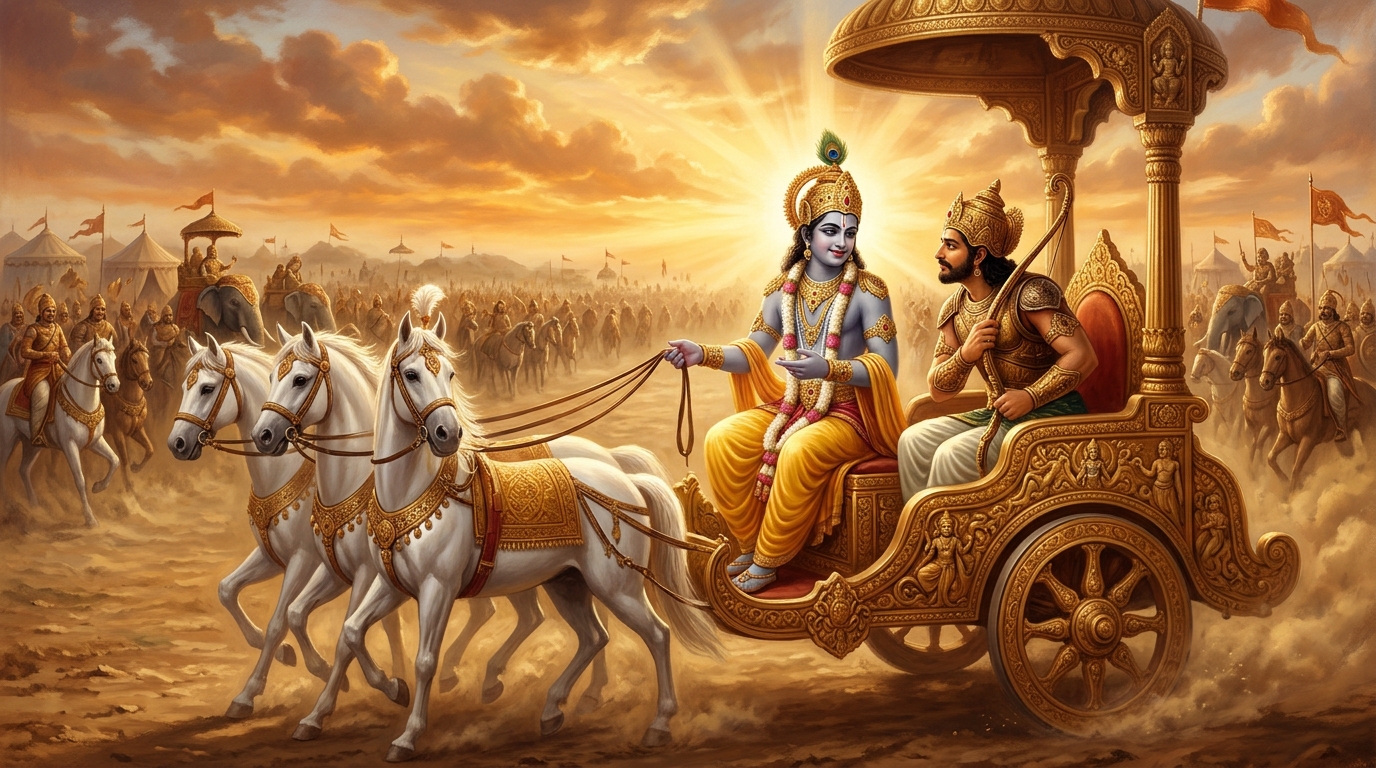

Welcome back to Vibes of Divinity. Bhagavad Gita Chapter 2 (Sankhya Yoga) is widely revered as the philosophical foundation and summary of all 18 chapters. When Arjuna surrenders to Lord Krishna as a humble student, Krishna speaks for the first time—addressing the deepest truths about life, death, the immortal soul (Atman), selfless duty, and emotional equanimity.
- Chapter Name: सांख्ययोग (Sankhya Yoga)
- Section: Section 1: The Path of Selfless Action & Discipline (Chapters 1–6)
- Complete Text Included: All 72 Sanskrit shlokas with IAST transliteration & English translation
- Series Index: Bhagavad Gita Complete Guide (All 18 Chapters & 701 Shlokas)
Chapter 2 Summary & Context on Kurukshetra
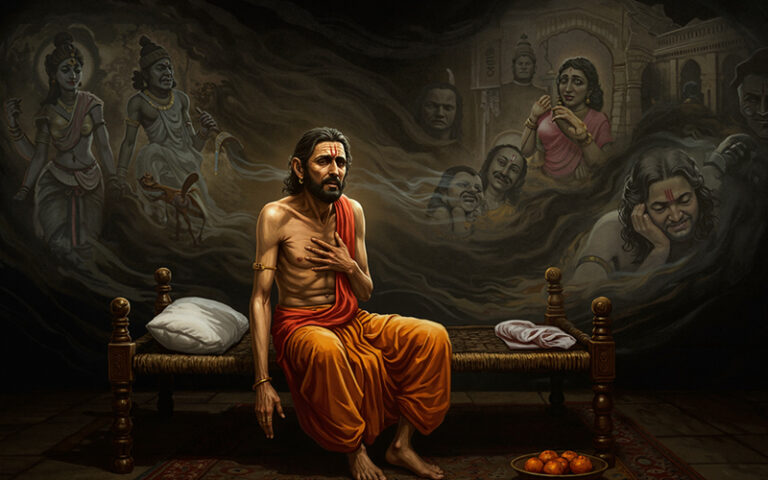
Seeing Arjuna paralyzed by grief, Krishna gently rebukes his weakness and accepts him as a disciple once Arjuna asks, ‘Tell me decisively what is best for me.’
Krishna immediately shifts Arjuna’s vision from the temporary physical body to the eternal, indestructible soul (Atman). Just as a person changes worn-out garments for new ones, the soul passes calmly from body to body—unborn, eternal, and untouched by weapons, fire, water, or wind.
From metaphysics, Krishna moves directly into practical living: Karma Yoga, the art of performing one’s duty with full dedication while letting go of anxious attachment to outcomes. The chapter concludes with Krishna’s famous portrait of a Sthitaprajna—a person of steady wisdom who remains serene amid pleasure and pain, praise and blame.
Highlighted Shlokas & Spiritual Reflections (Chapter 2)
Shloka 2.20 — The Immortality of the Soul
न जायते म्रियते वा कदाचिन्नायं भूत्वा भविता वा न भूयः । अजो नित्यः शाश्वतोऽयं पुराणो न हन्यते हन्यमाने शरीरे ॥
Na jāyate mriyate vā kadācin nāyaṁ bhūtvā bhavitā vā na bhūyaḥ | Ajo nityaḥ śāśvato ’yaṁ purāṇo na hanyate hanyamāne śarīre ||
Meaning: The soul is never born, nor does it ever die; having come into being, it never ceases to exist. It is unborn, eternal, everlasting, and primeval—it is not slain when the body is slain.
Understanding our immortal spiritual identity dissolves existential fear and restores courage during life’s inevitable transitions.
Shloka 2.47 — The Golden Rule of Karma Yoga
कर्मण्येवाधिकारस्ते मा फलेषु कदाचन । मा कर्मफलहेतुर्भूर्मा ते सङ्गोऽस्त्वकर्मणि ॥
Karmaṇy evādhikāras te mā phaleṣu kadācana | Mā karma-phala-hetur bhūr mā te saṅgo ’stv akarmaṇi ||
Meaning: You have a right to perform your prescribed duty alone, never to the fruits of action. Never consider yourself the cause of results, nor become attached to inaction.
This iconic verse teaches total excellence in effort combined with inner freedom from outcome anxiety—the secret behind peaceful productivity.
Shloka 2.48 — Yoga as Equanimity
योगस्थः कुरु कर्माणि सङ्गं त्यक्त्वा धनञ्जय । सिद्ध्यसिद्ध्योः समो भूत्वा समत्वं योग उच्यते ॥
Yoga-sthaḥ kuru karmāṇi saṅgaṁ tyaktvā dhanañjaya | Siddhy-asiddhyoḥ samo bhūtvā samatvaṁ yoga uchyate ||
Meaning: Steadfast in Yoga, perform your duties, O Arjuna, abandoning selfish attachment and remaining balanced in success and failure. Evenness of mind is called Yoga.
True yoga is not limited to a mat; it is keeping your inner poise intact whether outcomes go your way or not.
Complete Verse-by-Verse Bhagavad Gita Chapter 2 (All 72 Shlokas)
Read all 72 original Sanskrit verses of Chapter 2 below with Roman IAST transliteration and clear English meaning:
Verse 2.1
सञ्जय उवाच |
तं तथा कृपयाविष्टमश्रुपूर्णाकुलेक्षणम् |
विषीदन्तमिदं वाक्यमुवाच मधुसूदनः ||२-१||
sañjaya uvāca .
taṃ tathā kṛpayāviṣṭamaśrupūrṇākulekṣaṇam .
viṣīdantamidaṃ vākyamuvāca madhusūdanaḥ ||2-1||
Meaning: Sanjaya then told how the Lord Shri Krishna, seeing Arjuna overwhelmed with compassion, his eyes dimmed with flowing tears and full of despondency, consoled him:
Verse 2.2
श्रीभगवानुवाच |
कुतस्त्वा कश्मलमिदं विषमे समुपस्थितम् |
अनार्यजुष्टमस्वर्ग्यमकीर्तिकरमर्जुन ||२-२||
śrībhagavānuvāca .
kutastvā kaśmalamidaṃ viṣame samupasthitam .
anāryajuṣṭamasvargyamakīrtikaramarjuna ||2-2||
Meaning: The Lord said: My beloved friend! Why yield, just on the eve of battle, to this weakness which does no credit to those who call themselves Aryans, and only brings them infamy and bars against them the gates of heaven?
Verse 2.3
क्लैब्यं मा स्म गमः पार्थ नैतत्त्वय्युपपद्यते |
क्षुद्रं हृदयदौर्बल्यं त्यक्त्वोत्तिष्ठ परन्तप ||२-३||
klaibyaṃ mā sma gamaḥ pārtha naitattvayyupapadyate .
kṣudraṃ hṛdayadaurbalyaṃ tyaktvottiṣṭha parantapa ||2-3||
Meaning: O Arjuna! Why give way to unmanliness? O thou who art the terror of thine enemies! Shake off such shameful effeminacy, make ready to act!
Verse 2.4
अर्जुन उवाच |
कथं भीष्ममहं सङ्ख्ये द्रोणं च मधुसूदन |
इषुभिः प्रतियोत्स्यामि पूजार्हावरिसूदन ||२-४||
arjuna uvāca .
kathaṃ bhīṣmamahaṃ saṅkhye droṇaṃ ca madhusūdana .
iṣubhiḥ pratiyotsyāmi pūjārhāvarisūdana ||2-4||
Meaning: Arjuna argued: My Lord! How can I, when the battle rages, send an arrow through Bheeshma and Drona, who should receive my reverence?
Verse 2.5
गुरूनहत्वा हि महानुभावान्
श्रेयो भोक्तुं भैक्ष्यमपीह लोके |
हत्वार्थकामांस्तु गुरूनिहैव
भुञ्जीय भोगान् रुधिरप्रदिग्धान् ||२-५||
gurūnahatvā hi mahānubhāvān śreyo bhoktuṃ bhaikṣyamapīha loke .
hatvārthakāmāṃstu gurūnihaiva bhuñjīya bhogān rudhirapradigdhān ||2-5||
Meaning: Rather would I content myself with a beggar's crust that kill these teachers of mine, these precious noble souls! To slay these masters who are my benefactors would be to stain the sweetness of life's pleasures with their blood.
Verse 2.6
न चैतद्विद्मः कतरन्नो गरीयो
यद्वा जयेम यदि वा नो जयेयुः |
यानेव हत्वा न जिजीविषामस्-
तेऽवस्थिताः प्रमुखे धार्तराष्ट्राः ||२-६||
na caitadvidmaḥ kataranno garīyo yadvā jayema yadi vā no jayeyuḥ .
yāneva hatvā na jijīviṣāmaḥ te.avasthitāḥ pramukhe dhārtarāṣṭrāḥ ||2-6||
Meaning: Nor can I say whether it were better that they conquer me or for me to conquer them, since would no longer care to live if I killed these sons of Dhritarashtra, now preparing for fight.
Verse 2.7
कार्पण्यदोषोपहतस्वभावः
पृच्छामि त्वां धर्मसम्मूढचेताः |
यच्छ्रेयः स्यान्निश्चितं ब्रूहि तन्मे
शिष्यस्तेऽहं शाधि मां त्वां प्रपन्नम् ||२-७||
kārpaṇyadoṣopahatasvabhāvaḥ pṛcchāmi tvāṃ dharmasammūḍhacetāḥ .
yacchreyaḥ syānniścitaṃ brūhi tanme śiṣyaste.ahaṃ śādhi māṃ tvāṃ prapannam ||2-7||
Meaning: My heart is oppressed with pity; and my mind confused as to what my duty is. Therefore, my Lord, tell me what is best for my spiritual welfare, for I am Thy disciple. Please direct me, I pray.
Verse 2.8
न हि प्रपश्यामि ममापनुद्याद्
यच्छोकमुच्छोषणमिन्द्रियाणाम् |
अवाप्य भूमावसपत्नमृद्धं
राज्यं सुराणामपि चाधिपत्यम् ||२-८||
na hi prapaśyāmi mamāpanudyād yacchokamucchoṣaṇamindriyāṇām .
avāpya bhūmāvasapatnamṛddhaṃ rājyaṃ surāṇāmapi cādhipatyam ||2-8||
Meaning: For should I attain the monarchy of the visible world, or over the invisible world, it would not drive away the anguish which is now paralysing my senses.
Verse 2.9
सञ्जय उवाच |
एवमुक्त्वा हृषीकेशं गुडाकेशः परन्तप |
न योत्स्य इति गोविन्दमुक्त्वा तूष्णीं बभूव ह ||२-९||
sañjaya uvāca .
evamuktvā hṛṣīkeśaṃ guḍākeśaḥ parantapaḥ .
na yotsya iti govindamuktvā tūṣṇīṃ babhūva ha ||2-9||
Meaning: Sanjaya continued: Arjuna, the conqueror of all enemies, then told the Lord of All-Hearts that he would no fight, and became silent, O King!
Verse 2.10
तमुवाच हृषीकेशः प्रहसन्निव भारत |
सेनयोरुभयोर्मध्ये विषीदन्तमिदं वचः ||२-१०||
tamuvāca hṛṣīkeśaḥ prahasanniva bhārata .
senayorubhayormadhye viṣīdantamidaṃ vacaḥ ||2-10||
Meaning: Thereupon the Lord, with a gracious smile, addressed him who was so much depressed in the midst of the two armies.
Verse 2.11
श्रीभगवानुवाच |
अशोच्यानन्वशोचस्त्वं प्रज्ञावादांश्च भाषसे |
गतासूनगतासूंश्च नानुशोचन्ति पण्डिताः ||२-११||
śrībhagavānuvāca .
aśocyānanvaśocastvaṃ prajñāvādāṃśca bhāṣase .
gatāsūnagatāsūṃśca nānuśocanti paṇḍitāḥ ||2-11||
Meaning: Lord Shri Krishna said: Why grieve for those for whom no grief is due, and yet profess wisdom? The wise grieve neither for the dead nor the living.
Verse 2.12
न त्वेवाहं जातु नासं न त्वं नेमे जनाधिपाः |
न चैव न भविष्यामः सर्वे वयमतः परम् ||२-१२||
na tvevāhaṃ jātu nāsaṃ na tvaṃ neme janādhipāḥ .
na caiva na bhaviṣyāmaḥ sarve vayamataḥ param ||2-12||
Meaning: There was never a time when I was not, nor thou, nor these princes were not; there will never be a time when we shall cease to be.
Verse 2.13
देहिनोऽस्मिन्यथा देहे कौमारं यौवनं जरा |
तथा देहान्तरप्राप्तिर्धीरस्तत्र न मुह्यति ||२-१३||
dehino.asminyathā dehe kaumāraṃ yauvanaṃ jarā .
tathā dehāntaraprāptirdhīrastatra na muhyati ||2-13||
Meaning: As the soul experiences in this body infancy, youth and old age, so finally it passes into another. The wise have no delusion about this.
Verse 2.14
मात्रास्पर्शास्तु कौन्तेय शीतोष्णसुखदुःखदाः |
आगमापायिनोऽनित्यास्तांस्तितिक्षस्व भारत ||२-१४||
mātrāsparśāstu kaunteya śītoṣṇasukhaduḥkhadāḥ .
āgamāpāyino.anityāstāṃstitikṣasva bhārata ||2-14||
Meaning: Those external relations which bring cold and heat, pain and happiness, they come and go; they are not permanent. Endure them bravely, O Prince!
Verse 2.15
यं हि न व्यथयन्त्येते पुरुषं पुरुषर्षभ |
समदुःखसुखं धीरं सोऽमृतत्वाय कल्पते ||२-१५||
yaṃ hi na vyathayantyete puruṣaṃ puruṣarṣabha .
samaduḥkhasukhaṃ dhīraṃ so.amṛtatvāya kalpate ||2-15||
Meaning: The hero whose soul is unmoved by circumstance, who accepts pleasure and pain with equanimity, only he is fit for immortality.
Verse 2.16
नासतो विद्यते भावो नाभावो विद्यते सतः |
उभयोरपि दृष्टोऽन्तस्त्वनयोस्तत्त्वदर्शिभिः ||२-१६||
nāsato vidyate bhāvo nābhāvo vidyate sataḥ .
ubhayorapi dṛṣṭo.antastvanayostattvadarśibhiḥ ||2-16||
Meaning: That which is not, shall never be; that which is, shall never cease to be. To the wise, these truths are self-evident.
Verse 2.17
अविनाशि तु तद्विद्धि येन सर्वमिदं ततम् |
विनाशमव्ययस्यास्य न कश्चित्कर्तुमर्हति ||२-१७||
avināśi tu tadviddhi yena sarvamidaṃ tatam .
vināśamavyayasyāsya na kaścitkartumarhati ||2-17||
Meaning: The Spirit, which pervades all that we see, is imperishable. Nothing can destroy the Spirit.
Verse 2.18
अन्तवन्त इमे देहा नित्यस्योक्ताः शरीरिणः |
अनाशिनोऽप्रमेयस्य तस्माद्युध्यस्व भारत ||२-१८||
antavanta ime dehā nityasyoktāḥ śarīriṇaḥ .
anāśino.aprameyasya tasmādyudhyasva bhārata ||2-18||
Meaning: The material bodies which this Eternal, Indestructible, Immeasurable Spirit inhabits are all finite. Therefore fight, O Valiant Man!
Verse 2.19
य एनं वेत्ति हन्तारं यश्चैनं मन्यते हतम् |
उभौ तौ न विजानीतो नायं हन्ति न हन्यते ||२-१९||
ya enaṃ vetti hantāraṃ yaścainaṃ manyate hatam ubhau tau na vijānīto nāyaṃ hanti na hanyate ||2-19||
Meaning: He who thinks that the Spirit kills, and he who thinks of It as killed, are both ignorant. The Spirit kills not, nor is It killed.
Verse 2.20
न जायते म्रियते वा कदाचिन्
नायं भूत्वा भविता वा न भूयः |
अजो नित्यः शाश्वतोऽयं पुराणो
न हन्यते हन्यमाने शरीरे ||२-२०||
na jāyate mriyate vā kadācin nāyaṃ bhūtvā bhavitā vā na bhūyaḥ .
ajo nityaḥ śāśvato.ayaṃ purāṇo na hanyate hanyamāne śarīre ||2-20||
Meaning: It was not born; It will never die, nor once having been, can It cease to be. Unborn, Eternal, Ever-enduring, yet Most Ancient, the Spirit dies not when the body is dead.
Verse 2.21
वेदाविनाशिनं नित्यं य एनमजमव्ययम् |
कथं स पुरुषः पार्थ कं घातयति हन्ति कम् ||२-२१||
vedāvināśinaṃ nityaṃ ya enamajamavyayam .
kathaṃ sa puruṣaḥ pārtha kaṃ ghātayati hanti kam ||2-21||
Meaning: He who knows the Spirit as Indestructible, Immortal, Unborn, Always-the-Same, how should he kill or cause to be killed?
Verse 2.22
वासांसि जीर्णानि यथा विहाय
नवानि गृह्णाति नरोऽपराणि |
तथा शरीराणि विहाय जीर्णा-
न्यन्यानि संयाति नवानि देही ||२-२२||
vāsāṃsi jīrṇāni yathā vihāya navāni gṛhṇāti naro.aparāṇi .
tathā śarīrāṇi vihāya jīrṇāni anyāni saṃyāti navāni dehī ||2-22||
Meaning: As a man discards his threadbare robes and puts on new, so the Spirit throws off Its worn-out bodies and takes fresh ones.
Verse 2.23
नैनं छिन्दन्ति शस्त्राणि नैनं दहति पावकः |
न चैनं क्लेदयन्त्यापो न शोषयति मारुतः ||२-२३||
nainaṃ chindanti śastrāṇi nainaṃ dahati pāvakaḥ .
na cainaṃ kledayantyāpo na śoṣayati mārutaḥ ||2-23||
Meaning: Weapons cleave It not, fire burns It not, water drenches It not, and wind dries It not.
Verse 2.24
अच्छेद्योऽयमदाह्योऽयमक्लेद्योऽशोष्य एव च |
नित्यः सर्वगतः स्थाणुरचलोऽयं सनातनः ||२-२४||
acchedyo.ayamadāhyo.ayamakledyo.aśoṣya eva ca .
nityaḥ sarvagataḥ sthāṇuracalo.ayaṃ sanātanaḥ ||2-24||
Meaning: It is impenetrable; It can be neither drowned nor scorched nor dried. It is Eternal, All-pervading, Unchanging, Immovable and Most Ancient.
Verse 2.25
अव्यक्तोऽयमचिन्त्योऽयमविकार्योऽयमुच्यते |
तस्मादेवं विदित्वैनं नानुशोचितुमर्हसि ||२-२५||
avyakto.ayamacintyo.ayamavikāryo.ayamucyate .
tasmādevaṃ viditvainaṃ nānuśocitumarhasi ||2-25||
Meaning: It is named the Unmanifest, the Unthinkable, the immutable. Wherefore, knowing the Spirit as such, thou hast no cause to grieve.
Verse 2.26
अथ चैनं नित्यजातं नित्यं वा मन्यसे मृतम् |
तथापि त्वं महाबाहो नैवं शोचितुमर्हसि ||२-२६||
atha cainaṃ nityajātaṃ nityaṃ vā manyase mṛtam .
tathāpi tvaṃ mahābāho naivaṃ śocitumarhasi ||2-26||
Meaning: Even if thou thinkest of It as constantly being born, constantly dying, even then, O Mighty Man, thou still hast no cause to grieve.
Verse 2.27
जातस्य हि ध्रुवो मृत्युर्ध्रुवं जन्म मृतस्य च |
तस्मादपरिहार्येऽर्थे न त्वं शोचितुमर्हसि ||२-२७||
jātasya hi dhruvo mṛtyurdhruvaṃ janma mṛtasya ca .
tasmādaparihārye.arthe na tvaṃ śocitumarhasi ||2-27||
Meaning: For death is as sure for that which is born, as birth is for that which is dead. Therefore grieve not for what is inevitable.
Verse 2.28
अव्यक्तादीनि भूतानि व्यक्तमध्यानि भारत |
अव्यक्तनिधनान्येव तत्र का परिदेवना ||२-२८||
avyaktādīni bhūtāni vyaktamadhyāni bhārata .
avyaktanidhanānyeva tatra kā paridevanā ||2-28||
Meaning: The end and the beginning of beings are unknown. We see only the intervening formations. Then what cause is there for grief?
Verse 2.29
आश्चर्यवत्पश्यति कश्चिदेन-
माश्चर्यवद्वदति तथैव चान्यः |
आश्चर्यवच्चैनमन्यः शृणोति
श्रुत्वाप्येनं वेद न चैव कश्चित् ||२-२९||
āścaryavatpaśyati kaścidenam āścaryavadvadati tathaiva cānyaḥ .
āścaryavaccainamanyaḥ śṛṇoti śrutvāpyenaṃ veda na caiva kaścit ||2-29||
Meaning: One hears of the Spirit with surprise, another thinks It marvellous, the third listens without comprehending. Thus, though many are told about It, scarcely is there one who knows It.
Verse 2.30
देही नित्यमवध्योऽयं देहे सर्वस्य भारत |
तस्मात्सर्वाणि भूतानि न त्वं शोचितुमर्हसि ||२-३०||
dehī nityamavadhyo.ayaṃ dehe sarvasya bhārata .
tasmātsarvāṇi bhūtāni na tvaṃ śocitumarhasi ||2-30||
Meaning: Be not anxious about these armies. The Spirit in man is imperishable.
Verse 2.31
स्वधर्ममपि चावेक्ष्य न विकम्पितुमर्हसि |
धर्म्याद्धि युद्धाच्छ्रेयोऽन्यत्क्षत्रियस्य न विद्यते ||२-३१||
svadharmamapi cāvekṣya na vikampitumarhasi .
dharmyāddhi yuddhācchreyo.anyatkṣatriyasya na vidyate ||2-31||
Meaning: Thou must look at thy duty. Nothing can be more welcome to a soldier than a righteous war. Therefore to waver in this resolve is unworthy, O Arjuna!
Verse 2.32
यदृच्छया चोपपन्नं स्वर्गद्वारमपावृतम् |
सुखिनः क्षत्रियाः पार्थ लभन्ते युद्धमीदृशम् ||२-३२||
yadṛcchayā copapannaṃ svargadvāramapāvṛtam .
sukhinaḥ kṣatriyāḥ pārtha labhante yuddhamīdṛśam ||2-32||
Meaning: Blessed are the soldiers who find their opportunity. This opportunity has opened for thee the gates of heaven.
Verse 2.33
अथ चेत्त्वमिमं धर्म्यं संग्रामं न करिष्यसि |
ततः स्वधर्मं कीर्तिं च हित्वा पापमवाप्स्यसि ||२-३३||
atha cettvamimaṃ dharmyaṃ saṃgrāmaṃ na kariṣyasi .
tataḥ svadharmaṃ kīrtiṃ ca hitvā pāpamavāpsyasi ||2-33||
Meaning: Refuse to fight in this righteous cause, and thou wilt be a traitor, lost to fame, incurring only sin.
Verse 2.34
अकीर्तिं चापि भूतानि कथयिष्यन्ति तेऽव्ययाम् |
सम्भावितस्य चाकीर्तिर्मरणादतिरिच्यते ||२-३४||
akīrtiṃ cāpi bhūtāni kathayiṣyanti te.avyayām .
sambhāvitasya cākīrtirmaraṇādatiricyate ||2-34||
Meaning: Men will talk forever of thy disgrace; and to the noble, dishonour is worse than death.
Verse 2.35
भयाद्रणादुपरतं मंस्यन्ते त्वां महारथाः |
येषां च त्वं बहुमतो भूत्वा यास्यसि लाघवम् ||२-३५||
bhayādraṇāduparataṃ maṃsyante tvāṃ mahārathāḥ .
yeṣāṃ ca tvaṃ bahumato bhūtvā yāsyasi lāghavam ||2-35||
Meaning: Great generals will think that thou hast fled from the battlefield through cowardice; though once honoured thou wilt seem despicable.
Verse 2.36
अवाच्यवादांश्च बहून्वदिष्यन्ति तवाहिताः |
निन्दन्तस्तव सामर्थ्यं ततो दुःखतरं नु किम् ||२-३६||
avācyavādāṃśca bahūnvadiṣyanti tavāhitāḥ .
nindantastava sāmarthyaṃ tato duḥkhataraṃ nu kim ||2-36||
Meaning: Thine enemies will spread scandal and mock at thy courage. Can anything be more humiliating?
Verse 2.37
हतो वा प्राप्स्यसि स्वर्गं जित्वा वा भोक्ष्यसे महीम् |
तस्मादुत्तिष्ठ कौन्तेय युद्धाय कृतनिश्चयः ||२-३७||
hato vā prāpsyasi svargaṃ jitvā vā bhokṣyase mahīm .
tasmāduttiṣṭha kaunteya yuddhāya kṛtaniścayaḥ ||2-37||
Meaning: If killed, thou shalt attain Heaven; if victorious, enjoy the kingdom of earth. Therefore arise, O Son of Kunti, and fight!
Verse 2.38
सुखदुःखे समे कृत्वा लाभालाभौ जयाजयौ |
ततो युद्धाय युज्यस्व नैवं पापमवाप्स्यसि ||२-३८||
sukhaduḥkhe same kṛtvā lābhālābhau jayājayau .
tato yuddhāya yujyasva naivaṃ pāpamavāpsyasi ||2-38||
Meaning: Look upon pleasure and pain, victory and defeat, with an equal eye. Make ready for the combat, and thou shalt commit no sin.
Verse 2.39
एषा तेऽभिहिता साङ्ख्ये बुद्धिर्योगे त्विमां शृणु |
बुद्ध्या युक्तो यया पार्थ कर्मबन्धं प्रहास्यसि ||२-३९||
eṣā te.abhihitā sāṅkhye buddhiryoge tvimāṃ śṛṇu .
buddhyā yukto yayā pārtha karmabandhaṃ prahāsyasi ||2-39||
Meaning: I have told thee the philosophy of Knowledge. Now listen and I will explain the philosophy of Action, by means of which, O Arjuna, thou shalt break through the bondage of all action.
Verse 2.40
नेहाभिक्रमनाशोऽस्ति प्रत्यवायो न विद्यते |
स्वल्पमप्यस्य धर्मस्य त्रायते महतो भयात् ||२-४०||
nehābhikramanāśo.asti pratyavāyo na vidyate .
svalpamapyasya dharmasya trāyate mahato bhayāt ||2-40||
Meaning: On this Path, endeavour is never wasted, nor can it ever be repressed. Even a very little of its practice protects one from great danger.
Verse 2.41
व्यवसायात्मिका बुद्धिरेकेह कुरुनन्दन |
बहुशाखा ह्यनन्ताश्च बुद्धयोऽव्यवसायिनाम् ||२-४१||
vyavasāyātmikā buddhirekeha kurunandana .
bahuśākhā hyanantāśca buddhayo.avyavasāyinām ||2-41||
Meaning: By its means, the straying intellect becomes steadied in the contemplation of one object only; whereas the minds of the irresolute stray into bypaths innumerable.
Verse 2.42
यामिमां पुष्पितां वाचं प्रवदन्त्यविपश्चितः |
वेदवादरताः पार्थ नान्यदस्तीति वादिनः ||२-४२||
yāmimāṃ puṣpitāṃ vācaṃ pravadantyavipaścitaḥ .
vedavādaratāḥ pārtha nānyadastīti vādinaḥ ||2-42||
Meaning: Only the ignorant speak in figurative language. It is they who extol the letter of the scriptures, saying, There is nothing deeper than this.'
Verse 2.43
कामात्मानः स्वर्गपरा जन्मकर्मफलप्रदाम् |
क्रियाविशेषबहुलां भोगैश्वर्यगतिं प्रति ||२-४३||
kāmātmānaḥ svargaparā janmakarmaphalapradām .
kriyāviśeṣabahulāṃ bhogaiśvaryagatiṃ prati ||2-43||
Meaning: Consulting only their own desires, they construct their own heaven, devising arduous and complex rites to secure their own pleasure and their own power; and the only result is rebirth.
Verse 2.44
भोगैश्वर्यप्रसक्तानां तयापहृतचेतसाम् |
व्यवसायात्मिका बुद्धिः समाधौ न विधीयते ||२-४४||
bhogaiśvaryaprasaktānāṃ tayāpahṛtacetasām .
vyavasāyātmikā buddhiḥ samādhau na vidhīyate ||2-44||
Meaning: While their minds are absorbed with ideas of power and personal enjoyment, they cannot concentrate their discrimination on one point.
Verse 2.45
त्रैगुण्यविषया वेदा निस्त्रैगुण्यो भवार्जुन |
निर्द्वन्द्वो नित्यसत्त्वस्थो निर्योगक्षेम आत्मवान् ||२-४५||
traiguṇyaviṣayā vedā nistraiguṇyo bhavārjuna .
nirdvandvo nityasattvastho niryogakṣema ātmavān ||2-45||
Meaning: The Vedic Scriptures tell of the three constituents of life – the Qualities. Rise above all of them, O Arjuna, above all the pairs of opposing sensations; be steady in truth, free from worldly anxieties and centered in the Self.
Verse 2.46
यावानर्थ उदपाने सर्वतः सम्प्लुतोदके |
तावान्सर्वेषु वेदेषु ब्राह्मणस्य विजानतः ||२-४६||
yāvānartha udapāne sarvataḥ samplutodake .
tāvānsarveṣu vedeṣu brāhmaṇasya vijānataḥ ||2-46||
Meaning: As a man can drink water from any side of a full tank, so the skilled theologian can wrest from any scripture that which will serve his purpose.
Verse 2.47
कर्मण्येवाधिकारस्ते मा फलेषु कदाचन |
मा कर्मफलहेतुर्भूर्मा ते सङ्गोऽस्त्वकर्मणि ||२-४७||
karmaṇyevādhikāraste mā phaleṣu kadācana .
mā karmaphalaheturbhūrmā te saṅgo.astvakarmaṇi ||2-47||
Meaning: But thou hast only the right to work, but none to the fruit thereof. Let not then the fruit of thy action be thy motive; nor yet be thou enamored of inaction.
Verse 2.48
योगस्थः कुरु कर्माणि सङ्गं त्यक्त्वा धनञ्जय |
सिद्ध्यसिद्ध्योः समो भूत्वा समत्वं योग उच्यते ||२-४८||
yogasthaḥ kuru karmāṇi saṅgaṃ tyaktvā dhanañjaya .
siddhyasiddhyoḥ samo bhūtvā samatvaṃ yoga ucyate ||2-48||
Meaning: Perform all thy actions with mind concentrated on the Divine, renouncing attachment and looking upon success and failure with an equal eye. Spirituality implies equanimity.
Verse 2.49
दूरेण ह्यवरं कर्म बुद्धियोगाद्धनञ्जय |
बुद्धौ शरणमन्विच्छ कृपणाः फलहेतवः ||२-४९||
dūreṇa hyavaraṃ karma buddhiyogāddhanañjaya .
buddhau śaraṇamanviccha kṛpaṇāḥ phalahetavaḥ ||2-49||
Meaning: Physical action is far inferior to an intellect concentrated on the Divine. Have recourse then to Pure Intelligence. It is only the petty-minded who work for reward.
Verse 2.50
बुद्धियुक्तो जहातीह उभे सुकृतदुष्कृते |
तस्माद्योगाय युज्यस्व योगः कर्मसु कौशलम् ||२-५०||
buddhiyukto jahātīha ubhe sukṛtaduṣkṛte .
tasmādyogāya yujyasva yogaḥ karmasu kauśalam ||2-50||
Meaning: When a man attains to Pure Reason, he renounces in this world the results of good and evil alike. Cling thou to Right Action. Spirituality is the real art of living.
Verse 2.51
कर्मजं बुद्धियुक्ता हि फलं त्यक्त्वा मनीषिणः |
जन्मबन्धविनिर्मुक्ताः पदं गच्छन्त्यनामयम् ||२-५१||
karmajaṃ buddhiyuktā hi phalaṃ tyaktvā manīṣiṇaḥ .
janmabandhavinirmuktāḥ padaṃ gacchantyanāmayam ||2-51||
Meaning: The sages guided by Pure Intellect renounce the fruit of action; and, freed from the chains of rebirth, they reach the highest bliss.
Verse 2.52
यदा ते मोहकलिलं बुद्धिर्व्यतितरिष्यति |
तदा गन्तासि निर्वेदं श्रोतव्यस्य श्रुतस्य च ||२-५२||
yadā te mohakalilaṃ buddhirvyatitariṣyati .
tadā gantāsi nirvedaṃ śrotavyasya śrutasya ca ||2-52||
Meaning: When thy reason has crossed the entanglements of illusion, then shalt thou become indifferent both to the philosophies thou hast heard and to those thou mayest yet hear.
Verse 2.53
श्रुतिविप्रतिपन्ना ते यदा स्थास्यति निश्चला |
समाधावचला बुद्धिस्तदा योगमवाप्स्यसि ||२-५३||
śrutivipratipannā te yadā sthāsyati niścalā .
samādhāvacalā buddhistadā yogamavāpsyasi ||2-53||
Meaning: When the intellect, bewildered by the multiplicity of holy scripts, stands unperturbed in blissful contemplation of the Infinite, then hast thou attained Spirituality.
Verse 2.54
अर्जुन उवाच |
स्थितप्रज्ञस्य का भाषा समाधिस्थस्य केशव |
स्थितधीः किं प्रभाषेत किमासीत व्रजेत किम् ||२-५४||
arjuna uvāca .
sthitaprajñasya kā bhāṣā samādhisthasya keśava .
sthitadhīḥ kiṃ prabhāṣeta kimāsīta vrajeta kim ||2-54||
Meaning: Arjuna asked: My Lord! How can we recognise the saint who has attained Pure Intellect, who has reached this state of Bliss, and whose mind is steady? how does he talk, how does he live, and how does he act?
Verse 2.55
श्रीभगवानुवाच |
प्रजहाति यदा कामान्सर्वान्पार्थ मनोगतान् |
आत्मन्येवात्मना तुष्टः स्थितप्रज्ञस्तदोच्यते ||२-५५||
śrībhagavānuvāca .
prajahāti yadā kāmānsarvānpārtha manogatān .
ātmanyevātmanā tuṣṭaḥ sthitaprajñastadocyate ||2-55||
Meaning: Lord Shri Krishna replied: When a man has given up the desires of his heart and is satisfied with the Self alone, be sure that he has reached the highest state.
Verse 2.56
दुःखेष्वनुद्विग्नमनाः सुखेषु विगतस्पृहः |
वीतरागभयक्रोधः स्थितधीर्मुनिरुच्यते ||२-५६||
duḥkheṣvanudvignamanāḥ sukheṣu vigataspṛhaḥ .
vītarāgabhayakrodhaḥ sthitadhīrmunirucyate ||2-56||
Meaning: The sage, whose mind is unruffled in suffering, whose desire is not roused by enjoyment, who is without attachment, anger or fear – take him to be one who stands at that lofty level.
Verse 2.57
यः सर्वत्रानभिस्नेहस्तत्तत्प्राप्य शुभाशुभम् |
नाभिनन्दति न द्वेष्टि तस्य प्रज्ञा प्रतिष्ठिता ||२-५७||
yaḥ sarvatrānabhisnehastattatprāpya śubhāśubham .
nābhinandati na dveṣṭi tasya prajñā pratiṣṭhitā ||2-57||
Meaning: He who wherever he goes is attached to no person and to no place by ties of flesh; who accepts good and evil alike, neither welcoming the one nor shrinking from the other – take him to be one who is merged in the Infinite.
Verse 2.58
यदा संहरते चायं कूर्मोऽङ्गानीव सर्वशः |
इन्द्रियाणीन्द्रियार्थेभ्यस्तस्य प्रज्ञा प्रतिष्ठिता ||२-५८||
yadā saṃharate cāyaṃ kūrmo.aṅgānīva sarvaśaḥ .
indriyāṇīndriyārthebhyastasya prajñā pratiṣṭhitā ||2-58||
Meaning: He who can withdraw his senses from the attraction of their objects, as the tortoise draws his limbs within its shell – take it that such a one has attained Perfection.
Verse 2.59
विषया विनिवर्तन्ते निराहारस्य देहिनः |
रसवर्जं रसोऽप्यस्य परं दृष्ट्वा निवर्तते ||२-५९||
viṣayā vinivartante nirāhārasya dehinaḥ .
rasavarjaṃ raso.apyasya paraṃ dṛṣṭvā nivartate ||2-59||
Meaning: The objects of sense turn from him who is abstemious. Even the relish for them is lost in him who has seen the Truth.
Verse 2.60
यततो ह्यपि कौन्तेय पुरुषस्य विपश्चितः |
इन्द्रियाणि प्रमाथीनि हरन्ति प्रसभं मनः ||२-६०||
yatato hyapi kaunteya puruṣasya vipaścitaḥ .
indriyāṇi pramāthīni haranti prasabhaṃ manaḥ ||2-60||
Meaning: O Arjuna! The mind of him, who is trying to conquer it, is forcibly carried away in spite of his efforts, by his tumultuous senses.
Verse 2.61
तानि सर्वाणि संयम्य युक्त आसीत मत्परः |
वशे हि यस्येन्द्रियाणि तस्य प्रज्ञा प्रतिष्ठिता ||२-६१||
tāni sarvāṇi saṃyamya yukta āsīta matparaḥ .
vaśe hi yasyendriyāṇi tasya prajñā pratiṣṭhitā ||2-61||
Meaning: Restraining them all, let him meditate steadfastly on Me; for who thus conquers his senses achieves perfection.
Verse 2.62
ध्यायतो विषयान्पुंसः सङ्गस्तेषूपजायते |
सङ्गात्सञ्जायते कामः कामात्क्रोधोऽभिजायते ||२-६२||
dhyāyato viṣayānpuṃsaḥ saṅgasteṣūpajāyate .
saṅgātsañjāyate kāmaḥ kāmātkrodho.abhijāyate ||2-62||
Meaning: When a man dwells on the objects of sense, he creates an attraction for them; attraction develops into desire, and desire breeds anger.
Verse 2.63
क्रोधाद्भवति सम्मोहः सम्मोहात्स्मृतिविभ्रमः |
स्मृतिभ्रंशाद् बुद्धिनाशो बुद्धिनाशात्प्रणश्यति ||२-६३||
krodhādbhavati sammohaḥ sammohātsmṛtivibhramaḥ .
smṛtibhraṃśād buddhināśo buddhināśātpraṇaśyati ||2-63||
Meaning: Anger induces delusion; delusion, loss of memory; through loss of memory, reason is shattered; and loss of reason leads to destruction.
Verse 2.64
रागद्वेषविमुक्तैस्तु विषयानिन्द्रियैश्चरन् | (or वियुक्तैस्तु)
आत्मवश्यैर्विधेयात्मा प्रसादमधिगच्छति ||२-६४||
rāgadveṣavimuktaistu viṣayānindriyaiścaran .
orviyuktaistu ātmavaśyairvidheyātmā prasādamadhigacchati ||2-64||
Meaning: But the self-controlled soul, who moves amongst sense objects, free from either attachment or repulsion, he wins eternal Peace.
Verse 2.65
प्रसादे सर्वदुःखानां हानिरस्योपजायते |
प्रसन्नचेतसो ह्याशु बुद्धिः पर्यवतिष्ठते ||२-६५||
prasāde sarvaduḥkhānāṃ hānirasyopajāyate .
prasannacetaso hyāśu buddhiḥ paryavatiṣṭhate ||2-65||
Meaning: Having attained Peace, he becomes free from misery; for when the mind gains peace, right discrimination follows.
Verse 2.66
नास्ति बुद्धिरयुक्तस्य न चायुक्तस्य भावना |
न चाभावयतः शान्तिरशान्तस्य कुतः सुखम् ||२-६६||
nāsti buddhirayuktasya na cāyuktasya bhāvanā .
na cābhāvayataḥ śāntiraśāntasya kutaḥ sukham ||2-66||
Meaning: Right discrimination is not for him who cannot concentrate. Without concentration, there cannot be meditation; he who cannot meditate must not expect peace; and without peace, how can anyone expect happiness?
Verse 2.67
इन्द्रियाणां हि चरतां यन्मनोऽनुविधीयते |
तदस्य हरति प्रज्ञां वायुर्नावमिवाम्भसि ||२-६७||
indriyāṇāṃ hi caratāṃ yanmano.anuvidhīyate .
tadasya harati prajñāṃ vāyurnāvamivāmbhasi ||2-67||
Meaning: As a ship at sea is tossed by the tempest, so the reason is carried away by the mind when preyed upon by straying senses.
Verse 2.68
तस्माद्यस्य महाबाहो निगृहीतानि सर्वशः |
इन्द्रियाणीन्द्रियार्थेभ्यस्तस्य प्रज्ञा प्रतिष्ठिता ||२-६८||
tasmādyasya mahābāho nigṛhītāni sarvaśaḥ .
indriyāṇīndriyārthebhyastasya prajñā pratiṣṭhitā ||2-68||
Meaning: Therefore, O Might-in-Arms, he who keeps his senses detached from their objects – take it that his reason is purified.
Verse 2.69
या निशा सर्वभूतानां तस्यां जागर्ति संयमी |
यस्यां जाग्रति भूतानि सा निशा पश्यतो मुनेः ||२-६९||
yā niśā sarvabhūtānāṃ tasyāṃ jāgarti saṃyamī .
yasyāṃ jāgrati bhūtāni sā niśā paśyato muneḥ ||2-69||
Meaning: The saint is awake when the world sleeps, and he ignores that for which the world lives.
Verse 2.70
आपूर्यमाणमचलप्रतिष्ठं
समुद्रमापः प्रविशन्ति यद्वत् |
तद्वत्कामा यं प्रविशन्ति सर्वे
स शान्तिमाप्नोति न कामकामी ||२-७०||
āpūryamāṇamacalapratiṣṭhaṃ samudramāpaḥ praviśanti yadvat .
tadvatkāmā yaṃ praviśanti sarve sa śāntimāpnoti na kāmakāmī ||2-70||
Meaning: He attains Peace, into whom desires flow as rivers into the ocean, which though brimming with water remains ever the same; not he whom desire carries away.
Verse 2.71
विहाय कामान्यः सर्वान्पुमांश्चरति निःस्पृहः |
निर्ममो निरहङ्कारः स शान्तिमधिगच्छति ||२-७१||
vihāya kāmānyaḥ sarvānpumāṃścarati niḥspṛhaḥ .
nirmamo nirahaṅkāraḥ sa śāntimadhigacchati ||2-71||
Meaning: He attains Peace who, giving up desire, moves through the world without aspiration, possessing nothing which he can call his own, and free from pride.
Verse 2.72
एषा ब्राह्मी स्थितिः पार्थ नैनां प्राप्य विमुह्यति |
स्थित्वास्यामन्तकालेऽपि ब्रह्मनिर्वाणमृच्छति ||२-७२||
eṣā brāhmī sthitiḥ pārtha naināṃ prāpya vimuhyati .
sthitvāsyāmantakāle.api brahmanirvāṇamṛcchati ||2-72||
Meaning: O Arjuna! This is the state of the Self, the Supreme Spirit, to which if a man once attain, it shall never be taken from him. Even at the time of leaving the body, he will remain firmly enthroned there, and will become one with the Eternal.
Timeless Life Lessons for Modern Seekers
- Focus on Effort, Not Anxiety: Give 100% energy to your duty, while releasing obsessive worry over rewards you cannot fully control.
- Cultivate Equanimity (Samatva): Treat temporary highs and lows as passing waves rather than permanent definitions of your worth.
- Master the Senses Before They Master You: Anger arises from frustrated desire, leading to delusion and loss of wisdom—mindful restraint protects inner clarity.
- See Beyond the Physical Body: Remembering the eternal Atman cultivates fearlessness, dignity, and deeper compassion.
Frequently Asked Questions — Bhagavad Gita Chapter 2
Why is Chapter 2 called the summary of the Bhagavad Gita?
Chapter 2 introduces every major pillar expanded in later chapters: Atma-jnana (knowledge of the soul), Karma Yoga (selfless action), Buddhi Yoga (wisdom), and Sthitaprajna (spiritual steadiness).
What does ‘Sthitaprajna’ mean in Gita Chapter 2?
A Sthitaprajna is one whose intellect is firmly anchored in wisdom—free from compulsive cravings, unshaken by sorrow, and undisturbed by fear or anger.
How many shlokas are in Bhagavad Gita Chapter 2?
Chapter 2 contains 72 verses, including some of the most frequently chanted shlokas in Sanatana Dharma (such as 2.20, 2.22, 2.47, and 2.48).
Continue Your Bhagavad Gita Journey
← Previous: Chapter 1 | All 18 Gita Chapters | Next: Chapter 3 →
To explore more Bhagavad Gita teachings, Puranic stories, and sacred chants and timeless wisdom from Hindu scriptures, visit and subscribe to our official Vibes of Divinity YouTube channel.
Which shloka from this chapter touches your heart most today? Share your reflection in the comments below.