
Welcome to Vibes of Divinity. Concluding the epic hundred-thousand-verse journey, Svargarohana Parva brings one final, breathtaking moral test before lifting the curtain onto cosmic peace—reminding us why Vyasa ends the entire Mahabharata with a radiant cry for Dharma.
- Parva (Book): स्वर्गारोहणपर्व (Svargarohana Parva — Ascent to Heaven)
- Series Index: Mahabharata Complete 18-Parva Guide
Narrative Summary & Key Events of Parva 18
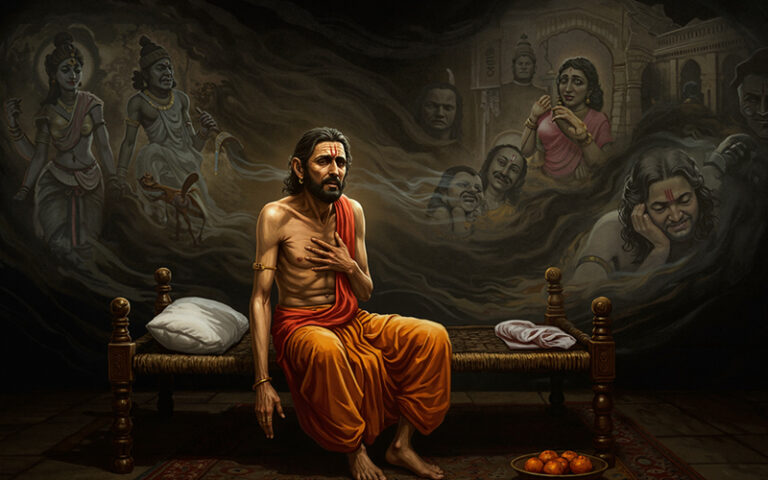
Entering heaven, Yudhishthira is shocked to see Duryodhana seated upon a shining celestial throne while his beloved brothers and Draupadi are nowhere in sight. Asking to go wherever his family is, Yudhishthira is led down a dark, terrifying path filled with suffering voices begging him to stay a moment just for comfort.
Though tempted with heavenly ease if he turns back, Yudhishthira refuses: ‘I would rather remain here in darkness bringing comfort to my brothers and Draupadi than sit alone in bright paradise!’ Instantly, the dark illusion vanishes—Lord Dharma and Indra reveal it was one final merciful clearing of past karmic shadows (like the Drona half-truth).
Bathing in the celestial Ganga, Yudhishthira sheds human grief and beholds Draupadi, Karna, Bhima, Arjuna, Nakula, Sahadeva, and Lord Krishna shining in timeless peace. Maharishi Vyasa closes the Mahabharata with the eternal four-verse Bharata Savitri—warning humanity that Dharma brings true joy while greed ends in emptiness.
Key Sanskrit Shlokas & Meanings
Svargarohana Parva (Bharata Savitri) — Vyasa’s Eternal Cry
ऊर्ध्वबाहुर्विरौम्येष न च कश्चिच्छृणोति मे । धर्मादर्थश्च कामश्च स किमर्थं न सेव्यते ॥
Ūrdhva-bāhur viraumy eṣa na ca kaścic chṛṇoti me | Dharmād arthaś ca kāmaś ca sa kim arthaṁ na sevyate ||
Meaning: With uplifted arms I cry aloud, yet scarcely anyone listens! From Dharma alone flow both true prosperity and fulfillment—then why do people fail to practice Dharma?
These heartbreaking closing lines of Vyasa summarize the entire 18-Parva epic: integrity is not an enemy of joy—it is the only reliable foundation of joy.
Svargarohana Parva — Never Abandon Dharma Out of Fear or Greed
न जातु कामान्न भयान्न लोभाद्धर्मं त्यजेज्जीवितस्यापि हेतोः । नित्यो धर्मः सुखदुःखे त्वनित्ये जीवो नित्यो हेतुरस्य त्वनित्यः ॥
Na jātu kāmān na bhayān na lobhād dharmaṁ tyajej jīvitasyāpi hetoḥ | Nityo dharmaḥ sukha-duḥkhe tv anitye jīvo nityo hetur asya tv anityaḥ ||
Meaning: Never abandon Dharma out of craving, fear, or greed—not even to save one’s life. Dharma is eternal; pleasure and pain pass away. The soul is eternal; earthly conditions pass away.
One of the noblest closing verses in all of Sanskrit literature.
Timeless Lessons for Modern Life
- Solidarity Beats Selfish Comfort: Yudhishthira chose dark hardship beside loved ones over lonely paradise—and that choice dissolved the illusion.
- Dharma Is the Source of Lasting Joy: As Vyasa cries in the Bharata Savitri, ethics and fulfillment belong together.
- Everything Earthly Passes—Integrity Endures: Live for what remains eternal after applause and crowns fade.
Frequently Asked Questions
Why did Yudhishthira briefly see Duryodhana in heaven first?
Duryodhana experienced temporary heavenly fruits for dying fearlessly as a warrior on Kurukshetra, while Yudhishthira briefly witnessed a purifying illusion for the half-truth spoken to Drona.
What is the Bharata Savitri at the end of Svargarohana Parva?
It is Maharishi Vyasa’s famous four-verse concluding summary emphasizing that Dharma is eternal and the true source of both prosperity and liberation.
Continue Your Mahabharata Journey
← Previous: Parva 17 | All 18 Mahabharata Parvas
To explore more Mahabharata untold stories, Bhishma’s wisdom, and Gita teachings and timeless wisdom from Hindu scriptures, visit and subscribe to our official Vibes of Divinity YouTube channel.
Which moment from this Parva speaks to you most? Share your reflection in the comments below!