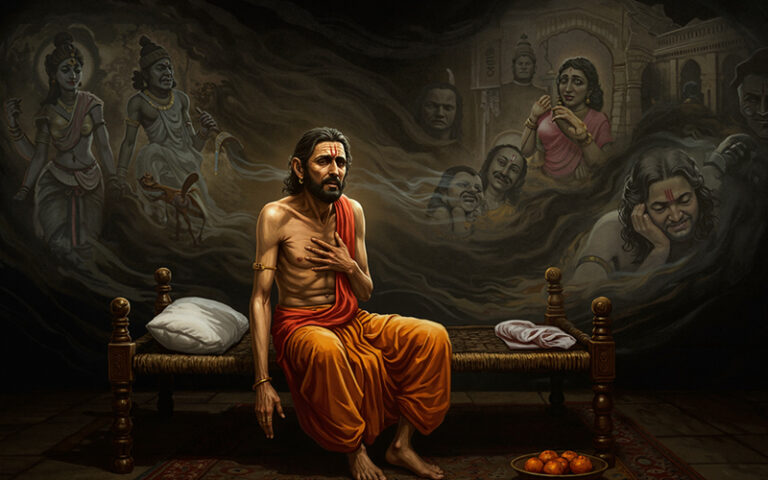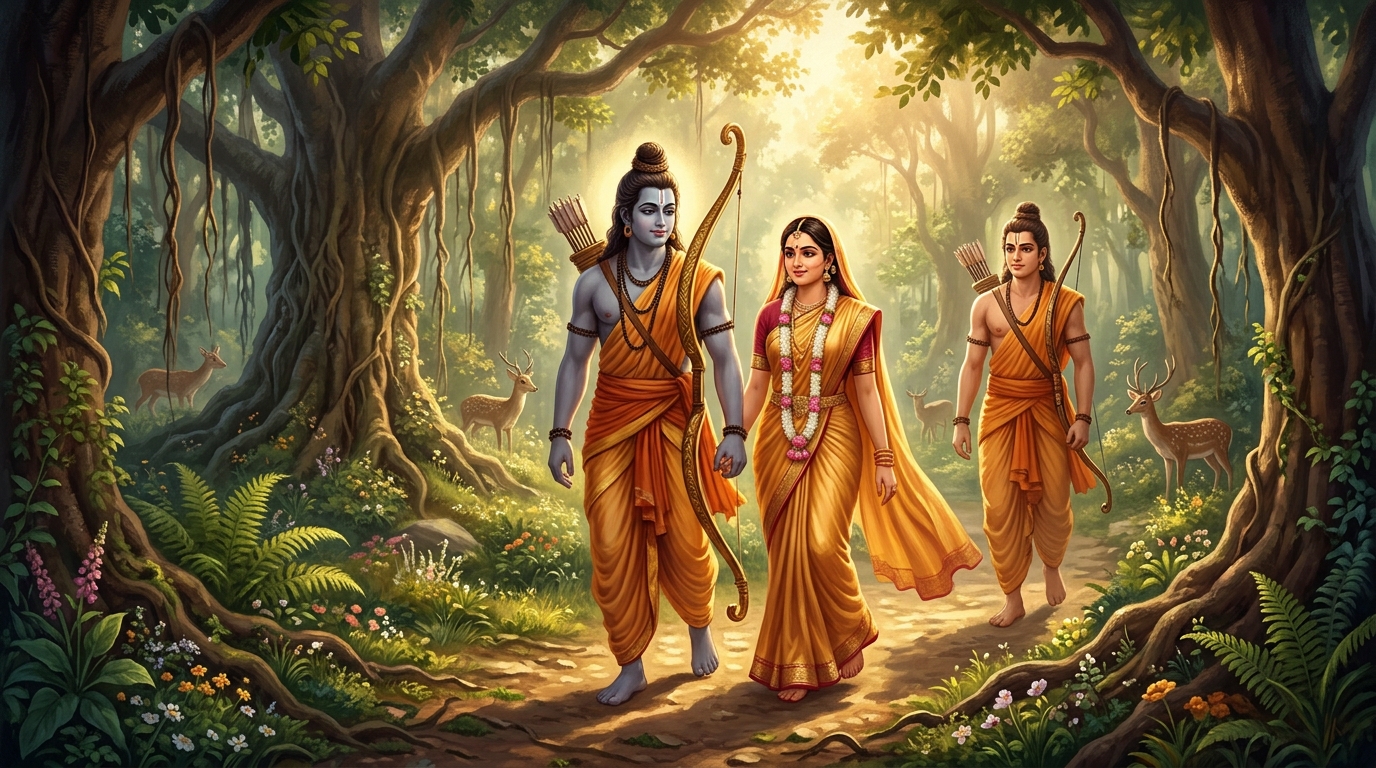

Namaste and welcome to Vibes of Divinity. Every timeless epic begins by introducing both the ideal and the journey required to embody it. Bala Kanda—the opening book of Maharishi Valmiki’s Ramayana—begins with a profound question asked by Valmiki to Sage Narada: Is there a single living person who embodies every noble virtue—truthfulness, courage, compassion, self-control, and dharma? Narada replies with the radiant life of Shri Rama of Ayodhya.
- Kanda (Book): बालकाण्ड (Bala Kanda — Book of Childhood)
- Series Index: Valmiki Ramayana Complete 7-Kanda Guide
Narrative Summary of Kanda 1
Noble King Dasharatha of Ayodhya performs the sacred Putrakameshti Yajna under Sage Rishyashringa’s guidance. From the sacrificial fire emerges a divine messenger bearing celestial payasam, leading to the birth of four extraordinary princes—Rama, Bharata, Lakshmana, and Shatrughna. (Read the full story here: The Miraculous Birth of Shri Ram.)
While still youths, Rama and Lakshmana are summoned by Sage Vishwamitra to protect his forest hermitage from the demons Tataka, Maricha, and Subahu. Along the way, Vishwamitra imparts sacred mantras (Bala and Atibala) and narrates ancient Puranic legends such as the descent of Mother Ganga and the liberation of Ahalya by Rama’s gentle grace.
Their journey culminates in King Janaka’s court in Mithila, where great kings fail even to lift Lord Shiva’s mighty bow Pinaka. With calm humility and Vishwamitra’s blessing, young Rama effortlessly strings and breaks the bow—winning the hand of Mata Sita, daughter of Earth, and uniting Ayodhya and Mithila in sacred harmony.
Key Sanskrit Shlokas & Meanings
Bala Kanda 1.1.1 — Valmiki’s Search for the Ideal Human
तपःस्वाध्यायनिरतं तपस्वी वाग्विदां वरम् । नारदं परिपप्रच्छ वाल्मीकिर्मुनिपुङ्गवम् ॥
Tapaḥ-svādhyāya-nirataṁ tapasvī vāgvidāṁ varam | Nāradaṁ paripapraccha vālmīkir muni-puṅgavam ||
Meaning: The ascetic Valmiki inquired of Sage Narada—the foremost among munis, ever devoted to austerity, sacred study, and eloquent truth—who in this world embodies complete righteousness.
Notice the Ramayana begins not with blind myth, but with an ethical question: what does an ideal, principled human life look like?
Bala Kanda 1.2.15 — The Birth of Poetry from Compassion (Ma Nishada)
मा निषाद प्रतिष्ठां त्वमगमः शाश्वतीः समाः । यत्क्रौञ्चमिथुनादेकमवधीः काममोहितम् ॥
Mā niṣāda pratiṣṭhāṁ tvam agamaḥ śāśvatīḥ samāḥ | Yat krauñca-mithunād ekam avadhīḥ kāma-mohitam ||
Meaning: O hunter, you shall find no lasting peace for eternal years, because you struck down one of the innocent Krauncha birds while lost in gentle companionship.
Born spontaneously from Valmiki’s sorrow (shoka) upon seeing an innocent bird slain, this shloka became the very first classical Sanskrit verse—reminding us that great art springs from empathy.
Timeless Dharmic Lessons
- Character Matters More Than Comfort: Even as a royal prince, Rama trains under Sage Vishwamitra in harsh forest conditions before assuming leadership.
- Strength Coupled with Humility: Breaking Shiva’s bow comes not from boasting, but from calm obedience and inner poise.
- Compassion Awakens Wisdom: Valmiki’s spontaneous grief for a small bird birthed the entire Ramayana.
- Seek Worthy Mentors: Just as Vishwamitra guided Rama, wise teachers unlock hidden potential.
Frequently Asked Questions
What does Bala Kanda cover in the Valmiki Ramayana?
Bala Kanda covers Valmiki’s inspiration to compose the epic, the divine birth of Rama and his brothers, training with Sage Vishwamitra, Ahalya’s redemption, and the marriage of Rama and Sita in Mithila.
Who first narrated the story of Rama to Maharishi Valmiki?
Celestial Sage Narada narrated the concise biography of Shri Rama to Valmiki at the beginning of Bala Kanda.
Continue Your Ramayana Journey
All 7 Ramayana Kandas | Next: Kanda 2 →
To explore more Ramayana stories, Hanuman devotion, and epic insights and timeless wisdom from Hindu scriptures, visit and subscribe to our official Vibes of Divinity YouTube channel.
Which moment from this Kanda inspires you most? Share your reflections in the comments below!