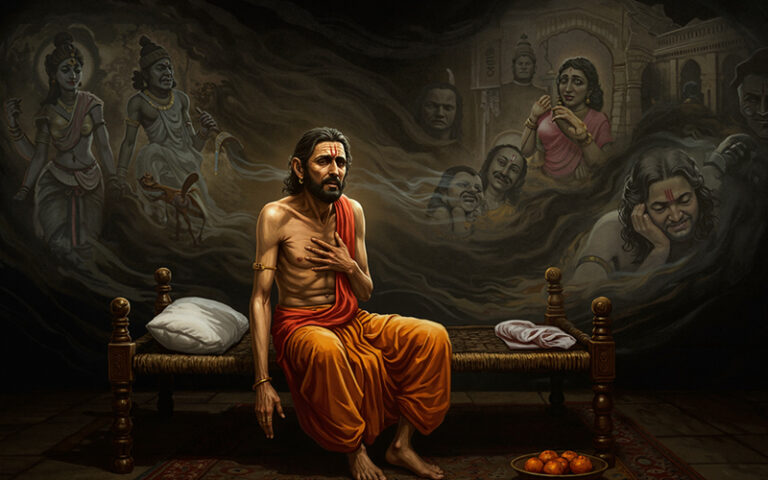

Welcome to Vibes of Divinity. Everything taught across seventeen chapters converges in Bhagavad Gita Chapter 18 (Moksha Sanyasa Yoga)—the longest and culminating chapter of the Gita. Here, Lord Krishna unifies action, wisdom, and devotion into one unforgettable final call: do your duty with integrity, surrender anxiety to the Divine, and walk forward free from fear.
- Chapter Name: मोक्षसंन्यासयोग (Moksha Sanyasa Yoga)
- Section: Section 3: Deepening Wisdom & Final Liberation (Chapters 13–18)
- Complete Text Included: All 78 Sanskrit shlokas with IAST transliteration & English translation
- Series Index: Bhagavad Gita Complete Guide (All 18 Chapters & 701 Shlokas)
Chapter 18 Summary & Context on Kurukshetra
Arjuna opens by asking the subtle difference between Sanyasa (renouncing desire-driven works) and Tyaga (relinquishing selfish attachment to the fruits of all actions). Krishna clarifies that charity, inner discipline, and selfless service should never be abandoned—only ego-driven attachment to results should be dropped.
Krishna reviews how the three gunas color knowledge, action, intellect, determination, and happiness—noting that Sattvic joy may taste bitter at first through discipline, yet becomes nectar in the end. He affirms that fulfilling one’s natural work as worship of the Divine leads straight to perfection.
In the moving climax (18.63–18.66), Krishna honors Arjuna’s free will (‘Reflect deeply, then do as you choose’) before offering the Gita’s supreme secret: surrender completely to Me and fear nothing. Arjuna’s confusion vanishes—‘My delusion is gone; I stand firm, free of doubt, and will act by Your word.’ Sanjaya closes the Gita declaring that wherever Krishna (Yoga) and Arjuna (action) stand united, victory, prosperity, and justice are assured.
Highlighted Shlokas & Spiritual Reflections (Chapter 18)
Shloka 18.46 — Worshipping God Through Honest Work
यतः प्रवृत्तिर्भूतानां येन सर्वमिदं ततम् । स्वकर्मणा तमभ्यर्च्य सिद्धिं विन्दति मानवः ॥
Yataḥ pravṛttir bhūtānāṁ yena sarvam idaṁ tatam | Sva-karmaṇā tam abhyarcya siddhiṁ vindati mānavaḥ ||
Meaning: By worshipping Him from whom all beings originate and by whom all this universe is pervaded—through the sincere performance of one’s own duty—a human being attains perfection.
Your everyday work becomes sacred prayer the moment you offer it honestly to the Creator.
Shloka 18.66 — The Supreme Assurance (Charama Shloka)
सर्वधर्मान्परित्यज्य मामेकं शरणं व्रज । अहं त्वां सर्वपापेभ्यो मोक्षयिष्यामि मा शुचः ॥
Sarva-dharmān parityajya mām ekaṁ śaraṇaṁ vraja | Ahaṁ tvāṁ sarva-pāpebhyo mokṣayiṣyāmi mā śucaḥ ||
Meaning: Abandoning all narrow attachments, take refuge in Me alone. I shall liberate you from all sins and sorrows; do not grieve.
Known as the Charama Shloka, this verse captures the tender core of the Gita: complete trust in divine grace dissolves guilt and fear.
Shloka 18.78 — Where Wisdom Meets Courageous Action
यत्र योगेश्वरः कृष्णो यत्र पार्थो धनुर्धरः । तत्र श्रीर्विजयो भूतिर्ध्रुवा नीतिर्मतिर्मम ॥
Yatra yogeśvaraḥ kṛṣṇo yatra pārtho dhanur-dharaḥ | Tatra śrīr vijayo bhūtir dhruvā nītir matir mama ||
Meaning: Wherever there is Krishna, the Lord of Yoga, and wherever there is Arjuna, the wielder of the bow, there surely abide prosperity, victory, glory, and unfailing righteousness.
Inner spiritual wisdom (Krishna) united with courageous, disciplined action (Arjuna) brings lasting harmony and true success.
Complete Verse-by-Verse Bhagavad Gita Chapter 18 (All 78 Shlokas)
Read all 78 original Sanskrit verses of Chapter 18 below with Roman IAST transliteration and clear English meaning:
Verse 18.1
अर्जुन उवाच |
संन्यासस्य महाबाहो तत्त्वमिच्छामि वेदितुम् |
त्यागस्य च हृषीकेश पृथक्केशिनिषूदन ||१८-१||
arjuna uvāca .
saṃnyāsasya mahābāho tattvamicchāmi veditum .
tyāgasya ca hṛṣīkeśa pṛthakkeśiniṣūdana ||18-1||
Meaning: Arjuna asked: O mighty One! I desire to know how relinquishment is distinguished from renunciation.
Verse 18.2
श्रीभगवानुवाच |
काम्यानां कर्मणां न्यासं संन्यासं कवयो विदुः |
सर्वकर्मफलत्यागं प्राहुस्त्यागं विचक्षणाः ||१८-२||
śrībhagavānuvāca .
kāmyānāṃ karmaṇāṃ nyāsaṃ saṃnyāsaṃ kavayo viduḥ .
sarvakarmaphalatyāgaṃ prāhustyāgaṃ vicakṣaṇāḥ ||18-2||
Meaning: Lord Shri Krishna replied: The sages say that renunciation means forgoing an action which springs from desire; and relinquishing means the surrender of its fruit.
Verse 18.3
त्याज्यं दोषवदित्येके कर्म प्राहुर्मनीषिणः |
यज्ञदानतपःकर्म न त्याज्यमिति चापरे ||१८-३||
tyājyaṃ doṣavadityeke karma prāhurmanīṣiṇaḥ .
yajñadānatapaḥkarma na tyājyamiti cāpare ||18-3||
Meaning: Some philosophers say that all action is evil and should be abandoned. Others that acts of sacrifice, benevolence and austerity should not be given up.
Verse 18.4
निश्चयं शृणु मे तत्र त्यागे भरतसत्तम |
त्यागो हि पुरुषव्याघ्र त्रिविधः सम्प्रकीर्तितः ||१८-४||
niścayaṃ śṛṇu me tatra tyāge bharatasattama .
tyāgo hi puruṣavyāghra trividhaḥ samprakīrtitaḥ ||18-4||
Meaning: O best of Indians! Listen to my judgment as regards this problem. It has a threefold aspect.
Verse 18.5
यज्ञदानतपःकर्म न त्याज्यं कार्यमेव तत् |
यज्ञो दानं तपश्चैव पावनानि मनीषिणाम् ||१८-५||
yajñadānatapaḥkarma na tyājyaṃ kāryameva tat .
yajño dānaṃ tapaścaiva pāvanāni manīṣiṇām ||18-5||
Meaning: Acts of sacrifice, benevolence and austerity should not be given up but should be performed, for they purify the aspiring soul.
Verse 18.6
एतान्यपि तु कर्माणि सङ्गं त्यक्त्वा फलानि च |
कर्तव्यानीति मे पार्थ निश्चितं मतमुत्तमम् ||१८-६||
etānyapi tu karmāṇi saṅgaṃ tyaktvā phalāni ca .
kartavyānīti me pārtha niścitaṃ matamuttamam ||18-6||
Meaning: But they should be done with detachment and without thought of recompense. This is my final judgment.
Verse 18.7
नियतस्य तु संन्यासः कर्मणो नोपपद्यते |
मोहात्तस्य परित्यागस्तामसः परिकीर्तितः ||१८-७||
niyatasya tu saṃnyāsaḥ karmaṇo nopapadyate .
mohāttasya parityāgastāmasaḥ parikīrtitaḥ ||18-7||
Meaning: It is not right to give up actions which are obligatory; and if they are misunderstood, it is the result of sheer ignorance.
Verse 18.8
दुःखमित्येव यत्कर्म कायक्लेशभयात्त्यजेत् |
स कृत्वा राजसं त्यागं नैव त्यागफलं लभेत् ||१८-८||
duḥkhamityeva yatkarma kāyakleśabhayāttyajet .
sa kṛtvā rājasaṃ tyāgaṃ naiva tyāgaphalaṃ labhet ||18-8||
Meaning: To avoid an action through fear of physical suffering, because it is likely to be painful, is to act from passion, and the benefit of renunciation will not follow.
Verse 18.9
कार्यमित्येव यत्कर्म नियतं क्रियतेऽर्जुन |
सङ्गं त्यक्त्वा फलं चैव स त्यागः सात्त्विको मतः ||१८-९||
kāryamityeva yatkarma niyataṃ kriyate.arjuna .
saṅgaṃ tyaktvā phalaṃ caiva sa tyāgaḥ sāttviko mataḥ ||18-9||
Meaning: He who performs an obligatory action, because he believes it to be a duty which ought to be done, without any personal desire to do the act or to receive any return – such renunciation is Pure.
Verse 18.10
न द्वेष्ट्यकुशलं कर्म कुशले नानुषज्जते |
त्यागी सत्त्वसमाविष्टो मेधावी छिन्नसंशयः ||१८-१०||
na dveṣṭyakuśalaṃ karma kuśale nānuṣajjate .
tyāgī sattvasamāviṣṭo medhāvī chinnasaṃśayaḥ ||18-10||
Meaning: The wise man who has attained purity, whose doubts are solved, who is filled with the spirit of self-abnegation, does not shrink from action because it brings pain, nor does he desire it because it brings pleasure.
Verse 18.11
न हि देहभृता शक्यं त्यक्तुं कर्माण्यशेषतः |
यस्तु कर्मफलत्यागी स त्यागीत्यभिधीयते ||१८-११||
na hi dehabhṛtā śakyaṃ tyaktuṃ karmāṇyaśeṣataḥ .
yastu karmaphalatyāgī sa tyāgītyabhidhīyate ||18-11||
Meaning: But since those still in the body cannot entirely avoid action, in their case abandonment of the fruit of action is considered as complete renunciation.
Verse 18.12
अनिष्टमिष्टं मिश्रं च त्रिविधं कर्मणः फलम् |
भवत्यत्यागिनां प्रेत्य न तु संन्यासिनां क्वचित् ||१८-१२||
aniṣṭamiṣṭaṃ miśraṃ ca trividhaṃ karmaṇaḥ phalam .
bhavatyatyāgināṃ pretya na tu saṃnyāsināṃ kvacit ||18-12||
Meaning: For those who cannot renounce all desire, the fruit of action hereafter is threefold – good, evil, and partly good and partly evil. But for him who has renounced, there is none.
Verse 18.13
पञ्चैतानि महाबाहो कारणानि निबोध मे |
साङ्ख्ये कृतान्ते प्रोक्तानि सिद्धये सर्वकर्मणाम् ||१८-१३||
pañcaitāni mahābāho kāraṇāni nibodha me .
sāṅkhye kṛtānte proktāni siddhaye sarvakarmaṇām ||18-13||
Meaning: I will tell thee now, O Mighty Man, the five causes which, according to the final decision of philosophy, must concur before an action can be accomplished.
Verse 18.14
अधिष्ठानं तथा कर्ता करणं च पृथग्विधम् |
विविधाश्च पृथक्चेष्टा दैवं चैवात्र पञ्चमम् ||१८-१४||
adhiṣṭhānaṃ tathā kartā karaṇaṃ ca pṛthagvidham .
vividhāśca pṛthakceṣṭā daivaṃ caivātra pañcamam ||18-14||
Meaning: They are a body, a personality, physical organs, their manifold activity and destiny.
Verse 18.15
शरीरवाङ्मनोभिर्यत्कर्म प्रारभते नरः |
न्याय्यं वा विपरीतं वा पञ्चैते तस्य हेतवः ||१८-१५||
śarīravāṅmanobhiryatkarma prārabhate naraḥ .
nyāyyaṃ vā viparītaṃ vā pañcaite tasya hetavaḥ ||18-15||
Meaning: Whatever action a man performs, whether by muscular effort or by speech or by thought, and whether it be right or wrong, these five are the essential causes.
Verse 18.16
तत्रैवं सति कर्तारमात्मानं केवलं तु यः |
पश्यत्यकृतबुद्धित्वान्न स पश्यति दुर्मतिः ||१८-१६||
tatraivaṃ sati kartāramātmānaṃ kevalaṃ tu yaḥ .
paśyatyakṛtabuddhitvānna sa paśyati durmatiḥ ||18-16||
Meaning: But the fool who supposes, because of his immature judgment, that it is his own Self alone that acts, he perverts the truth and does not see rightly.
Verse 18.17
यस्य नाहंकृतो भावो बुद्धिर्यस्य न लिप्यते |
हत्वाऽपि स इमाँल्लोकान्न हन्ति न निबध्यते ||१८-१७||
yasya nāhaṃkṛto bhāvo buddhiryasya na lipyate .
hatvā.api sa imā.Nllokānna hanti na nibadhyate ||18-17||
Meaning: He who has no pride, and whose intellect is unalloyed by attachment, even though he kill these people, yet he does not kill them, and his act does not bind him.
Verse 18.18
ज्ञानं ज्ञेयं परिज्ञाता त्रिविधा कर्मचोदना |
करणं कर्म कर्तेति त्रिविधः कर्मसंग्रहः ||१८-१८||
jñānaṃ jñeyaṃ parijñātā trividhā karmacodanā .
karaṇaṃ karma karteti trividhaḥ karmasaṃgrahaḥ ||18-18||
Meaning: Knowledge, the knower and the object of knowledge, these are the three incentives to action; and the act, the actor and the instrument are the threefold constituents.
Verse 18.19
ज्ञानं कर्म च कर्ताच त्रिधैव गुणभेदतः |
प्रोच्यते गुणसङ्ख्याने यथावच्छृणु तान्यपि ||१८-१९||
jñānaṃ karma ca kartāca tridhaiva guṇabhedataḥ .
procyate guṇasaṅkhyāne yathāvacchṛṇu tānyapi ||18-19||
Meaning: The knowledge, the act and the doer differ according to the Qualities. Listen to this too:
Verse 18.20
सर्वभूतेषु येनैकं भावमव्ययमीक्षते |
अविभक्तं विभक्तेषु तज्ज्ञानं विद्धि सात्त्विकम् ||१८-२०||
sarvabhūteṣu yenaikaṃ bhāvamavyayamīkṣate .
avibhaktaṃ vibhakteṣu tajjñānaṃ viddhi sāttvikam ||18-20||
Meaning: That knowledge which sees the One Indestructible in all beings, the One Indivisible in all separate lives, may be truly called Pure Knowledge.
Verse 18.21
पृथक्त्वेन तु यज्ज्ञानं नानाभावान्पृथग्विधान् |
वेत्ति सर्वेषु भूतेषु तज्ज्ञानं विद्धि राजसम् ||१८-२१||
pṛthaktvena tu yajjñānaṃ nānābhāvānpṛthagvidhān .
vetti sarveṣu bhūteṣu tajjñānaṃ viddhi rājasam ||18-21||
Meaning: The knowledge which thinks of the manifold existence in all beings as separate – that comes from Passion.
Verse 18.22
यत्तु कृत्स्नवदेकस्मिन्कार्ये सक्तमहैतुकम् |
अतत्त्वार्थवदल्पं च तत्तामसमुदाहृतम् ||१८-२२||
yattu kṛtsnavadekasminkārye saktamahaitukam .
atattvārthavadalpaṃ ca tattāmasamudāhṛtam ||18-22||
Meaning: But that which clings blindly to one idea as if it were all, without logic, truth or insight, that has its origin in Darkness.
Verse 18.23
नियतं सङ्गरहितमरागद्वेषतः कृतम् |
अफलप्रेप्सुना कर्म यत्तत्सात्त्विकमुच्यते ||१८-२३||
niyataṃ saṅgarahitamarāgadveṣataḥ kṛtam .
aphalaprepsunā karma yattatsāttvikamucyate ||18-23||
Meaning: An obligatory action done by one who is disinterested, who neither likes nor dislikes it, and gives no thought to the consequences that follow, such an action is Pure.
Verse 18.24
यत्तु कामेप्सुना कर्म साहंकारेण वा पुनः |
क्रियते बहुलायासं तद्राजसमुदाहृतम् ||१८-२४||
yattu kāmepsunā karma sāhaṃkāreṇa vā punaḥ .
kriyate bahulāyāsaṃ tadrājasamudāhṛtam ||18-24||
Meaning: But even though an action involve the most strenuous endeavour, yet if the doer is seeking to gratify his desires, and is filled with personal vanity, it may be assumed to originate in Passion.
Verse 18.25
अनुबन्धं क्षयं हिंसामनपेक्ष्य च पौरुषम् |
मोहादारभ्यते कर्म यत्तत्तामसमुच्यते ||१८-२५||
anubandhaṃ kṣayaṃ hiṃsāmanapekṣya ca pauruṣam .
mohādārabhyate karma yattattāmasamucyate ||18-25||
Meaning: An action undertaken through delusion, and with no regard to the spiritual issues involved, or the real capacity of the doer, or to the injury which may follow, such an act may be assumed to be the product of Ignorance.
Verse 18.26
मुक्तसङ्गोऽनहंवादी धृत्युत्साहसमन्वितः |
सिद्ध्यसिद्ध्योर्निर्विकारः कर्ता सात्त्विक उच्यते ||१८-२६||
muktasaṅgo.anahaṃvādī dhṛtyutsāhasamanvitaḥ .
siddhyasiddhyornirvikāraḥ kartā sāttvika ucyate ||18-26||
Meaning: But when a man has no sentiment and no personal vanity, when he possesses courage and confidence, cares not whether he succeeds or fails, then his action arises from Purity.
Verse 18.27
रागी कर्मफलप्रेप्सुर्लुब्धो हिंसात्मकोऽशुचिः |
हर्षशोकान्वितः कर्ता राजसः परिकीर्तितः ||१८-२७||
rāgī karmaphalaprepsurlubdho hiṃsātmako.aśuciḥ .
harṣaśokānvitaḥ kartā rājasaḥ parikīrtitaḥ ||18-27||
Meaning: In him who is impulsive, greedy, looking for reward, violent, impure, torn between joy and sorrow,it may be assumed that in him Passion is predominant.
Verse 18.28
अयुक्तः प्राकृतः स्तब्धः शठो नैष्कृतिकोऽलसः |
विषादी दीर्घसूत्री च कर्ता तामस उच्यते ||१८-२८||
ayuktaḥ prākṛtaḥ stabdhaḥ śaṭho naiṣkṛtiko.alasaḥ .
viṣādī dīrghasūtrī ca kartā tāmasa ucyate ||18-28||
Meaning: While he whose purpose is infirm, who is low-minded, stubborn, dishonest, malicious, indolent, despondent, procrastinating – he may be assumed to be in Darkness.
Verse 18.29
बुद्धेर्भेदं धृतेश्चैव गुणतस्त्रिविधं शृणु |
प्रोच्यमानमशेषेण पृथक्त्वेन धनञ्जय ||१८-२९||
buddherbhedaṃ dhṛteścaiva guṇatastrividhaṃ śṛṇu .
procyamānamaśeṣeṇa pṛthaktvena dhanañjaya ||18-29||
Meaning: Reason and conviction are threefold, according to the Quality which is dominant. I will explain them fully and severally, O Arjuna!
Verse 18.30
प्रवृत्तिं च निवृत्तिं च कार्याकार्ये भयाभये |
बन्धं मोक्षं च या वेत्ति बुद्धिः सा पार्थ सात्त्विकी ||१८-३०||
pravṛttiṃ ca nivṛttiṃ ca kāryākārye bhayābhaye .
bandhaṃ mokṣaṃ ca yā vetti buddhiḥ sā pārtha sāttvikī ||18-30||
Meaning: That intellect which understands the creation and dissolution of life, what actions should be done and what not, which discriminates between fear and fearlessness, bondage and deliverance, that is Pure.
Verse 18.31
यया धर्ममधर्मं च कार्यं चाकार्यमेव च |
अयथावत्प्रजानाति बुद्धिः सा पार्थ राजसी ||१८-३१||
yayā dharmamadharmaṃ ca kāryaṃ cākāryameva ca .
ayathāvatprajānāti buddhiḥ sā pārtha rājasī ||18-31||
Meaning: The intellect which does not understand what is right and what is wrong, and what should be done and what not, is under the sway of Passion.
Verse 18.32
अधर्मं धर्ममिति या मन्यते तमसावृता |
सर्वार्थान्विपरीतांश्च बुद्धिः सा पार्थ तामसी ||१८-३२||
adharmaṃ dharmamiti yā manyate tamasāvṛtā .
sarvārthānviparītāṃśca buddhiḥ sā pārtha tāmasī ||18-32||
Meaning: And that which, shrouded in Ignorance, thinks wrong right, and sees everything perversely, O Arjuna, that intellect is ruled by Darkness.
Verse 18.33
धृत्या यया धारयते मनःप्राणेन्द्रियक्रियाः |
योगेनाव्यभिचारिण्या धृतिः सा पार्थ सात्त्विकी ||१८-३३||
dhṛtyā yayā dhārayate manaḥprāṇendriyakriyāḥ .
yogenāvyabhicāriṇyā dhṛtiḥ sā pārtha sāttvikī ||18-33||
Meaning: The conviction and steady concentration by which the mind, the vitality and the senses are controlled – O Arjuna! They are the product of Purity.
Verse 18.34
यया तु धर्मकामार्थान्धृत्या धारयतेऽर्जुन |
प्रसङ्गेन फलाकाङ्क्षी धृतिः सा पार्थ राजसी ||१८-३४||
yayā tu dharmakāmārthāndhṛtyā dhārayate.arjuna .
prasaṅgena phalākāṅkṣī dhṛtiḥ sā pārtha rājasī ||18-34||
Meaning: The conviction which always holds fast to rituals, to self-interest and wealth, for the sake of what they may bring forth – that comes from Passion.
Verse 18.35
यया स्वप्नं भयं शोकं विषादं मदमेव च |
न विमुञ्चति दुर्मेधा धृतिः सा पार्थ तामसी ||१८-३५||
yayā svapnaṃ bhayaṃ śokaṃ viṣādaṃ madameva ca .
na vimuñcati durmedhā dhṛtiḥ sā pārtha tāmasī ||18-35||
Meaning: And that which clings perversely to false idealism, fear, grief, despair and vanity is the product of Ignorance.
Verse 18.36
सुखं त्विदानीं त्रिविधं शृणु मे भरतर्षभ |
अभ्यासाद्रमते यत्र दुःखान्तं च निगच्छति ||१८-३६||
sukhaṃ tvidānīṃ trividhaṃ śṛṇu me bharatarṣabha .
abhyāsādramate yatra duḥkhāntaṃ ca nigacchati ||18-36||
Meaning: Hear further the three kinds of pleasure. That which increases day after day delivers one from misery,
Verse 18.37
यत्तदग्रे विषमिव परिणामेऽमृतोपमम् |
तत्सुखं सात्त्विकं प्रोक्तमात्मबुद्धिप्रसादजम् ||१८-३७||
yattadagre viṣamiva pariṇāme.amṛtopamam .
tatsukhaṃ sāttvikaṃ proktamātmabuddhiprasādajam ||18-37||
Meaning: Which at first seems like poison but afterwards acts like nectar – that pleasure is Pure, for it is born of Wisdom.
Verse 18.38
विषयेन्द्रियसंयोगाद्यत्तदग्रेऽमृतोपमम् |
परिणामे विषमिव तत्सुखं राजसं स्मृतम् ||१८-३८||
viṣayendriyasaṃyogādyattadagre.amṛtopamam .
pariṇāme viṣamiva tatsukhaṃ rājasaṃ smṛtam ||18-38||
Meaning: That which as first is like nectar, because the senses revel in their objects, but in the end acts like poison – that pleasure arises from Passion.
Verse 18.39
यदग्रे चानुबन्धे च सुखं मोहनमात्मनः |
निद्रालस्यप्रमादोत्थं तत्तामसमुदाहृतम् ||१८-३९||
yadagre cānubandhe ca sukhaṃ mohanamātmanaḥ .
nidrālasyapramādotthaṃ tattāmasamudāhṛtam ||18-39||
Meaning: While the pleasure which from first to last merely drugs the senses, which springs from indolence, lethargy and folly – that pleasure flows from Ignorance.
Verse 18.40
न तदस्ति पृथिव्यां वा दिवि देवेषु वा पुनः |
सत्त्वं प्रकृतिजैर्मुक्तं यदेभिः स्यात्त्रिभिर्गुणैः ||१८-४०||
na tadasti pṛthivyāṃ vā divi deveṣu vā punaḥ .
sattvaṃ prakṛtijairmuktaṃ yadebhiḥ syāttribhirguṇaiḥ ||18-40||
Meaning: There is nothing anywhere on earth or in the higher worlds which is free from the three Qualities – for they are born of Nature.
Verse 18.41
ब्राह्मणक्षत्रियविशां शूद्राणां च परन्तप |
कर्माणि प्रविभक्तानि स्वभावप्रभवैर्गुणैः ||१८-४१||
brāhmaṇakṣatriyaviśāṃ śūdrāṇāṃ ca parantapa .
karmāṇi pravibhaktāni svabhāvaprabhavairguṇaiḥ ||18-41||
Meaning: O Arjuna! The duties of spiritual teachers, the soldiers, the traders and the servants have all been fixed according to the dominant Quality in their nature.
Verse 18.42
शमो दमस्तपः शौचं क्षान्तिरार्जवमेव च |
ज्ञानं विज्ञानमास्तिक्यं ब्रह्मकर्म स्वभावजम् ||१८-४२||
śamo damastapaḥ śaucaṃ kṣāntirārjavameva ca .
jñānaṃ vijñānamāstikyaṃ brahmakarma svabhāvajam ||18-42||
Meaning: Serenity, self-restraint, austerity, purity, forgiveness, as well as uprightness, knowledge, wisdom and faith in God – these constitute the duty of a spiritual Teacher.
Verse 18.43
शौर्यं तेजो धृतिर्दाक्ष्यं युद्धे चाप्यपलायनम् |
दानमीश्वरभावश्च क्षात्रं कर्म स्वभावजम् ||१८-४३||
śauryaṃ tejo dhṛtirdākṣyaṃ yuddhe cāpyapalāyanam .
dānamīśvarabhāvaśca kṣātraṃ karma svabhāvajam ||18-43||
Meaning: Valour, glory, firmness, skill, generosity, steadiness in battle and ability to rule – these constitute the duty of a soldier. They flow from his own nature.
Verse 18.44
कृषिगौरक्ष्यवाणिज्यं वैश्यकर्म स्वभावजम् |
परिचर्यात्मकं कर्म शूद्रस्यापि स्वभावजम् ||१८-४४||
kṛṣigaurakṣyavāṇijyaṃ vaiśyakarma svabhāvajam .
paricaryātmakaṃ karma śūdrasyāpi svabhāvajam ||18-44||
Meaning: Agriculture, protection of the cow and trade are the duty of a trader, again in accordance with his nature. The duty of a servant is to serve, and that too agrees with his nature.
Verse 18.45
स्वे स्वे कर्मण्यभिरतः संसिद्धिं लभते नरः |
स्वकर्मनिरतः सिद्धिं यथा विन्दति तच्छृणु ||१८-४५||
sve sve karmaṇyabhirataḥ saṃsiddhiṃ labhate naraḥ .
svakarmanirataḥ siddhiṃ yathā vindati tacchṛṇu ||18-45||
Meaning: 5.10 He who dedicates his actions to the Spirit, without any personal attachment to them, he is no more tainted by sin than the water lily is wetted by water.
Verse 18.46
यतः प्रवृत्तिर्भूतानां येन सर्वमिदं ततम् |
स्वकर्मणा तमभ्यर्च्य सिद्धिं विन्दति मानवः ||१८-४६||
yataḥ pravṛttirbhūtānāṃ yena sarvamidaṃ tatam .
svakarmaṇā tamabhyarcya siddhiṃ vindati mānavaḥ ||18-46||
Meaning: Man reaches perfection by dedicating his actions to God, Who is the source of all being, and fills everything.
Verse 18.47
श्रेयान्स्वधर्मो विगुणः परधर्मात्स्वनुष्ठितात् |
स्वभावनियतं कर्म कुर्वन्नाप्नोति किल्बिषम् ||१८-४७||
śreyānsvadharmo viguṇaḥ paradharmātsvanuṣṭhitāt .
svabhāvaniyataṃ karma kurvannāpnoti kilbiṣam ||18-47||
Meaning: It is better to do one's own duty, however defective it may be, than to follow the duty of another, however well one may perform it. He who does his duty as his own nature reveals it, never sins.
Verse 18.48
सहजं कर्म कौन्तेय सदोषमपि न त्यजेत् |
सर्वारम्भा हि दोषेण धूमेनाग्निरिवावृताः ||१८-४८||
sahajaṃ karma kaunteya sadoṣamapi na tyajet .
sarvārambhā hi doṣeṇa dhūmenāgnirivāvṛtāḥ ||18-48||
Meaning: The duty that of itself falls to one's lot should not be abandoned, though it may have its defects. All acts are marred by defects, as fire is obscured by smoke.
Verse 18.49
असक्तबुद्धिः सर्वत्र जितात्मा विगतस्पृहः |
नैष्कर्म्यसिद्धिं परमां संन्यासेनाधिगच्छति ||१८-४९||
asaktabuddhiḥ sarvatra jitātmā vigataspṛhaḥ .
naiṣkarmyasiddhiṃ paramāṃ saṃnyāsenādhigacchati ||18-49||
Meaning: He whose mind is entirely detached, who has conquered himself, whose desires have vanished, by his renunciation reaches that stage of perfect freedom where action completes itself and leaves no seed.
Verse 18.50
सिद्धिं प्राप्तो यथा ब्रह्म तथाप्नोति निबोध मे |
समासेनैव कौन्तेय निष्ठा ज्ञानस्य या परा ||१८-५०||
siddhiṃ prāpto yathā brahma tathāpnoti nibodha me .
samāsenaiva kaunteya niṣṭhā jñānasya yā parā ||18-50||
Meaning: I will now state briefly how he, who has reached perfection, finds the Eternal Spirit, the state of Supreme Wisdom.
Verse 18.51
बुद्ध्या विशुद्धया युक्तो धृत्यात्मानं नियम्य च |
शब्दादीन्विषयांस्त्यक्त्वा रागद्वेषौ व्युदस्य च ||१८-५१||
buddhyā viśuddhayā yukto dhṛtyātmānaṃ niyamya ca .
śabdādīnviṣayāṃstyaktvā rāgadveṣau vyudasya ca ||18-51||
Meaning: Guided always by pure reason, bravely restraining himself, renouncing the objects of sense and giving up attachment and hatred;
Verse 18.52
विविक्तसेवी लघ्वाशी यतवाक्कायमानसः |
ध्यानयोगपरो नित्यं वैराग्यं समुपाश्रितः ||१८-५२||
viviktasevī laghvāśī yatavākkāyamānasaḥ .
dhyānayogaparo nityaṃ vairāgyaṃ samupāśritaḥ ||18-52||
Meaning: Enjoying solitude, abstemiousness, his body, mind and speech under perfect control, absorbed in meditation, he becomes free – always filled with the spirit of renunciation.
Verse 18.53
अहंकारं बलं दर्पं कामं क्रोधं परिग्रहम् |
विमुच्य निर्ममः शान्तो ब्रह्मभूयाय कल्पते ||१८-५३||
ahaṃkāraṃ balaṃ darpaṃ kāmaṃ krodhaṃ parigraham .
vimucya nirmamaḥ śānto brahmabhūyāya kalpate ||18-53||
Meaning: Having abandoned selfishness, power, arrogance, anger and desire, possessing nothing of his own and having attained peace, he is fit to join the Eternal Spirit.
Verse 18.54
ब्रह्मभूतः प्रसन्नात्मा न शोचति न काङ्क्षति |
समः सर्वेषु भूतेषु मद्भक्तिं लभते पराम् ||१८-५४||
brahmabhūtaḥ prasannātmā na śocati na kāṅkṣati .
samaḥ sarveṣu bhūteṣu madbhaktiṃ labhate parām ||18-54||
Meaning: And when he becomes one with the Eternal, and his soul knows the bliss that belongs to the Self, he feels no desire and no regret, he regards all beings equally and enjoys the blessing of supreme devotion to Me.
Verse 18.55
भक्त्या मामभिजानाति यावान्यश्चास्मि तत्त्वतः |
ततो मां तत्त्वतो ज्ञात्वा विशते तदनन्तरम् ||१८-५५||
bhaktyā māmabhijānāti yāvānyaścāsmi tattvataḥ .
tato māṃ tattvato jñātvā viśate tadanantaram ||18-55||
Meaning: By such devotion, he sees Me, who I am and what I am; and thus realising the Truth, he enters My Kingdom.
Verse 18.56
सर्वकर्माण्यपि सदा कुर्वाणो मद्व्यपाश्रयः |
मत्प्रसादादवाप्नोति शाश्वतं पदमव्ययम् ||१८-५६||
sarvakarmāṇyapi sadā kurvāṇo madvyapāśrayaḥ .
matprasādādavāpnoti śāśvataṃ padamavyayam ||18-56||
Meaning: Relying on Me in all his action and doing them for My sake, he attains, by My Grace, Eternal and Unchangeable Life.
Verse 18.57
चेतसा सर्वकर्माणि मयि संन्यस्य मत्परः |
बुद्धियोगमुपाश्रित्य मच्चित्तः सततं भव ||१८-५७||
cetasā sarvakarmāṇi mayi saṃnyasya matparaḥ .
buddhiyogamupāśritya maccittaḥ satataṃ bhava ||18-57||
Meaning: Surrender then thy actions unto Me, live in Me, concentrate thine intellect on Me, and think always of Me.
Verse 18.58
मच्चित्तः सर्वदुर्गाणि मत्प्रसादात्तरिष्यसि |
अथ चेत्त्वमहंकारान्न श्रोष्यसि विनङ्क्ष्यसि ||१८-५८||
maccittaḥ sarvadurgāṇi matprasādāttariṣyasi .
atha cettvamahaṃkārānna śroṣyasi vinaṅkṣyasi ||18-58||
Meaning: Fix but thy mind on Me, and by My grace thou shalt overcome the obstacles in thy path. But if, misled by pride, thou wilt not listen, then indeed thou shalt be lost.
Verse 18.59
यदहंकारमाश्रित्य न योत्स्य इति मन्यसे |
मिथ्यैष व्यवसायस्ते प्रकृतिस्त्वां नियोक्ष्यति ||१८-५९||
yadahaṃkāramāśritya na yotsya iti manyase .
mithyaiṣa vyavasāyaste prakṛtistvāṃ niyokṣyati ||18-59||
Meaning: If thou in thy vanity thinkest of avoiding this fight, thy will shall not be fulfilled, for Nature herself will compel thee.
Verse 18.60
स्वभावजेन कौन्तेय निबद्धः स्वेन कर्मणा |
कर्तुं नेच्छसि यन्मोहात्करिष्यस्यवशोपि तत् ||१८-६०||
svabhāvajena kaunteya nibaddhaḥ svena karmaṇā .
kartuṃ necchasi yanmohātkariṣyasyavaśopi tat ||18-60||
Meaning: O Arjuna! Thy duty binds thee. From thine own nature has it arisen, and that which in thy delusion thou desire not to do, that very thing thou shalt do. Thou art helpless.
Verse 18.61
ईश्वरः सर्वभूतानां हृद्देशेऽर्जुन तिष्ठति |
भ्रामयन्सर्वभूतानि यन्त्रारूढानि मायया ||१८-६१||
īśvaraḥ sarvabhūtānāṃ hṛddeśe.arjuna tiṣṭhati .
bhrāmayansarvabhūtāni yantrārūḍhāni māyayā ||18-61||
Meaning: God dwells in the hearts of all beings, O Arjuna! He causes them to revolve as it were on a wheel by His mystic power.
Verse 18.62
तमेव शरणं गच्छ सर्वभावेन भारत |
तत्प्रसादात्परां शान्तिं स्थानं प्राप्स्यसि शाश्वतम् ||१८-६२||
tameva śaraṇaṃ gaccha sarvabhāvena bhārata .
tatprasādātparāṃ śāntiṃ sthānaṃ prāpsyasi śāśvatam ||18-62||
Meaning: With all thy strength, fly unto Him and surrender thyself, and by His grace shalt thou attain Supreme Peace and reach the Eternal Home.
Verse 18.63
इति ते ज्ञानमाख्यातं गुह्याद्गुह्यतरं मया |
विमृश्यैतदशेषेण यथेच्छसि तथा कुरु ||१८-६३||
iti te jñānamākhyātaṃ guhyādguhyataraṃ mayā .
vimṛśyaitadaśeṣeṇa yathecchasi tathā kuru ||18-63||
Meaning: Thus have I revealed to thee the Truth, the Mystery of mysteries. Having thought it over, thou art free to act as thou wilt.
Verse 18.64
सर्वगुह्यतमं भूयः शृणु मे परमं वचः |
इष्टोऽसि मे दृढमिति ततो वक्ष्यामि ते हितम् ||१८-६४||
sarvaguhyatamaṃ bhūyaḥ śṛṇu me paramaṃ vacaḥ .
iṣṭo.asi me dṛḍhamiti tato vakṣyāmi te hitam ||18-64||
Meaning: Only listen once more to My last word, the deepest secret of all; thou art My beloved, thou are My friend, and I speak for thy welfare.
Verse 18.65
मन्मना भव मद्भक्तो मद्याजी मां नमस्कुरु |
मामेवैष्यसि सत्यं ते प्रतिजाने प्रियोऽसि मे ||१८-६५||
manmanā bhava madbhakto madyājī māṃ namaskuru .
māmevaiṣyasi satyaṃ te pratijāne priyo.asi me ||18-65||
Meaning: Dedicate thyself to Me, worship Me, sacrifice all for Me, prostrate thyself before Me, and to Me thou shalt surely come. Truly do I pledge thee; thou art My own beloved.
Verse 18.66
सर्वधर्मान्परित्यज्य मामेकं शरणं व्रज |
अहं त्वा सर्वपापेभ्यो मोक्षयिष्यामि मा शुचः ||१८-६६||
sarvadharmānparityajya māmekaṃ śaraṇaṃ vraja .
ahaṃ tvāṃ sarvapāpebhyo mokṣyayiṣyāmi mā śucaḥ ||18-66||
Meaning: Give up then thy earthly duties, surrender thyself to Me only. Do not be anxious; I will absolve thee from all thy sin.
Verse 18.67
इदं ते नातपस्काय नाभक्ताय कदाचन |
न चाशुश्रूषवे वाच्यं न च मां योऽभ्यसूयति ||१८-६७||
idaṃ te nātapaskāya nābhaktāya kadācana .
na cāśuśrūṣave vācyaṃ na ca māṃ yo.abhyasūyati ||18-67||
Meaning: Speak not this to one who has not practised austerities, or to him who does not love, or who will not listen, or who mocks.
Verse 18.68
य इदं परमं गुह्यं मद्भक्तेष्वभिधास्यति |
भक्तिं मयि परां कृत्वा मामेवैष्यत्यसंशयः ||१८-६८||
ya idaṃ paramaṃ guhyaṃ madbhakteṣvabhidhāsyati .
bhaktiṃ mayi parāṃ kṛtvā māmevaiṣyatyasaṃśayaḥ ||18-68||
Meaning: But he who teaches this great secret to My devotees, his is the highest devotion, and verily he shall come unto Me.
Verse 18.69
न च तस्मान्मनुष्येषु कश्चिन्मे प्रियकृत्तमः |
भविता न च मे तस्मादन्यः प्रियतरो भुवि ||१८-६९||
na ca tasmānmanuṣyeṣu kaścinme priyakṛttamaḥ .
bhavitā na ca me tasmādanyaḥ priyataro bhuvi ||18-69||
Meaning: Nor is there among men any who can perform a service dearer to Me than this, or any man on earth more beloved by Me than he.
Verse 18.70
अध्येष्यते च य इमं धर्म्यं संवादमावयोः |
ज्ञानयज्ञेन तेनाहमिष्टः स्यामिति मे मतिः ||१८-७०||
adhyeṣyate ca ya imaṃ dharmyaṃ saṃvādamāvayoḥ .
jñānayajñena tenāhamiṣṭaḥ syāmiti me matiḥ ||18-70||
Meaning: He who will study this spiritual discourse of ours, I assure thee, he shall thereby worship Me at the altar of Wisdom.
Verse 18.71
श्रद्धावाननसूयश्च शृणुयादपि यो नरः |
सोऽपि मुक्तः शुभाँल्लोकान्प्राप्नुयात्पुण्यकर्मणाम् ||१८-७१||
śraddhāvānanasūyaśca śṛṇuyādapi yo naraḥ .
so.api muktaḥ śubhā.Nllokānprāpnuyātpuṇyakarmaṇām ||18-71||
Meaning: Yea, he who listens to it with faith and without doubt, even he, freed from evil, shalt rise to the worlds which the virtuous attain through righteous deeds.
Verse 18.72
कच्चिदेतच्छ्रुतं पार्थ त्वयैकाग्रेण चेतसा |
कच्चिदज्ञानसम्मोहः प्रनष्टस्ते धनञ्जय ||१८-७२||
kaccidetacchrutaṃ pārtha tvayaikāgreṇa cetasā .
kaccidajñānasammohaḥ pranaṣṭaste dhanañjaya ||18-72||
Meaning: O Arjuna! Hast thou listened attentively to My words? Has thy ignorance and thy delusion gone?
Verse 18.73
अर्जुन उवाच |
नष्टो मोहः स्मृतिर्लब्धा त्वत्प्रसादान्मयाच्युत |
स्थितोऽस्मि गतसन्देहः करिष्ये वचनं तव ||१८-७३||
arjuna uvāca .
naṣṭo mohaḥ smṛtirlabdhā tvatprasādānmayācyuta .
sthito.asmi gatasandehaḥ kariṣye vacanaṃ tava ||18-73||
Meaning: Arjuna replied: My Lord! O Immutable One! My delusion has fled. By Thy Grace, O Changeless One, the light has dawned. My doubts are gone, and I stand before Thee ready to do Thy will.
Verse 18.74
सञ्जय उवाच |
इत्यहं वासुदेवस्य पार्थस्य च महात्मनः |
संवादमिममश्रौषमद्भुतं रोमहर्षणम् ||१८-७४||
sañjaya uvāca .
ityahaṃ vāsudevasya pārthasya ca mahātmanaḥ .
saṃvādamimamaśrauṣamadbhutaṃ romaharṣaṇam ||18-74||
Meaning: Sanjaya told: Thus have I heard this rare, wonderful and soul-stirring discourse of the Lord Shri Krishna and the great-souled Arjuna.
Verse 18.75
व्यासप्रसादाच्छ्रुतवानेतद्गुह्यमहं परम् |
योगं योगेश्वरात्कृष्णात्साक्षात्कथयतः स्वयम् ||१८-७५||
vyāsaprasādācchrutavānetadguhyamahaṃ param .
yogaṃ yogeśvarātkṛṣṇātsākṣātkathayataḥ svayam ||18-75||
Meaning: Through the blessing of the sage Vyasa, I listened to this secret and noble science from the lips of its Master, the Lord Shri Krishna.
Verse 18.76
राजन्संस्मृत्य संस्मृत्य संवादमिममद्भुतम् |
केशवार्जुनयोः पुण्यं हृष्यामि च मुहुर्मुहुः ||१८-७६||
rājansaṃsmṛtya saṃsmṛtya saṃvādamimamadbhutam .
keśavārjunayoḥ puṇyaṃ hṛṣyāmi ca muhurmuhuḥ ||18-76||
Meaning: O King! The more I think of that marvellous and holy discourse, the more I lose myself in joy.
Verse 18.77
तच्च संस्मृत्य संस्मृत्य रूपमत्यद्भुतं हरेः |
विस्मयो मे महान् राजन्हृष्यामि च पुनः पुनः ||१८-७७||
tacca saṃsmṛtya saṃsmṛtya rūpamatyadbhutaṃ hareḥ .
vismayo me mahān rājanhṛṣyāmi ca punaḥ punaḥ ||18-77||
Meaning: As memory recalls again and again the exceeding beauty of the Lord, I am filled with amazement and happiness.
Verse 18.78
यत्र योगेश्वरः कृष्णो यत्र पार्थो धनुर्धरः |
तत्र श्रीर्विजयो भूतिर्ध्रुवा नीतिर्मतिर्मम ||१८-७८||
yatra yogeśvaraḥ kṛṣṇo yatra pārtho dhanurdharaḥ .
tatra śrīrvijayo bhūtirdhruvā nītirmatirmama ||18-78||
Meaning: Wherever is the Lord Shri Krishna, the Prince of Wisdom, and wherever is Arjuna, the Great Archer, I am more than convinced that good fortune, victory, happiness and righteousness will follow
Timeless Life Lessons for Modern Seekers
- Choose Tyaga Over Escapism: Don’t quit meaningful responsibilities; instead, release anxious ego-attachment to outcomes.
- Respect Free Will & Discernment: Like Krishna in 18.63, true wisdom guides without forcing—reflect deeply and act consciously.
- Turn Career & Service into Worship: Excellence in your own calling (18.46) is itself a spiritual offering.
- Unite Krishna & Arjuna Within You: Pair calm spiritual mindfulness with bold, ethical action in the world.
Frequently Asked Questions — Bhagavad Gita Chapter 18
What is the difference between Sanyasa and Tyaga in Gita Chapter 18?
Sanyasa traditionally refers to renouncing desire-motivated actions, while Tyaga means performing rightful duties while relinquishing selfish attachment to their rewards.
Why is verse 18.66 called the Charama Shloka?
It is Krishna’s final, supreme assurance of grace—promising liberation from sorrow and fear to every soul who takes sincere refuge in Him.
How many verses are in Bhagavad Gita Chapter 18?
Chapter 18 is the longest chapter of the Bhagavad Gita with 78 verses.
Continue Your Bhagavad Gita Journey
← Previous: Chapter 17 | All 18 Gita Chapters
To explore more Bhagavad Gita teachings, Puranic stories, and sacred chants and timeless wisdom from Hindu scriptures, visit and subscribe to our official Vibes of Divinity YouTube channel.
Which shloka from this chapter touches your heart most today? Share your reflection in the comments below.