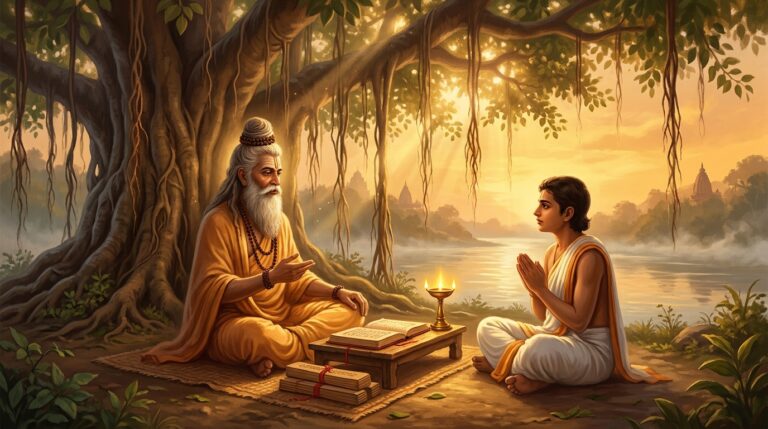

Welcome to Vibes of Divinity. From ancient hermitages to modern classrooms, Sanatana Dharma places extraordinary reverence upon the Guru—not merely as someone who shares facts, but as the luminous guide who removes darkness (Gu = darkness, Ru = remover).
Drawn from the sacred Guru Gita (part of the Skanda Purana), the beloved verse Guru Brahma Guru Vishnu reminds us how true guidance creates, nurtures, and transforms human consciousness.
Sacred Text, Transliteration & Meaning
Verse 1
गुरुर्ब्रह्मा गुरुर्विष्णुर्गुरुर्देवो महेश्वरः ।
गुरुः साक्षात्परं ब्रह्म तस्मै श्रीगुरवे नमः ॥
Gurur brahmā gurur viṣṇur gurur devo maheśvaraḥ |
Guruḥ sākṣāt paraṁ brahma tasmai śrī-gurave namaḥ ||
Meaning: The Guru is Brahma (who sows and creates righteous understanding), the Guru is Vishnu (who sustains and nurtures wisdom), and the Guru is Lord Maheshwara (Shiva, who destroys ignorance and ego). Indeed, the true Guru is the living embodiment of the Supreme Reality (Para Brahman)—to that revered Guru, I offer my humble salutations.
Verse 2
अखण्डमण्डलाकारं व्याप्तं येन चराचरम् ।
तत्पदं दर्शितं येन तस्मै श्रीगुरवे नमः ॥
Akhaṇḍa-maṇḍalākāraṁ vyāptaṁ yena carācaram |
Tat-padaṁ darśitaṁ yena tasmai śrī-gurave namaḥ ||
Meaning: Salutations to that revered Guru who reveals the indivisible, infinite Reality that pervades the entire moving and unmoving universe.
Spiritual Significance & Deeper Insights
- Brahma, Vishnu, and Shiva Within True Teaching: A wise teacher plants seeds of curiosity (Brahma), patiently protects your growth (Vishnu), and lovingly cuts away limiting illusions (Maheshwara).
- Gratitude Unlocks Learning: As Lord Krishna emphasizes in Bhagavad Gita Chapter 4, humility and gratitude turn mere information into living wisdom.
- Honoring Every Teacher in Life: Parents, mentors, elders, and life experiences that push us toward truth all reflect the Guru principle.
How & When to Chant
- Best Occasions: Guru Purnima, Teacher’s Day, Thursdays, and daily before scriptural study or meditation.
- Mindful Practice: Recite the shloka slowly while remembering with gratitude the teachers and mentors who helped shape your character.
- Living the Verse: Express respect through attentive listening, humility, and passing helpful knowledge onward generously.
Frequently Asked Questions
Where does ‘Guru Brahma Guru Vishnu’ originate?
It comes from the sacred Guru Gita, a dialogue between Lord Shiva and Goddess Parvati traditionally found in the Skanda Purana.
What does the word ‘Guru’ literally mean?
Gu signifies darkness or ignorance, and Ru signifies the dispeller—so a Guru is one who dispels darkness with light.
Does Guru Vandana apply to school teachers and mentors as well?
Yes! While its highest meaning points to spiritual realization, honoring teachers, parents, and wise mentors with gratitude is central to Dharmic culture.
Explore more sacred hymns in our Mantras & Chants Library or read the Complete Bhagavad Gita Guide.
To explore more sacred mantras, stotras, and Puranic wisdom and timeless wisdom from Hindu scriptures, visit and subscribe to our official Vibes of Divinity YouTube channel.
Have you chanted this sacred prayer in your daily practice? Share your experience in the comments below!