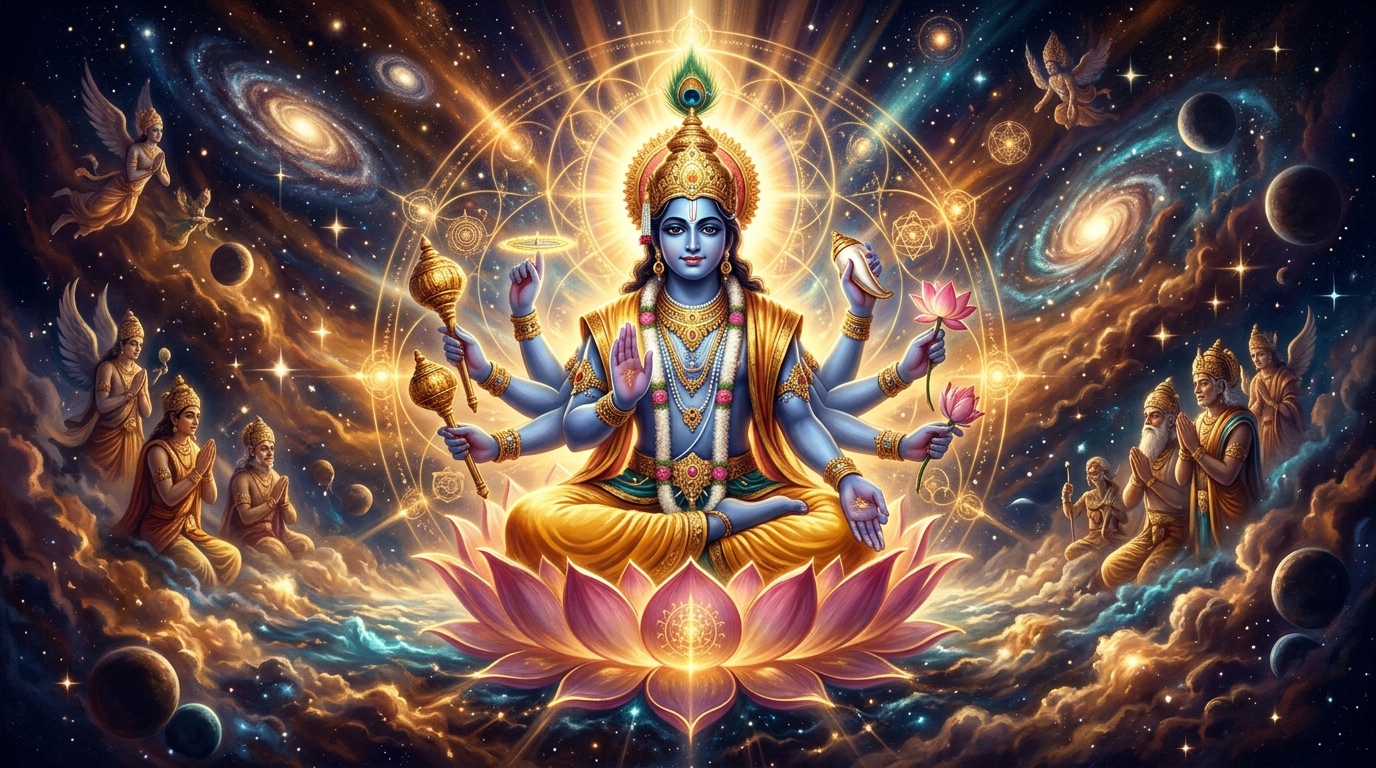

Welcome to Vibes of Divinity. With Chapter 7, the Bhagavad Gita enters its heart—the middle six chapters dedicated directly to knowing and loving the Supreme Reality. In Bhagavad Gita Chapter 7 (Jnana Vijnana Yoga), Lord Krishna explains both theoretical knowledge (Jnana) and direct experiential realization (Vijnana).
- Chapter Name: ज्ञानविज्ञानयोग (Jnana Vijnana Yoga)
- Section: Section 2: Divine Knowledge & Devotion (Chapters 7–12)
- Complete Text Included: All 30 Sanskrit shlokas with IAST transliteration & English translation
- Series Index: Bhagavad Gita Complete Guide (All 18 Chapters & 701 Shlokas)
Chapter 7 Summary & Context on Kurukshetra
Krishna reveals how everything rests upon Him like pearls strung on an invisible thread. His lower material nature consists of eight elements (earth, water, fire, air, ether, mind, intellect, and ego), while His higher spiritual nature sustains all conscious life.
He teaches us to perceive the Divine not only in distant heavens, but right inside ordinary wonders: Krishna is the taste in pure water, the radiance of the sun and moon, the sacred syllable Om in the Vedas, and the strength of the strong free from selfish craving.
Though material illusion (Maya) shaped by the three gunas is extraordinarily difficult to cross, Krishna assures us that those who surrender sincerely to Him cross beyond it with ease. He then describes four kinds of noble seekers who turn toward God: the distressed, the seeker of wealth/security, the curious seeker of truth, and the wise lover of God—declaring the wise devotee dearest of all.
Highlighted Shlokas & Spiritual Reflections (Chapter 7)
Shloka 7.7 — Pearls Strung on a Thread
मत्तः परतरं नान्यत्किञ्चिदस्ति धनञ्जय । मयि सर्वमिदं प्रोतं सूत्रे मणिगणा इव ॥
Mattaḥ parataraṁ nānyat kiñcid asti dhanañjaya | Mayi sarvam idaṁ protaṁ sūtre maṇi-gaṇā iva ||
Meaning: There is nothing higher than Me, O Arjuna. All this universe rests strung upon Me like clusters of pearls on a thread.
Beneath the endless diversity of forms and events lies one unifying Divine presence holding everything in harmony.
Shloka 7.14 — Crossing Beyond Maya
दैवी ह्येषा गुणमयी मम माया दुरत्यया । मामेव ये प्रपद्यन्ते मायामेतां तरन्ति ते ॥
Daivī hy eṣā guṇa-mayī mama māyā duratyayā | Mām eva ye prapadyante māyām etāṁ taranti te ||
Meaning: This divine illusion of Mine, made of the three gunas, is extremely hard to overcome; yet those who surrender unto Me alone easily cross beyond it.
Willpower alone often struggles against ego and conditioning; humble grace and devotion unlock freedom from illusion.
Shloka 7.16 — Four Kinds of Devotees
चतुर्विधा भजन्ते मां जनाः सुकृतिनोऽर्जुन । आर्तो जिज्ञासुरर्थार्थी ज्ञानी च भरतर्षभ ॥
Catur-vidhā bhajante māṁ janāḥ sukṛtino ’rjuna | Ārto jijñāsur arthārthī jñānī ca bharatarṣabha ||
Meaning: Four kinds of virtuous people worship Me, O Arjuna: the distressed, the seeker of knowledge, the seeker of worldly well-being, and the person of wisdom.
No matter what first brings you to prayer—pain, curiosity, or need—God welcomes every sincere step toward truth.
Complete Verse-by-Verse Bhagavad Gita Chapter 7 (All 30 Shlokas)
Read all 30 original Sanskrit verses of Chapter 7 below with Roman IAST transliteration and clear English meaning:
Verse 7.1
श्रीभगवानुवाच |
मय्यासक्तमनाः पार्थ योगं युञ्जन्मदाश्रयः |
असंशयं समग्रं मां यथा ज्ञास्यसि तच्छृणु ||७-१||
śrībhagavānuvāca .
mayyāsaktamanāḥ pārtha yogaṃ yuñjanmadāśrayaḥ .
asaṃśayaṃ samagraṃ māṃ yathā jñāsyasi tacchṛṇu ||7-1||
Meaning: Lord Shri Krishna said: Listen, O Arjuna! And I will tell thee how thou shalt know Me in my Full perfection, practising meditation with thy mind devoted to Me, and having Me for thy refuge.
Verse 7.2
ज्ञानं तेऽहं सविज्ञानमिदं वक्ष्याम्यशेषतः |
यज्ज्ञात्वा नेह भूयोऽन्यज्ज्ञातव्यमवशिष्यते ||७-२||
jñānaṃ te.ahaṃ savijñānamidaṃ vakṣyāmyaśeṣataḥ .
yajjñātvā neha bhūyo.anyajjñātavyamavaśiṣyate ||7-2||
Meaning: I will reveal to this knowledge unto thee, and how it may be realised; which, once accomplished, there remains nothing else worth having in this life.
Verse 7.3
मनुष्याणां सहस्रेषु कश्चिद्यतति सिद्धये |
यततामपि सिद्धानां कश्चिन्मां वेत्ति तत्त्वतः ||७-३||
manuṣyāṇāṃ sahasreṣu kaścidyatati siddhaye .
yatatāmapi siddhānāṃ kaścinmāṃ vetti tattvataḥ ||7-3||
Meaning: Among thousands of men scarcely one strives for perfection, and even amongst those who gain occult powers, perchance but one knows me in truth.
Verse 7.4
भूमिरापोऽनलो वायुः खं मनो बुद्धिरेव च |
अहंकार इतीयं मे भिन्ना प्रकृतिरष्टधा ||७-४||
bhūmirāpo.analo vāyuḥ khaṃ mano buddhireva ca .
ahaṃkāra itīyaṃ me bhinnā prakṛtiraṣṭadhā ||7-4||
Meaning: Earth, water, fire, air, ether, mind, intellect and personality; this is the eightfold division of My Manifested Nature.
Verse 7.5
अपरेयमितस्त्वन्यां प्रकृतिं विद्धि मे पराम् |
जीवभूतां महाबाहो ययेदं धार्यते जगत् ||७-५||
apareyamitastvanyāṃ prakṛtiṃ viddhi me parām .
jīvabhūtāṃ mahābāho yayedaṃ dhāryate jagat ||7-5||
Meaning: This is My inferior Nature; but distinct from this, O Valiant One, know thou that my Superior Nature is the very Life which sustains the universe.
Verse 7.6
एतद्योनीनि भूतानि सर्वाणीत्युपधारय |
अहं कृत्स्नस्य जगतः प्रभवः प्रलयस्तथा ||७-६||
etadyonīni bhūtāni sarvāṇītyupadhāraya .
ahaṃ kṛtsnasya jagataḥ prabhavaḥ pralayastathā ||7-6||
Meaning: It is the womb of all being; for I am He by Whom the worlds were created and shall be dissolved.
Verse 7.7
मत्तः परतरं नान्यत्किञ्चिदस्ति धनञ्जय |
मयि सर्वमिदं प्रोतं सूत्रे मणिगणा इव ||७-७||
mattaḥ parataraṃ nānyatkiñcidasti dhanañjaya .
mayi sarvamidaṃ protaṃ sūtre maṇigaṇā iva ||7-7||
Meaning: O Arjuna! There is nothing higher than Me; all is strung upon Me as rows of pearls upon a thread.
Verse 7.8
रसोऽहमप्सु कौन्तेय प्रभास्मि शशिसूर्ययोः |
प्रणवः सर्ववेदेषु शब्दः खे पौरुषं नृषु ||७-८||
raso.ahamapsu kaunteya prabhāsmi śaśisūryayoḥ .
praṇavaḥ sarvavedeṣu śabdaḥ khe pauruṣaṃ nṛṣu ||7-8||
Meaning: O Arjuna! I am the Fluidity in water, the Light in the sun and in the moon. I am the mystic syllable Om in the Vedic scriptures, the Sound in ether, the Virility in man.
Verse 7.9
पुण्यो गन्धः पृथिव्यां च तेजश्चास्मि विभावसौ |
जीवनं सर्वभूतेषु तपश्चास्मि तपस्विषु ||७-९||
puṇyo gandhaḥ pṛthivyāṃ ca tejaścāsmi vibhāvasau .
jīvanaṃ sarvabhūteṣu tapaścāsmi tapasviṣu ||7-9||
Meaning: I am the Fragrance of earth, the Brilliance of fire. I am the Life Force in all beings, and I am the Austerity of the ascetics.
Verse 7.10
बीजं मां सर्वभूतानां विद्धि पार्थ सनातनम् |
बुद्धिर्बुद्धिमतामस्मि तेजस्तेजस्विनामहम् ||७-१०||
bījaṃ māṃ sarvabhūtānāṃ viddhi pārtha sanātanam .
buddhirbuddhimatāmasmi tejastejasvināmaham ||7-10||
Meaning: Know, O Arjuna, that I am the eternal Seed of being; I am the Intelligence of the intelligent, the Splendour of the resplendent.
Verse 7.11
बलं बलवतां चाहं कामरागविवर्जितम् |
धर्माविरुद्धो भूतेषु कामोऽस्मि भरतर्षभ ||७-११||
balaṃ balavatāṃ cāhaṃ kāmarāgavivarjitam .
dharmāviruddho bhūteṣu kāmo.asmi bharatarṣabha ||7-11||
Meaning: I am the Strength of the strong, of them who are free from attachment and desire; and, O Arjuna, I am the Desire for righteousness.
Verse 7.12
ये चैव सात्त्विका भावा राजसास्तामसाश्च ये |
मत्त एवेति तान्विद्धि न त्वहं तेषु ते मयि ||७-१२||
ye caiva sāttvikā bhāvā rājasāstāmasāśca ye .
matta eveti tānviddhi na tvahaṃ teṣu te mayi ||7-12||
Meaning: Whatever be the nature of their life, whether it be pure or passionate or ignorant, they are all derived from Me. They are in Me, but I am not in them.
Verse 7.13
त्रिभिर्गुणमयैर्भावैरेभिः सर्वमिदं जगत् |
मोहितं नाभिजानाति मामेभ्यः परमव्ययम् ||७-१३||
tribhirguṇamayairbhāvairebhiḥ sarvamidaṃ jagat .
mohitaṃ nābhijānāti māmebhyaḥ paramavyayam ||7-13||
Meaning: The inhabitants of the world, misled by those natures which the Qualities have engendered, know not that I am higher than them all, and that I do not change.
Verse 7.14
दैवी ह्येषा गुणमयी मम माया दुरत्यया |
मामेव ये प्रपद्यन्ते मायामेतां तरन्ति ते ||७-१४||
daivī hyeṣā guṇamayī mama māyā duratyayā .
māmeva ye prapadyante māyāmetāṃ taranti te ||7-14||
Meaning: Verily, this Divine Illusion of Phenomenon manifesting itself in the Qualities is difficult to surmount. Only they who devote themselves to Me and to Me alone can accomplish it.
Verse 7.15
न मां दुष्कृतिनो मूढाः प्रपद्यन्ते नराधमाः |
माययापहृतज्ञाना आसुरं भावमाश्रिताः ||७-१५||
na māṃ duṣkṛtino mūḍhāḥ prapadyante narādhamāḥ .
māyayāpahṛtajñānā āsuraṃ bhāvamāśritāḥ ||7-15||
Meaning: The sinner, the ignorant, the vile, deprived of spiritual perception by the glamour of Illusion, and he who pursues a godless life – none of them shall find Me.
Verse 7.16
चतुर्विधा भजन्ते मां जनाः सुकृतिनोऽर्जुन |
आर्तो जिज्ञासुरर्थार्थी ज्ञानी च भरतर्षभ ||७-१६||
caturvidhā bhajante māṃ janāḥ sukṛtino.arjuna .
ārto jijñāsurarthārthī jñānī ca bharatarṣabha ||7-16||
Meaning: O Arjuna! The righteous who worship Me are grouped by stages: first, they who suffer, next they who desire knowledge, then they who thirst after truth, and lastly they who attain wisdom.
Verse 7.17
तेषां ज्ञानी नित्ययुक्त एकभक्तिर्विशिष्यते |
प्रियो हि ज्ञानिनोऽत्यर्थमहं स च मम प्रियः ||७-१७||
teṣāṃ jñānī nityayukta ekabhaktirviśiṣyate .
priyo hi jñānino.atyarthamahaṃ sa ca mama priyaḥ ||7-17||
Meaning: Of all of these, he who has gained wisdom, who meditates on Me without ceasing, devoting himself only to Me, he is the best; for by the wise man I am exceedingly beloved and the wise man, too, is beloved by Me.
Verse 7.18
उदाराः सर्व एवैते ज्ञानी त्वात्मैव मे मतम् |
आस्थितः स हि युक्तात्मा मामेवानुत्तमां गतिम् ||७-१८||
udārāḥ sarva evaite jñānī tvātmaiva me matam .
āsthitaḥ sa hi yuktātmā māmevānuttamāṃ gatim ||7-18||
Meaning: Noble-minded are they all, but the wise man I hold as my own Self; for he, remaining always at peace with Me, makes me his final goal.
Verse 7.19
बहूनां जन्मनामन्ते ज्ञानवान्मां प्रपद्यते |
वासुदेवः सर्वमिति स महात्मा सुदुर्लभः ||७-१९||
bahūnāṃ janmanāmante jñānavānmāṃ prapadyate .
vāsudevaḥ sarvamiti sa mahātmā sudurlabhaḥ ||7-19||
Meaning: After many lives, at last the wise man realises Me as I am. A man so enlightened that he sees God everywhere is very difficult to find.
Verse 7.20
कामैस्तैस्तैर्हृतज्ञानाः प्रपद्यन्तेऽन्यदेवताः |
तं तं नियममास्थाय प्रकृत्या नियताः स्वया ||७-२०||
kāmaistaistairhṛtajñānāḥ prapadyante.anyadevatāḥ .
taṃ taṃ niyamamāsthāya prakṛtyā niyatāḥ svayā ||7-20||
Meaning: They in whom wisdom is obscured by one desire or the other, worship the lesser Powers, practising many rites which vary according to their temperaments.
Verse 7.21
यो यो यां यां तनुं भक्तः श्रद्धयार्चितुमिच्छति |
तस्य तस्याचलां श्रद्धां तामेव विदधाम्यहम् ||७-२१||
yo yo yāṃ yāṃ tanuṃ bhaktaḥ śraddhayārcitumicchati .
tasya tasyācalāṃ śraddhāṃ tāmeva vidadhāmyaham ||7-21||
Meaning: But whatever the form of worship, if the devotee have faith, then upon his faith in that worship do I set My own seal.
Verse 7.22
स तया श्रद्धया युक्तस्तस्याराधनमीहते |
लभते च ततः कामान्मयैव विहितान्हि तान् ||७-२२||
sa tayā śraddhayā yuktastasyārādhanamīhate .
labhate ca tataḥ kāmānmayaivavihitānhi tān ||7-22||
Meaning: If he worships one form alone with real faith, then shall his desires be fulfilled through that only; for thus have I ordained.
Verse 7.23
अन्तवत्तु फलं तेषां तद्भवत्यल्पमेधसाम् |
देवान्देवयजो यान्ति मद्भक्ता यान्ति मामपि ||७-२३||
antavattu phalaṃ teṣāṃ tadbhavatyalpamedhasām .
devāndevayajo yānti madbhaktā yānti māmapi ||7-23||
Meaning: The fruit that comes to men of limited insight is, after all, finite. They who worship the Lower Powers attain them; but those who worship Me come unto Me alone.
Verse 7.24
अव्यक्तं व्यक्तिमापन्नं मन्यन्ते मामबुद्धयः |
परं भावमजानन्तो ममाव्ययमनुत्तमम् ||७-२४||
avyaktaṃ vyaktimāpannaṃ manyante māmabuddhayaḥ .
paraṃ bhāvamajānanto mamāvyayamanuttamam ||7-24||
Meaning: The ignorant think of Me, who am the Unmanifested Spirit, as if I were really in human form. They do not understand that My Superior Nature is changeless and most excellent.
Verse 7.25
नाहं प्रकाशः सर्वस्य योगमायासमावृतः |
मूढोऽयं नाभिजानाति लोको मामजमव्ययम् ||७-२५||
nāhaṃ prakāśaḥ sarvasya yogamāyāsamāvṛtaḥ .
mūḍho.ayaṃ nābhijānāti loko māmajamavyayam ||7-25||
Meaning: I am not visible to all, for I am enveloped by the illusion of Phenomenon. This deluded world does not know Me as the Unborn and the Imperishable.
Verse 7.26
वेदाहं समतीतानि वर्तमानानि चार्जुन |
भविष्याणि च भूतानि मां तु वेद न कश्चन ||७-२६||
vedāhaṃ samatītāni vartamānāni cārjuna .
bhaviṣyāṇi ca bhūtāni māṃ tu veda na kaścana ||7-26||
Meaning: I know, O Arjuna, all beings in the past, the present and the future; but they do not know Me.
Verse 7.27
इच्छाद्वेषसमुत्थेन द्वन्द्वमोहेन भारत |
सर्वभूतानि सम्मोहं सर्गे यान्ति परन्तप ||७-२७||
icchādveṣasamutthena dvandvamohena bhārata .
sarvabhūtāni sammohaṃ sarge yānti parantapa ||7-27||
Meaning: O brave Arjuna! Man lives in a fairy world, deceived by the glamour of opposite sensations, infatuated by desire and aversion.
Verse 7.28
येषां त्वन्तगतं पापं जनानां पुण्यकर्मणाम् |
ते द्वन्द्वमोहनिर्मुक्ता भजन्ते मां दृढव्रताः ||७-२८||
yeṣāṃ tvantagataṃ pāpaṃ janānāṃ puṇyakarmaṇām .
te dvandvamohanirmuktā bhajante māṃ dṛḍhavratāḥ ||7-28||
Meaning: But those who act righteously, in whom sin has been destroyed, who are free from the infatuation of the conflicting emotions, they worship Me with firm resolution.
Verse 7.29
जरामरणमोक्षाय मामाश्रित्य यतन्ति ये |
ते ब्रह्म तद्विदुः कृत्स्नमध्यात्मं कर्म चाखिलम् ||७-२९||
jarāmaraṇamokṣāya māmāśritya yatanti ye .
te brahma tadviduḥ kṛtsnamadhyātmaṃ karma cākhilam ||7-29||
Meaning: Those who make Me their refuge, who strive for liberation from decay and Death, they realise the Supreme Spirit, which is their own real Self, and in which all action finds its consummation.
Verse 7.30
साधिभूताधिदैवं मां साधियज्ञं च ये विदुः |
प्रयाणकालेऽपि च मां ते विदुर्युक्तचेतसः ||७-३०||
sādhibhūtādhidaivaṃ māṃ sādhiyajñaṃ ca ye viduḥ .
prayāṇakāle.api ca māṃ te viduryuktacetasaḥ ||7-30||
Meaning: Those who see Me in the life of the world, in the universal sacrifice, and as pure Divinity, keeping their minds steady, they live in Me, even in the crucial hour of death.
Timeless Life Lessons for Modern Seekers
- See the Sacred in Daily Life: Taste water with gratitude, greet the morning sun with reverence—divine beauty hides in plain sight.
- Move from Information to Experience: Reading scriptures (Jnana) comes alive only when practiced in daily compassion and remembrance (Vijnana).
- Honor Where You Start: Even if you first turn to prayer during hardship, let that spark mature into steady, grateful wisdom.
- Rely on Grace Over Ego: Surrendering stubborn pride helps you step clear of mental confusion.
Frequently Asked Questions — Bhagavad Gita Chapter 7
What is the difference between Jnana and Vijnana in Chapter 7?
Jnana is conceptual knowledge learned from scriptures and teachers, while Vijnana is direct inner realization of the Divine in everyday life.
Who are the four types of devotees mentioned in Gita 7.16?
They are the Arta (one in distress), Artharthi (one seeking prosperity/help), Jijnasu (the inquisitive truth-seeker), and Jnani (the wise devotee who loves God selflessly).
How many verses are in Gita Chapter 7?
Bhagavad Gita Chapter 7 has 30 verses.
Continue Your Bhagavad Gita Journey
← Previous: Chapter 6 | All 18 Gita Chapters | Next: Chapter 8 →
To explore more Bhagavad Gita teachings, Puranic stories, and sacred chants and timeless wisdom from Hindu scriptures, visit and subscribe to our official Vibes of Divinity YouTube channel.
Which shloka from this chapter touches your heart most today? Share your reflection in the comments below.