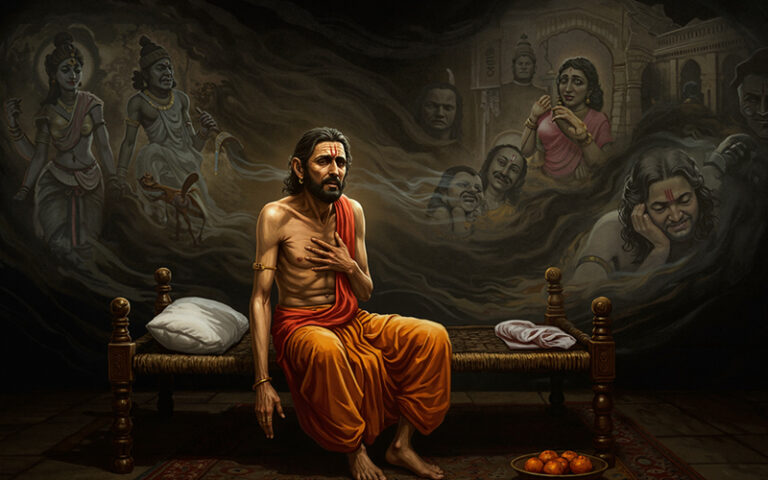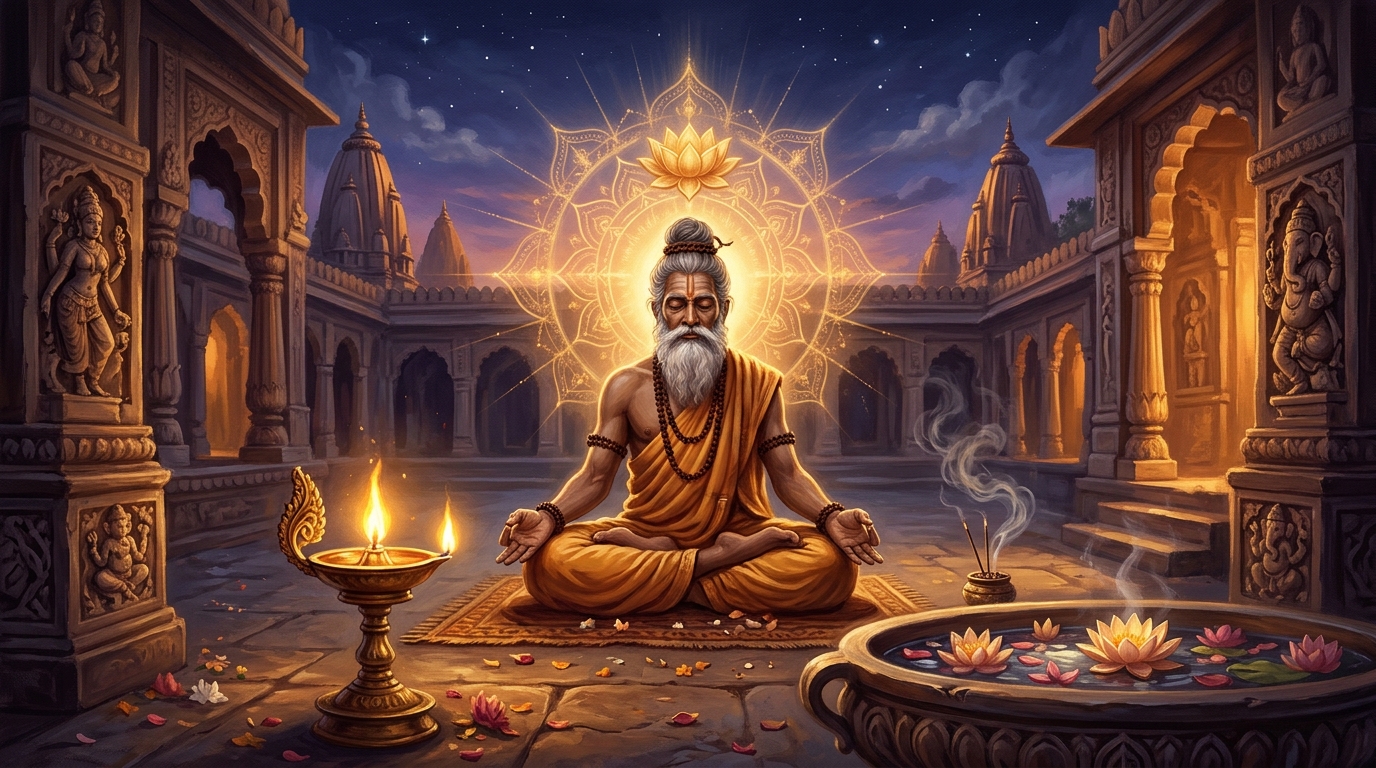

Welcome to Vibes of Divinity. Still wondering whether it is better to renounce worldly life or stay actively engaged in duty, Arjuna opens Bhagavad Gita Chapter 5 (Karma Sanyasa Yoga) asking Krishna for a clear answer. Krishna’s response is deeply empowering for householders and modern seekers alike: true renunciation is an inner attitude, not running away to a forest.
- Chapter Name: कर्मसंन्यासयोग (Karma Sanyasa Yoga)
- Section: Section 1: The Path of Selfless Action & Discipline (Chapters 1–6)
- Complete Text Included: All 29 Sanskrit shlokas with IAST transliteration & English translation
- Series Index: Bhagavad Gita Complete Guide (All 18 Chapters & 701 Shlokas)
Chapter 5 Summary & Context on Kurukshetra
Krishna declares that both Sanyasa (renunciation) and Karma Yoga (selfless action) lead to liberation—yet of the two, Karma Yoga is more practical and steady because renouncing action without inner purity only leads to frustration.
A true renunciant neither hates unpleasant tasks nor craves pleasant ones. Offering every action to Brahman, such a seeker remains untouched by sin just as a lotus leaf floats on water without ever getting wet.
Seeing the same Divine presence equally in a learned sage, a cow, an elephant, or an outcaste, the wise person attains unshakable peace by recognizing Krishna as the supreme friend of all living beings (Suhridam Sarva-Bhutanam).
Highlighted Shlokas & Spiritual Reflections (Chapter 5)
Shloka 5.10 — Untouched Like the Lotus Leaf
ब्रह्मण्याधाय कर्माणि सङ्गं त्यक्त्वा करोति यः । लिप्यते न स पापेन पद्मपत्रमिवाम्भसा ॥
Brahmaṇy ādhāya karmāṇi saṅgaṁ tyaktvā karoti yaḥ | Lipyate na sa pāpena padma-patram ivāmbhasā ||
Meaning: One who performs actions dedicating them to the Supreme, abandoning selfish attachment, is untouched by sin—just as a lotus leaf remains untouched by water.
Live fully in the world without letting stress, greed, or negativity soak into your heart.
Shloka 5.18 — Equal Vision (Samadarshana)
विद्याविनयसम्पन्ने ब्राह्मणे गवि हस्तिनि । शुनि चैव श्वपाके च पण्डिताः समदर्शिनः ॥
Vidyā-vinaya-sampanne brāhmaṇe gavi hastini | Śuni caiva śvapāke ca paṇḍitāḥ sama-darśinaḥ ||
Meaning: The truly wise see with equal vision a learned and humble sage, a cow, an elephant, a dog, and an outcaste.
True spiritual maturity erases prejudice and reveals the same sacred spark residing within every creature.
Shloka 5.29 — The Supreme Friend of All Beings
भोक्तारं यज्ञतपसां सर्वलोकमहेश्वरम् । सुहृदं सर्वभूतानां ज्ञात्वा मां शान्तिमृच्छति ॥
Bhoktāraṁ yajña-tapasāṁ sarva-loka-maheśvaram | Suhṛdaṁ sarva-bhūtānāṁ jñātvā māṁ śāntim ṛcchati ||
Meaning: Knowing Me as the enjoyer of all sacrifices and austerities, the Supreme Lord of all worlds, and the selfless friend of all beings, one attains lasting peace.
Peace blossoms the moment we realize we are never alone—the Divine walks beside every soul as a true friend.
Complete Verse-by-Verse Bhagavad Gita Chapter 5 (All 29 Shlokas)
Read all 29 original Sanskrit verses of Chapter 5 below with Roman IAST transliteration and clear English meaning:
Verse 5.1
अर्जुन उवाच |
संन्यासं कर्मणां कृष्ण पुनर्योगं च शंससि |
यच्छ्रेय एतयोरेकं तन्मे ब्रूहि सुनिश्चितम् ||५-१||
arjuna uvāca .
saṃnyāsaṃ karmaṇāṃ kṛṣṇa punaryogaṃ ca śaṃsasi .
yacchreya etayorekaṃ tanme brūhi suniścitam ||5-1||
Meaning: Arjuna said: My Lord! At one moment Thou praisest renunciation of action; at another, right action. Tell me truly, I pray, which of these is the more conducive to my highest welfare?
Verse 5.2
श्रीभगवानुवाच |
संन्यासः कर्मयोगश्च निःश्रेयसकरावुभौ |
तयोस्तु कर्मसंन्यासात्कर्मयोगो विशिष्यते ||५-२||
śrībhagavānuvāca .
saṃnyāsaḥ karmayogaśca niḥśreyasakarāvubhau .
tayostu karmasaṃnyāsātkarmayogo viśiṣyate ||5-2||
Meaning: Lord Shri Krishna replied: Renunciation of action and the path of right action both lead to the highest; of the two, right action is the better.
Verse 5.3
ज्ञेयः स नित्यसंन्यासी यो न द्वेष्टि न काङ्क्षति |
निर्द्वन्द्वो हि महाबाहो सुखं बन्धात्प्रमुच्यते ||५-३||
jñeyaḥ sa nityasaṃnyāsī yo na dveṣṭi na kāṅkṣati .
nirdvandvo hi mahābāho sukhaṃ bandhātpramucyate ||5-3||
Meaning: He is a true ascetic who never desires or dislikes, who is uninfluenced by the opposites and is easily freed from bondage.
Verse 5.4
साङ्ख्ययोगौ पृथग्बालाः प्रवदन्ति न पण्डिताः |
एकमप्यास्थितः सम्यगुभयोर्विन्दते फलम् ||५-४||
sāṅkhyayogau pṛthagbālāḥ pravadanti na paṇḍitāḥ .
ekamapyāsthitaḥ samyagubhayorvindate phalam ||5-4||
Meaning: Only the unenlightened speak of wisdom and right action as separate, not the wise. If any man knows one, he enjoys the fruit of both.
Verse 5.5
यत्साङ्ख्यैः प्राप्यते स्थानं तद्योगैरपि गम्यते |
एकं साङ्ख्यं च योगं च यः पश्यति स पश्यति ||५-५||
yatsāṅkhyaiḥ prāpyate sthānaṃ tadyogairapi gamyate .
ekaṃ sāṅkhyaṃ ca yogaṃ ca yaḥ paśyati sa paśyati ||5-5||
Meaning: The level which is reached by wisdom is attained through right action as well. He who perceives that the two are one, knows the truth.
Verse 5.6
संन्यासस्तु महाबाहो दुःखमाप्तुमयोगतः |
योगयुक्तो मुनिर्ब्रह्म नचिरेणाधिगच्छति ||५-६||
saṃnyāsastu mahābāho duḥkhamāptumayogataḥ .
yogayukto munirbrahma nacireṇādhigacchati ||5-6||
Meaning: Without concentration, O Mighty Man, renunciation is difficult. But the sage who is always meditating on the Divine, before long shall attain the Absolute.
Verse 5.7
योगयुक्तो विशुद्धात्मा विजितात्मा जितेन्द्रियः |
सर्वभूतात्मभूतात्मा कुर्वन्नपि न लिप्यते ||५-७||
yogayukto viśuddhātmā vijitātmā jitendriyaḥ .
sarvabhūtātmabhūtātmā kurvannapi na lipyate ||5-7||
Meaning: He who is spiritual, who is pure, who has overcome his senses and his personal self, who has realised his highest Self as the Self of all, such a one, even though he acts, is not bound by his acts.
Verse 5.8
नैव किञ्चित्करोमीति युक्तो मन्येत तत्त्ववित् |
पश्यञ्शृण्वन्स्पृशञ्जिघ्रन्नश्नन्गच्छन्स्वपञ्श्वसन् ||५-८||
naiva kiñcitkaromīti yukto manyeta tattvavit .
paśyañśruṇvanspṛśañjighrannaśnangacchansvapañśvasan ||5-8||
Meaning: Though the saint sees, hears, touches, smells, eats, moves, sleeps and breathes, yet he knows the Truth, and he knows that it is not he who acts.
Verse 5.9
प्रलपन्विसृजन्गृह्णन्नुन्मिषन्निमिषन्नपि |
इन्द्रियाणीन्द्रियार्थेषु वर्तन्त इति धारयन् ||५-९||
pralapanvisṛjangṛhṇannunmiṣannimiṣannapi .
indriyāṇīndriyārtheṣu vartanta iti dhārayan ||5-9||
Meaning: Though he talks, though he gives and receives, though he opens his eyes and shuts them, he still knows that his senses are merely disporting themselves among the objects of perception.
Verse 5.10
ब्रह्मण्याधाय कर्माणि सङ्गं त्यक्त्वा करोति यः |
लिप्यते न स पापेन पद्मपत्रमिवाम्भसा ||५-१०||
brahmaṇyādhāya karmāṇi saṅgaṃ tyaktvā karoti yaḥ .
lipyate na sa pāpena padmapatramivāmbhasā ||5-10||
Meaning: He who dedicates his actions to the Spirit, without any personal attachment to them, he is no more tainted by sin than the water lily is wetted by water.
Verse 5.11
कायेन मनसा बुद्ध्या केवलैरिन्द्रियैरपि |
योगिनः कर्म कुर्वन्ति सङ्गं त्यक्त्वात्मशुद्धये ||५-११||
kāyena manasā buddhyā kevalairindriyairapi .
yoginaḥ karma kurvanti saṅgaṃ tyaktvātmaśuddhaye ||5-11||
Meaning: The sage performs his action dispassionately, using his body, mind and intellect, and even his senses, always as a means of purification.
Verse 5.12
युक्तः कर्मफलं त्यक्त्वा शान्तिमाप्नोति नैष्ठिकीम् |
अयुक्तः कामकारेण फले सक्तो निबध्यते ||५-१२||
yuktaḥ karmaphalaṃ tyaktvā śāntimāpnoti naiṣṭhikīm .
ayuktaḥ kāmakāreṇa phale sakto nibadhyate ||5-12||
Meaning: Having abandoned the fruit of action, he wins eternal peace. Others unacquainted with spirituality, led by desire and clinging to the benefit which they think will follow their actions, become entangled in them.
Verse 5.13
सर्वकर्माणि मनसा संन्यस्यास्ते सुखं वशी |
नवद्वारे पुरे देही नैव कुर्वन्न कारयन् ||५-१३||
sarvakarmāṇi manasā saṃnyasyāste sukhaṃ vaśī .
navadvāre pure dehī naiva kurvanna kārayan ||5-13||
Meaning: Mentally renouncing all actions, the self-controlled soul enjoys bliss in this body, the city of the nine gates, neither doing anything himself nor causing anything to be done.
Verse 5.14
न कर्तृत्वं न कर्माणि लोकस्य सृजति प्रभुः |
न कर्मफलसंयोगं स्वभावस्तु प्रवर्तते ||५-१४||
na kartṛtvaṃ na karmāṇi lokasya sṛjati prabhuḥ .
na karmaphalasaṃyogaṃ svabhāvastu pravartate ||5-14||
Meaning: The Lord of this universe has not ordained activity, or any incentive thereto, or any relation between an act and its consequences. All this is the work of Nature.
Verse 5.15
नादत्ते कस्यचित्पापं न चैव सुकृतं विभुः |
अज्ञानेनावृतं ज्ञानं तेन मुह्यन्ति जन्तवः ||५-१५||
nādatte kasyacitpāpaṃ na caiva sukṛtaṃ vibhuḥ .
ajñānenāvṛtaṃ jñānaṃ tena muhyanti jantavaḥ ||5-15||
Meaning: The Lord does not accept responsibility for any man's sin or merit. Men are deluded because in them wisdom is submerged in ignorance.
Verse 5.16
ज्ञानेन तु तदज्ञानं येषां नाशितमात्मनः |
तेषामादित्यवज्ज्ञानं प्रकाशयति तत्परम् ||५-१६||
jñānena tu tadajñānaṃ yeṣāṃ nāśitamātmanaḥ .
teṣāmādityavajjñānaṃ prakāśayati tatparam ||5-16||
Meaning: Surely wisdom is like the sun, revealing the supreme truth to those whose ignorance is dispelled by the wisdom of the Self.
Verse 5.17
तद्बुद्धयस्तदात्मानस्तन्निष्ठास्तत्परायणाः |
गच्छन्त्यपुनरावृत्तिं ज्ञाननिर्धूतकल्मषाः ||५-१७||
tadbuddhayastadātmānastanniṣṭhāstatparāyaṇāḥ .
gacchantyapunarāvṛttiṃ jñānanirdhūtakalmaṣāḥ ||5-17||
Meaning: Meditating on the Divine, having faith in the Divine, concentrating on the Divine and losing themselves in the Divine, their sins dissolved in wisdom, they go whence there is no return.
Verse 5.18
विद्याविनयसम्पन्ने ब्राह्मणे गवि हस्तिनि |
शुनि चैव श्वपाके च पण्डिताः समदर्शिनः ||५-१८||
vidyāvinayasampanne brāhmaṇe gavi hastini .
śuni caiva śvapāke ca paṇḍitāḥ samadarśinaḥ ||5-18||
Meaning: Sages look equally upon all, whether he be a minister of learning and humility, or an infidel, or whether it be a cow, an elephant or a dog.
Verse 5.19
इहैव तैर्जितः सर्गो येषां साम्ये स्थितं मनः |
निर्दोषं हि समं ब्रह्म तस्माद् ब्रह्मणि ते स्थिताः ||५-१९||
ihaiva tairjitaḥ sargo yeṣāṃ sāmye sthitaṃ manaḥ .
nirdoṣaṃ hi samaṃ brahma tasmād brahmaṇi te sthitāḥ ||5-19||
Meaning: Even in this world they conquer their earth-life whose minds, fixed on the Supreme, remain always balanced; for the Supreme has neither blemish nor bias.
Verse 5.20
न प्रहृष्येत्प्रियं प्राप्य नोद्विजेत्प्राप्य चाप्रियम् |
स्थिरबुद्धिरसम्मूढो ब्रह्मविद् ब्रह्मणि स्थितः ||५-२०||
na prahṛṣyetpriyaṃ prāpya nodvijetprāpya cāpriyam .
sthirabuddhirasammūḍho brahmavid brahmaṇi sthitaḥ ||5-20||
Meaning: He who knows and lives in the Absolute remains unmoved and unperturbed; he is not elated by pleasure or depressed by pain.
Verse 5.21
बाह्यस्पर्शेष्वसक्तात्मा विन्दत्यात्मनि यत्सुखम् |
स ब्रह्मयोगयुक्तात्मा सुखमक्षयमश्नुते ||५-२१||
bāhyasparśeṣvasaktātmā vindatyātmani yatsukham .
sa brahmayogayuktātmā sukhamakṣayamaśnute ||5-21||
Meaning: He finds happiness in his own Self, and enjoys eternal bliss, whose heart does not yearn for the contacts of earth and whose Self is one with the Everlasting.
Verse 5.22
ये हि संस्पर्शजा भोगा दुःखयोनय एव ते |
आद्यन्तवन्तः कौन्तेय न तेषु रमते बुधः ||५-२२||
ye hi saṃsparśajā bhogā duḥkhayonaya eva te .
ādyantavantaḥ kaunteya na teṣu ramate budhaḥ ||5-22||
Meaning: The joys that spring from external associations bring pain; they have their beginning and their endings. The wise man does not rejoice in them.
Verse 5.23
शक्नोतीहैव यः सोढुं प्राक्शरीरविमोक्षणात् |
कामक्रोधोद्भवं वेगं स युक्तः स सुखी नरः ||५-२३||
śaknotīhaiva yaḥ soḍhuṃ prākśarīravimokṣaṇāt .
kāmakrodhodbhavaṃ vegaṃ sa yuktaḥ sa sukhī naraḥ ||5-23||
Meaning: He who, before he leaves his body, learns to surmount the promptings of desire and anger is a saint and is happy.
Verse 5.24
योऽन्तःसुखोऽन्तरारामस्तथान्तर्ज्योतिरेव यः |
स योगी ब्रह्मनिर्वाणं ब्रह्मभूतोऽधिगच्छति ||५-२४||
yo.antaḥsukho.antarārāmastathāntarjyotireva yaḥ .
sa yogī brahmanirvāṇaṃ brahmabhūto.adhigacchati ||5-24||
Meaning: He who is happy within his Self and has found Its peace, and in whom the inner light shines, that sage attains Eternal Bliss and becomes the Spirit Itself.
Verse 5.25
लभन्ते ब्रह्मनिर्वाणमृषयः क्षीणकल्मषाः |
छिन्नद्वैधा यतात्मानः सर्वभूतहिते रताः ||५-२५||
labhante brahmanirvāṇamṛṣayaḥ kṣīṇakalmaṣāḥ .
chinnadvaidhā yatātmānaḥ sarvabhūtahite ratāḥ ||5-25||
Meaning: Sages whose sins have been washed away, whose sense of separateness has vanished, who have subdued themselves, and seek only the welfare of all, come to the Eternal Spirit.
Verse 5.26
कामक्रोधवियुक्तानां यतीनां यतचेतसाम् |
अभितो ब्रह्मनिर्वाणं वर्तते विदितात्मनाम् ||५-२६||
kāmakrodhaviyuktānāṃ yatīnāṃ yatacetasām .
abhito brahmanirvāṇaṃ vartate viditātmanām ||5-26||
Meaning: Saints who know their Selves, who control their minds, and feel neither desire nor anger, find Eternal Bliss everywhere.
Verse 5.27
स्पर्शान्कृत्वा बहिर्बाह्यांश्चक्षुश्चैवान्तरे भ्रुवोः |
प्राणापानौ समौ कृत्वा नासाभ्यन्तरचारिणौ ||५-२७||
sparśānkṛtvā bahirbāhyāṃścakṣuścaivāntare bhruvoḥ .
prāṇāpānau samau kṛtvā nāsābhyantaracāriṇau ||5-27||
Meaning: Excluding external objects, his gaze fixed between the eyebrows, the inward and outward breathings passing equally through his nostrils;
Verse 5.28
यतेन्द्रियमनोबुद्धिर्मुनिर्मोक्षपरायणः |
विगतेच्छाभयक्रोधो यः सदा मुक्त एव सः ||५-२८||
yatendriyamanobuddhirmunirmokṣaparāyaṇaḥ .
vigatecchābhayakrodho yaḥ sadā mukta eva saḥ ||5-28||
Meaning: Governing sense, mind and intellect, intent on liberation, free from desire, fear and anger, the sage is forever free.
Verse 5.29
भोक्तारं यज्ञतपसां सर्वलोकमहेश्वरम् |
सुहृदं सर्वभूतानां ज्ञात्वा मां शान्तिमृच्छति ||५-२९||
bhoktāraṃ yajñatapasāṃ sarvalokamaheśvaram .
suhṛdaṃ sarvabhūtānāṃ jñātvā māṃ śāntimṛcchati ||5-29||
Meaning: Knowing me as Him who gladly receives all offerings of austerity and sacrifice, as the Might Ruler of all the Worlds and the Friend of all beings, he passes to Eternal Peace.
Timeless Life Lessons for Modern Seekers
- Practice the Lotus-Leaf Mindset: Engage wholeheartedly with work and family, without letting ego or drama stick to your spirit.
- Renounce Ego, Not Responsibility: True renunciation means dropping selfishness and possessiveness rather than abandoning people who depend on you.
- See Dignity in All Life: Practice equal respect and kindness toward every living being.
- Remember Krishna as Your Well-Wisher: Knowing the Divine is Suhridam—a loving friend—calms chronic anxiety.
Frequently Asked Questions — Bhagavad Gita Chapter 5
Is Sanyasa or Karma Yoga better according to Gita Chapter 5?
Krishna affirms both lead to liberation, but recommends Karma Yoga because performing duties without selfish attachment is safer and steadier than premature outer renunciation.
What does the lotus leaf metaphor in 5.10 mean?
Though a lotus grows in muddy water, its leaves stay spotless. Similarly, a spiritually centered person works in the material world without becoming corrupted by greed or ego.
How many verses are in Bhagavad Gita Chapter 5?
Chapter 5 contains 29 verses.
Continue Your Bhagavad Gita Journey
← Previous: Chapter 4 | All 18 Gita Chapters | Next: Chapter 6 →
To explore more Bhagavad Gita teachings, Puranic stories, and sacred chants and timeless wisdom from Hindu scriptures, visit and subscribe to our official Vibes of Divinity YouTube channel.
Which shloka from this chapter touches your heart most today? Share your reflection in the comments below.